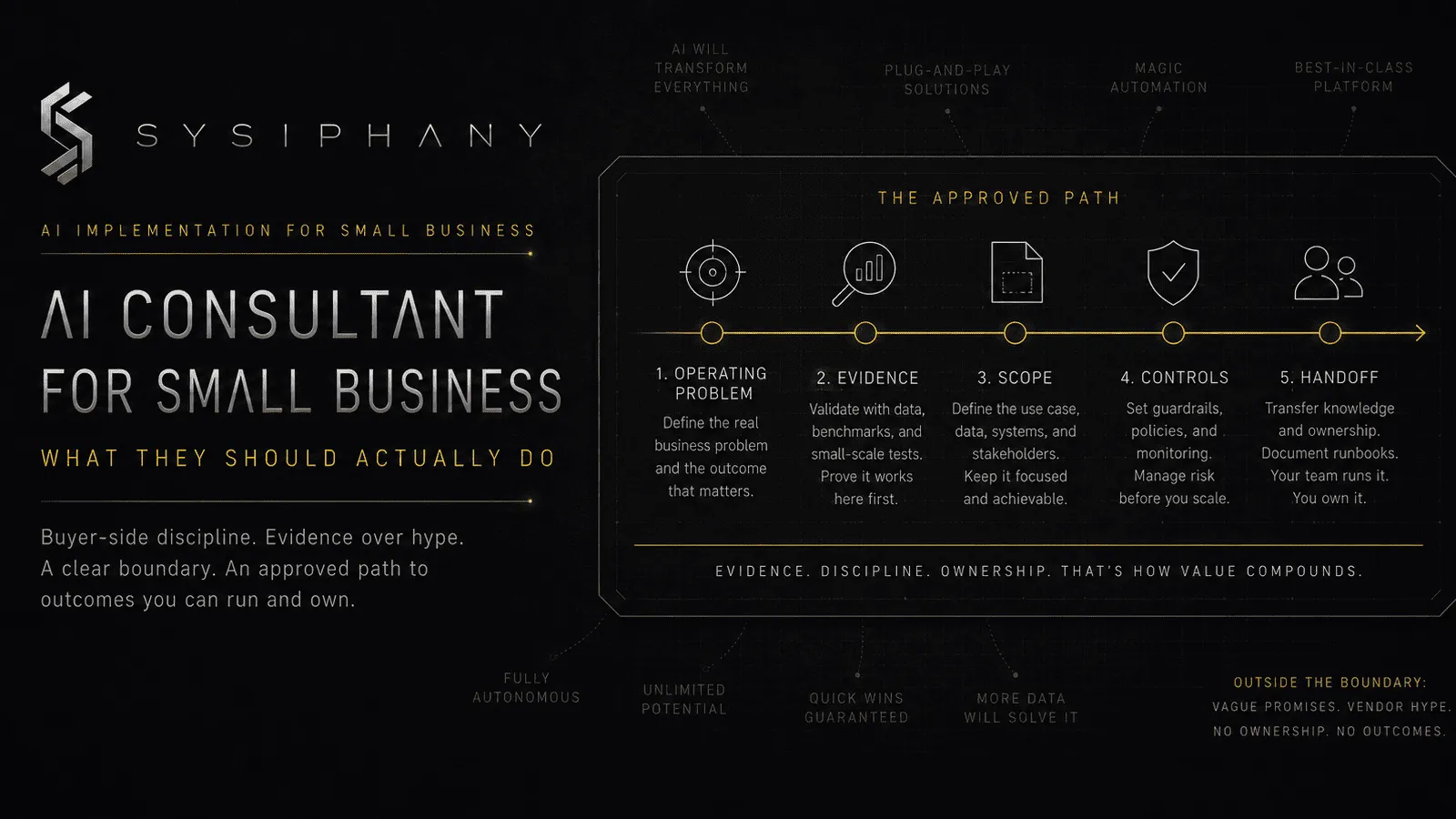
An AI consultant for a small business should leave you with a clearer decision, a bounded plan, and a system your team can own. Not a vague AI strategy. Not a stack of tool recommendations. Not a demo that only works while the consultant is in the room.
Before you hire one, require the engagement to name the operating problem, the expected result, the evidence behind the recommendation, the responsibilities on both sides, the controls around consequential work, and the conditions for acceptance. If those details are missing, the scope is not ready to sign.
This is a buyer’s guide. It does not run an operational audit, score AI readiness, choose the workflow, compare tools, or design an agent or chatbot. Those jobs belong to other articles in this cluster. AI Implementation for Small Business owns the implementation sequence. Here, the job is narrower: what to demand from a consulting engagement before money, access, and operating responsibility start moving.
Quick answer: What should an AI consultant actually do for a small business?
A useful AI consultant should help a small business define the right problem, inspect the relevant workflow, test whether AI is appropriate, recommend a bounded course of action, set measurable acceptance criteria, identify risks and human-review points, and transfer the resulting system to a named internal owner.
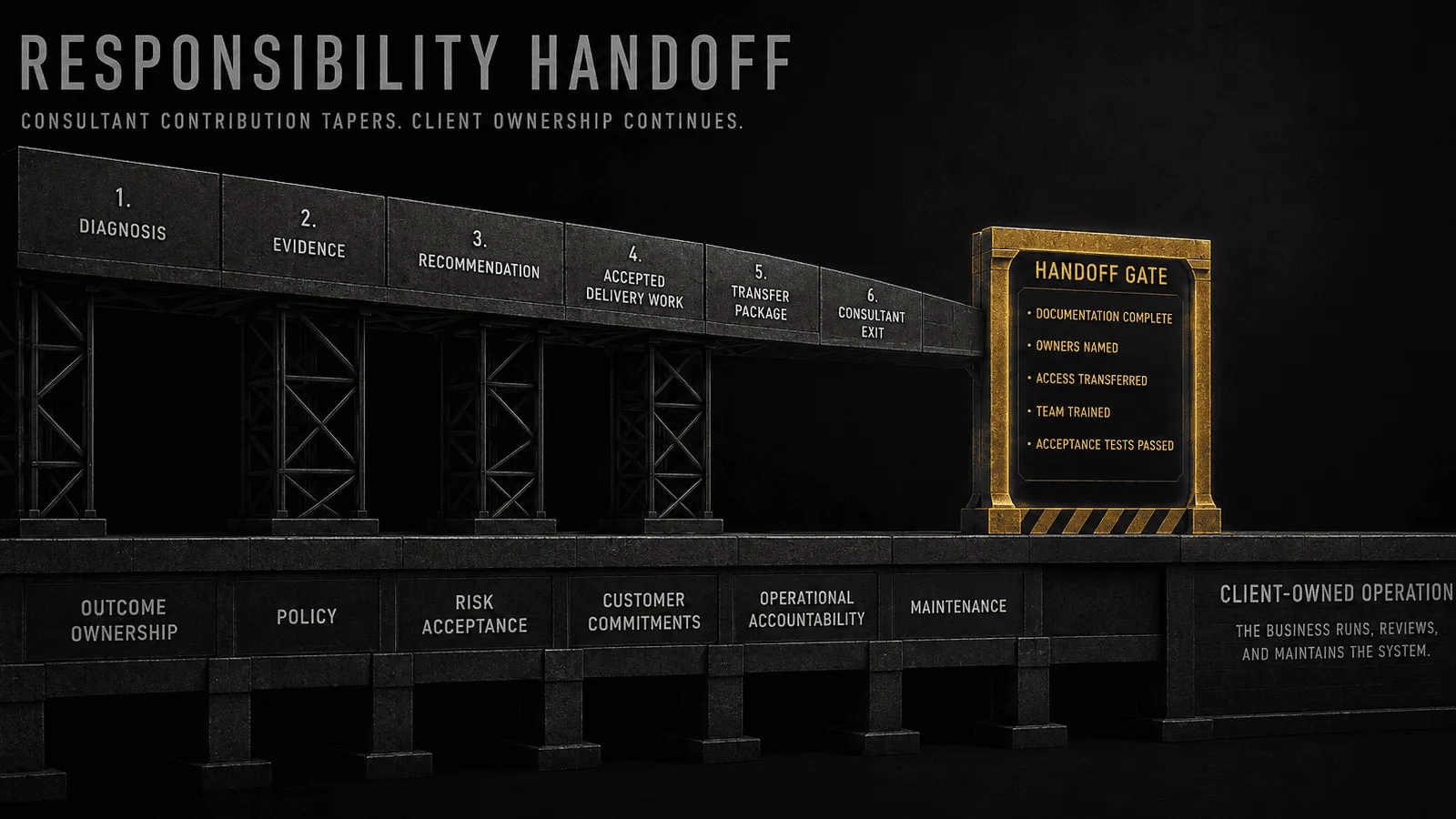
The consultant may diagnose, design, facilitate, and implement. Your business still owns the outcome, policy decisions, risk acceptance, customer commitments, and day-to-day workflow after handoff.
At minimum, expect five things:
- A problem statement tied to an operating result.
- Evidence from the work as it happens now.
- A scope with deliverables, exclusions, roles, and dependencies.
- A pilot or implementation plan with controls and acceptance measures.
- Documentation, training, ownership, and an exit condition.
If the proposal cannot state those plainly, do not approve a broader engagement. Narrow it until it can.
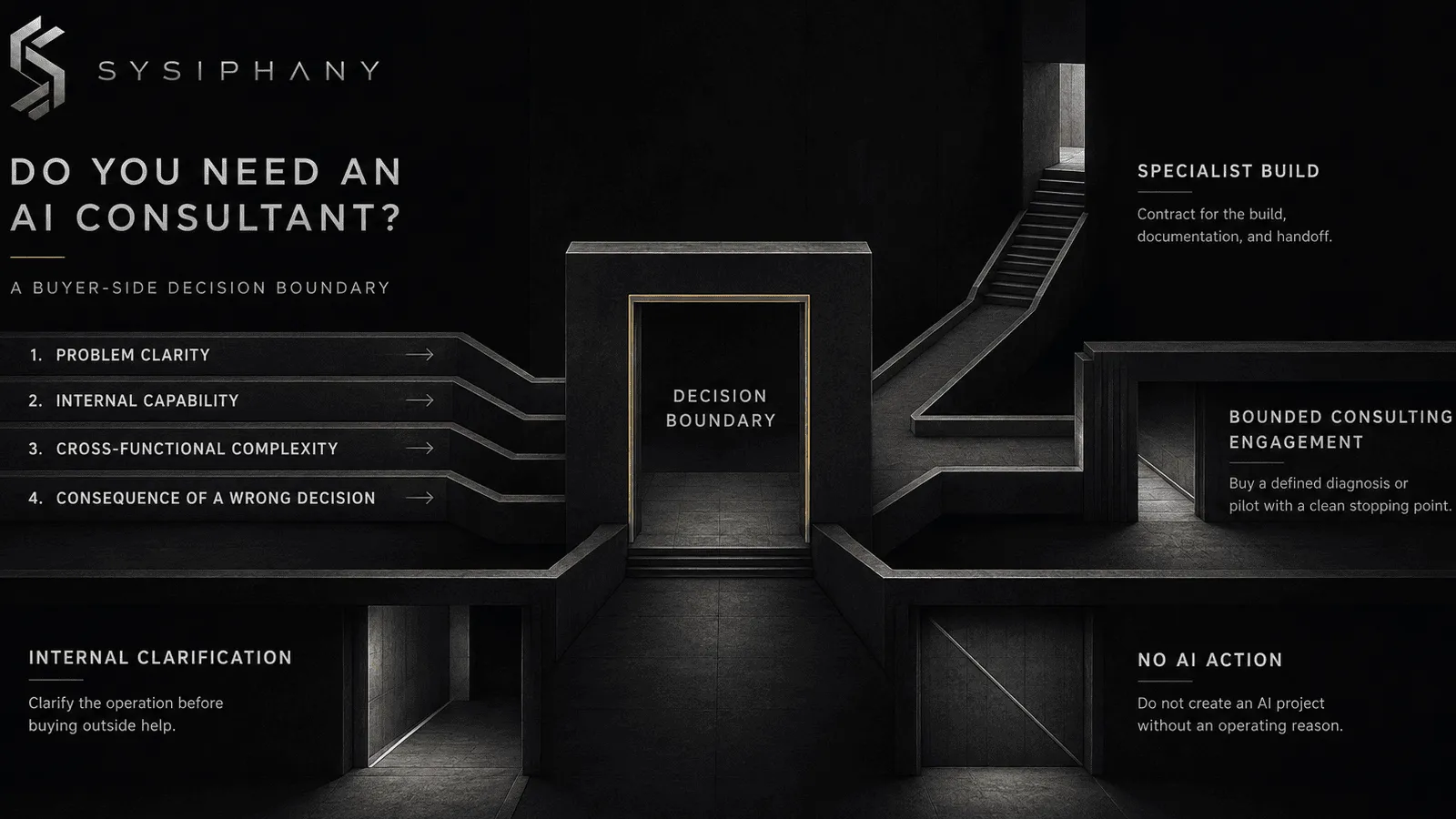
Do you need an AI consultant or a clearer internal decision?
You need an AI consultant when the business has a consequential operating question that it cannot resolve well with its current time, expertise, or cross-functional perspective. You do not need one merely because AI seems important.
Outside help is useful when several conditions are present at once: the workflow crosses teams or systems, internal accounts conflict, the cost of a wrong decision is material, earlier tool experiments failed, or nobody inside the company can turn the problem into a testable scope without protecting a favored solution.
You may need a specialist builder instead when the requirement is already precise. If the team can describe the job, the systems it touches, the limits on access, who reviews the result, and how the build will be accepted, more diagnosis may add little. You may need someone to build exactly that.
You may need no outside help yet when the team cannot agree on the problem. Start by choosing one workflow and writing down where it begins, what result it produces, and why the current path is costly or unreliable. AI Automation for Small Business covers that starting decision. An AI readiness assessment helps when the uncertainty is whether the operating conditions can support AI at all.
A consultant should reduce uncertainty you cannot economically resolve alone. Hiring one to manufacture urgency is a poor trade.
What should the consultant be accountable for?
The consultant should be accountable for the quality of the diagnosis, recommendation, scope, implementation work they accept, and transfer plan. They should not quietly become the permanent owner of your workflow.
That distinction matters because consulting work can look busy without making the buyer’s decision any better. Workshops happen. Interviews happen. Tools get compared. A polished strategy appears. Yet the business still cannot say which workflow should change, why that change is worth making, or who will own it.
A competent engagement produces decision-grade evidence:
- Observations tied to real workflows, records, handoffs, and exceptions
- A stated baseline, even if the first measurement is simple
- Options considered, with tradeoffs and rejected alternatives
- A recommendation that explains why AI, conventional automation, process redesign, or no technology is the right response
- Assumptions that can be tested rather than buried
- Risks assigned to owners, not parked in a slide
- A clear line between consultant responsibility and client responsibility
The consultant owns the integrity of the work they deliver. The client owns the business decision. Neither side should pretend otherwise.
What should appear in an AI consulting proposal before you sign?
An AI consulting proposal should define the problem, intended operating result, scope, exclusions, deliverables, responsibilities, evidence requirements, acceptance criteria, commercial terms, and handoff. “AI strategy and implementation support” is not a scope.
Use the proposal to settle ambiguity before it becomes a change order or a failed expectation.
| Proposal element | What adequate looks like | What should concern you |
|---|---|---|
| Operating problem | One workflow, decision, or measurable constraint is named | “Find AI opportunities across the company” |
| Intended result | A business outcome with a baseline and target or decision threshold | A promise to “increase efficiency” |
| Scope | Included teams, systems, data, environments, and stages are explicit | Broad access with no operating boundary |
| Exclusions | Work the consultant will not perform is written down | Every difficult edge case is “to be determined” |
| Deliverables | Named artifacts or working outputs, not activities | Workshops, meetings, and hours sold as results |
| Responsibilities | Consultant, executive sponsor, workflow owner, reviewer, and technical owner are assigned | “The client team” owns every dependency |
| Controls | Permissions, data handling, human review, exception routing, and rollback are defined | “Human in the loop” with no reviewer or trigger |
| Acceptance | Evidence required to approve, revise, or reject each deliverable is stated | Acceptance based on a demo or subjective satisfaction |
| Handoff | Documentation, training, access transfer, maintenance, and exit are included | Ongoing consultant access is assumed forever |
| Commercial terms | Fixed scope or clear change control connects fees to deliverables | Open-ended discovery with no decision gate |
Public-sector procurement is not the same as hiring a consultant for a private small business. Still, it offers useful buyer discipline when the scope is translated carefully. The Georgia Technology Authority’s Procurement of AI Tools Guidelines for Responsible Use (GS-25-002), written for Georgia state agencies, calls for defining the problem and desired outcome, considering non-AI alternatives, requesting production references, setting performance measures, addressing audit and remediation rights, providing documentation and training, and using a pilot where feasible. A small business can adapt those questions without importing the public-sector process around them.
Here is the difference in practice. “Automate invoice processing” leaves almost every expensive question unanswered. A usable first scope might cover invoices from the five highest-volume vendors, extraction of six named fields, routing into the existing approval queue, human review by accounts payable before posting, and a 30-day pilot. It would exclude purchase-order matching for exception vendors, define the acceptable extraction error rate and review time, and require the consultant to document the configuration and transfer the accounts at handoff. The second version gives both parties something concrete to price, test, and accept.
How should AI consulting fees and commercial terms be structured?
AI consulting fees should follow decision gates and deliverables, especially while the problem is still uncertain. For a first engagement, a fixed fee for a defined diagnosis or pilot is usually easier to govern than an open-ended block of hours.
The fee structure should state what is included, when payment is due, which evidence completes the phase, and how changes are approved. Separate diagnosis from implementation when the diagnosis could reasonably conclude that no build is needed. Separate the pilot from broader rollout when production fit is still unproven.
Also price the dependency, not only the project. A proposal that looks cheap can become expensive if the consultant retains the accounts, controls the configuration, charges indefinitely for routine maintenance, or leaves the team unable to diagnose a failure. Support after handoff should have a defined term, response boundary, and renewal decision. New scope should require a written change, not an informal expansion of the brief.
Hourly billing is not inherently wrong. It is simply harder to compare when the intended decision and stopping point are vague. Whatever the commercial model, connect the spend to named outputs and a clean right to stop.
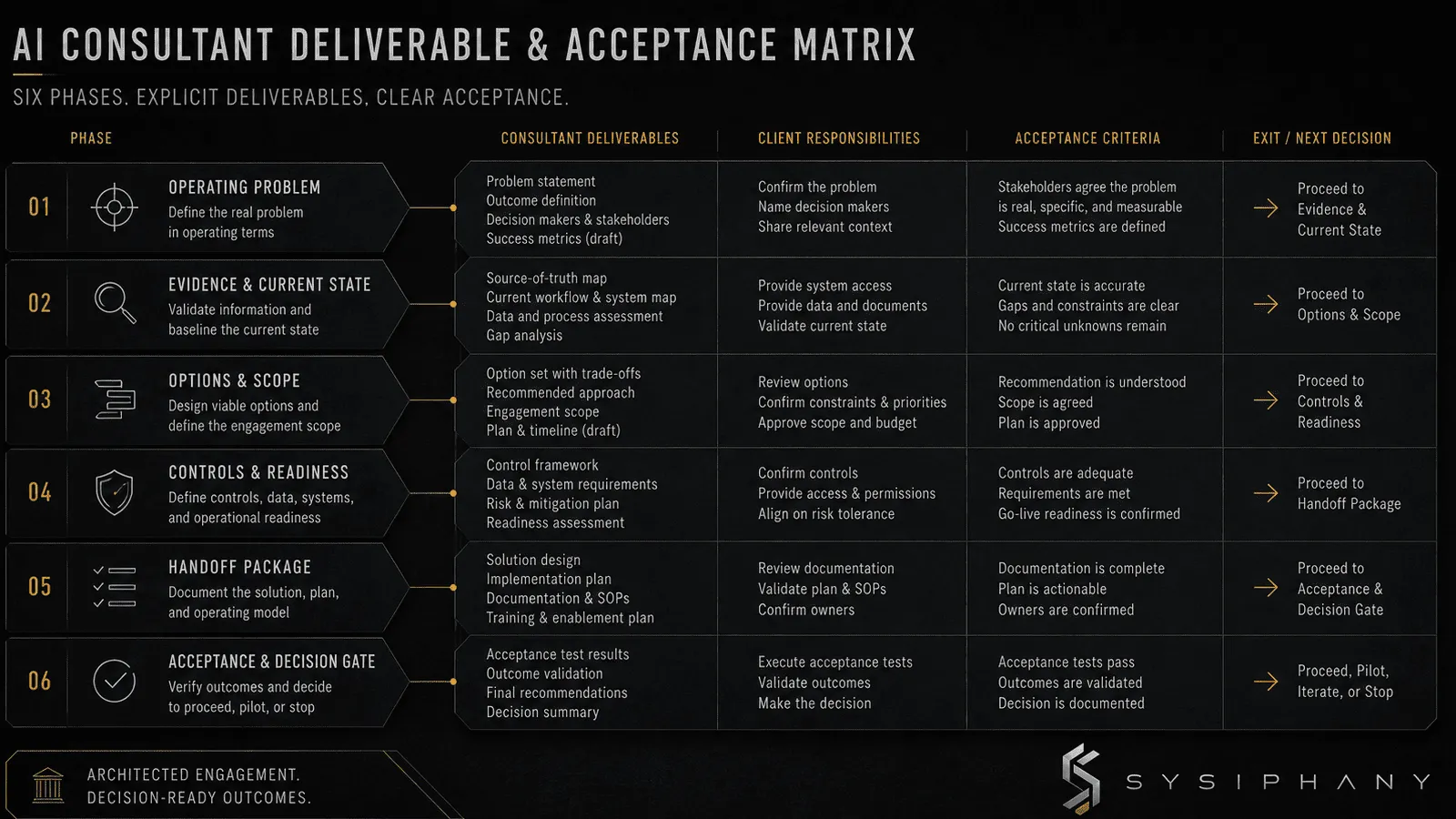
What evidence should each phase produce?
Each phase should produce evidence that lets the buyer approve, revise, stop, or narrow the engagement. Completion is not the date on the project plan. It is an observable condition.
| Engagement phase | Required consultant output | Client owner or input | Acceptance evidence |
|---|---|---|---|
| Problem definition | Agreed operating problem, baseline, constraints, and intended result | Executive sponsor and workflow owner | Signed problem statement; no solution assumed |
| Diagnosis | Findings tied to observed work, records, delays, errors, and exceptions | Workflow participants and data owners | Evidence can be traced to the current operation |
| Recommendation | Prioritized options, tradeoffs, costs, risks, and exclusions | Decision owner | Rationale explains why the chosen path beat the alternatives |
| Pilot charter | Bounded workflow, participants, permissions, controls, measures, and stop conditions | Workflow owner, reviewer, and technical owner | Pilot can run without unanswered ownership questions |
| Pilot review | Baseline comparison, error analysis, review burden, exceptions, and unresolved risks | Accountable reviewer | Written go, revise, or stop decision using agreed measures |
| Handoff | Documentation, training, access transfer, maintenance plan, and known limitations | Permanent internal owner | Team can run, inspect, pause, and recover the system without consultant dependence |
The acceptance evidence changes with the work. A diagnostic phase may end with a decision not to implement AI. That can be a successful result if the evidence shows a simpler process change or conventional automation will solve the problem at lower cost and risk.
A pilot may also fail its target and still be useful. The honest outcome is to stop or redesign, not redefine success after the fact.
What questions should you ask an AI consultant?
Ask questions that force the consultant to show how they think, what they have observed, and where their responsibility ends. Capability questions invite a sales answer. Evidence questions invite an operating answer.
Start here:
“What would make you recommend no AI?”
A credible consultant has a stopping rule. If every diagnosis ends with an AI project, the diagnosis is decorative.
“What do you need to observe before recommending a tool or architecture?”
The answer should include real work, actual records, handoffs, exceptions, owners, and truth sources. A generic discovery questionnaire is not enough for a consequential workflow.
“Which assumptions in this proposal are still untested?”
Every early scope contains assumptions. Competence shows up in naming them and designing the cheapest useful test.
“What exactly will we own at the end?”
Ask about workflows, prompts, configurations, credentials, integrations, code, data schemas, documentation, training material, and vendor accounts. “Your team will be empowered” is not an asset list.
“How will we know the pilot improved the operation?”
Time saved is only one measure. Review burden, error rate, queue time, rework, exception volume, adoption, and recovery time may matter more.
“What happens when the system is wrong?”
The consultant should identify detection, pause, escalation, correction, logging, and recovery. An alert is not a recovery path.
“Who remains accountable for each consequential decision?”
AI may prepare or recommend. A named person accepts financial, legal, employment, policy, and customer-relationship consequences.
“How does the engagement end?”
A clear answer includes acceptance, documentation, training, access transfer, support boundaries, and a date when ongoing help becomes optional.
Which AI consulting red flags should stop or narrow the engagement?
The most important red flag is a recommendation that arrives before the consultant understands the work. Several others tend to travel with it.
The proposal begins with a tool, agent, or platform
A consultant may have preferred tools. That is normal. It becomes a problem when the tool defines the problem. If the recommendation cannot survive a vendor change, you may be buying channel expertise rather than independent judgment. The AI tools selection guide explains how workflow requirements should precede vendor comparison.
The promised result has no baseline or test method
“Save 20 hours a week” means little until the current workload, included tasks, review time, error handling, and measurement period are defined. Ask what evidence produced the number.
The Federal Trade Commission’s FTC Announces Crackdown on Deceptive AI Claims and Schemes describes enforcement actions involving alleged AI hype, unsupported earnings claims, and claims that AI services could replace professional expertise without adequate testing. The cases are not a scorecard for consulting quality, but they reinforce a basic buyer rule: “AI-powered” is not evidence. Require the baseline, test method, production evidence, and acceptance criteria behind a promised result.
Discovery has no decision gate
Some operating questions need exploration. Open-ended discovery is still poor scope. State what decision the discovery phase must enable, what evidence it will collect, when it ends, and what happens if the answer is “do not proceed.”
Activities are presented as deliverables
Interviews, workshops, research, and meetings are work. They are not client outcomes by themselves. Tie each activity to an artifact, decision, or validated finding.
Human review is named but not designed
“Human in the loop” sounds responsible while leaving the control blank. The scope should name who reviews, what triggers review, what standard they apply, how long they have, what rejection does, and how the workflow resumes.
The consultant keeps the keys
Your team should not need permanent consultant access to run a routine operating workflow. Temporary support can be sensible. Undocumented configurations, consultant-owned accounts, hidden prompts, and inaccessible integrations create a new dependency while claiming to remove one.
Success means the technology went live
Deployment is an event. Success is an operating result. If review burden doubled, exceptions disappeared into an inbox, or the team returned to manual work, the project did not succeed because the automation ran.
What must the client continue to own?
The client must own the operating outcome, policy, data authority, risk acceptance, consequential decisions, and permanent workflow accountability. A consultant can make those responsibilities visible. They cannot absorb them on the client’s behalf.
Name an executive sponsor who can settle scope and tradeoffs. Name a workflow owner who remains accountable after handoff. Name the people authorized to approve customer, financial, legal, employment, or policy consequences. Name the technical owner who can manage access and recovery. If one person holds all four roles, make that concentration explicit rather than pretending the team owns the system.
The client also owes the consultant access to reality. Sanitized process descriptions produce sanitized recommendations. Show the workarounds, disputed records, missing fields, exception messages, and manual rescues. The source-of-truth problem cannot be fixed if everyone protects their own version of events.
This is why a good consultant will sometimes be inconvenient. They will ask who decides, which record wins, what can be removed, and what happens when the normal path fails. Those questions slow the sales conversation down. They speed the actual work up.
How should you decide whether to hire, narrow, or walk away?
Decide from the quality of the problem definition, evidence, scope, responsibility split, and acceptance plan. Do not decide from the sophistication of the demo.
| Decision | Use it when | Required next move |
|---|---|---|
| Hire | The operating problem is bounded; evidence supports outside help; roles and acceptance are clear | Approve the first gated phase, not every possible phase |
| Hire with narrower scope | The consultant appears capable, but the problem, data, or dependencies are still uncertain | Buy a time-boxed diagnosis or pilot with an explicit stop decision |
| Request more evidence | Claims, references, assumptions, baseline, or controls are incomplete | Require production examples and written answers before signing |
| Use a specialist builder | The workflow and acceptance test are already precise | Contract for the build, documentation, and handoff rather than more strategy |
| Do not hire yet | The team cannot name the problem, owner, truth source, or intended result | Clarify the operation or run an operational audit before buying consulting |
| Walk away | The provider will not define exclusions, evidence, ownership, controls, or exit terms | Preserve the problem statement; replace the provider, not the operating need |
When in doubt, shrink the first commitment. A narrow diagnosis with a real decision gate is more useful than a broad transformation promise with no clean stopping point.
FAQ
Should an AI consultant need access to all of our data?
No. Access should follow the approved scope and the least-privilege principle. The consultant should name which records, systems, and environments are required, why each is needed, how access will be secured and logged, and when it will be removed. Broad access “for discovery” is a reason to narrow the engagement, not a default requirement.
How much should a small business pay an AI consultant?
Price depends on the decision, deliverables, complexity, systems involved, data condition, risk, and whether the engagement includes diagnosis, implementation, or both. A first gated phase should have a clear fee, completion evidence, change-control rule, and right to stop. Compare the total cost of ownership and dependency, not only the hourly rate. A low fee for an undefined scope is not a bargain.
How do I know whether an AI consultant is qualified?
Ask for evidence from comparable production work, not only certifications or demos. Have the consultant explain what they observed, what they recommended against, how they measured the result, what failed, how the system recovered, and what the client owned after handoff. Strong answers are specific about boundaries and tradeoffs.
Should an AI consultant recommend specific tools?
Yes, when the workflow requirements justify the recommendation. The consultant should explain which requirements drove the choice, which alternatives were considered, what would trigger a switch, and how the business avoids unnecessary lock-in. A tool recommendation should follow the diagnosis, not substitute for it.
When does an ongoing AI consulting retainer make sense?
An ongoing retainer can make sense when the business has a stable portfolio of live systems that require monitoring, controlled improvement, incident review, or recurring governance support beyond the internal team’s capacity. It should still name the covered systems, service levels, decisions, exclusions, monthly outputs, and exit terms. A retainer should support an owned system, not compensate for a missing handoff.
Who owns an AI system after the consultant leaves?
The contract should make that explicit. The small business should control its vendor accounts, credentials, configurations, prompts, documentation, data, integrations, and any custom code it has paid to own. A named internal owner should be able to operate, inspect, pause, and recover the system without routine consultant involvement.
Bring one real scope into review
If you are evaluating an AI consultant, bring one proposed workflow, failed AI effort, or consulting scope to a SYSIPHANY discovery call. SYSIPHANY works fixed-scope and fixed-fee, with explicit deliverables and acceptance criteria. The systems and documentation transfer to the client, and the work includes a real handoff rather than assumed dependency. If the evidence says AI is the wrong answer, we will say so.
The first question is not which tool to use. It is whether the problem, evidence, ownership, and acceptance boundary are clear enough to support an engagement.
If you cannot yet name that scope, start with the Operational Drag Diagnostic Kit. It helps you inspect the operational drag created by workflow fractures, ownership gaps, truth-source conflicts, repeated approvals, and AI-readiness risks before asking a consultant to solve the wrong layer.