
Founder dependency is not a personnel problem. It is an architecture problem.
The business still works. Customers are served. Revenue grows. But growth slows in proportion to one person’s capacity to approve, adjust, explain, and rescue. The founder knows something is wrong because they are always busy. The team knows something is wrong because they are always waiting. Neither group usually names the problem correctly.
This article explains why founder dependency forms, how to recognize it in your own business, and what to change first so the company can operate without you as the navigation layer.
If handoffs and truth sources are unclear first, start with an operational audit before redesigning decision rights.
Quick answer: What is founder dependency?
Founder dependency is the condition in which a business cannot reliably complete decisions, exceptions, customer relationships, or strategic direction without the founder’s direct involvement. It usually starts as speed. It ends as the operating system.
The pattern shows up as repeated approvals, unreachable decisions, undocumented judgment, customer relationships that only the founder can maintain, and a team that defaults to waiting instead of acting.
The Harvard Business Review observed that the habits and skills that make founders successful early are precisely the ones that can undermine their ability to lead larger organizations. Founder dependency is a pattern shift, not a personality flaw. That matters because it can be diagnosed and redesigned instead of managed through delegation pep talks.
What is founder dependency?
Founder dependency is not simply being hands-on. It is a structural condition in which the founder has become the only path for certain categories of work.
In the early days, that is efficient. The founder can answer quickly, adjust without process, and protect quality through direct oversight. The problem is that the same behavior does not scale. As the team, customer base, and product surface grow, the founder’s bandwidth becomes the constraint on everything else.
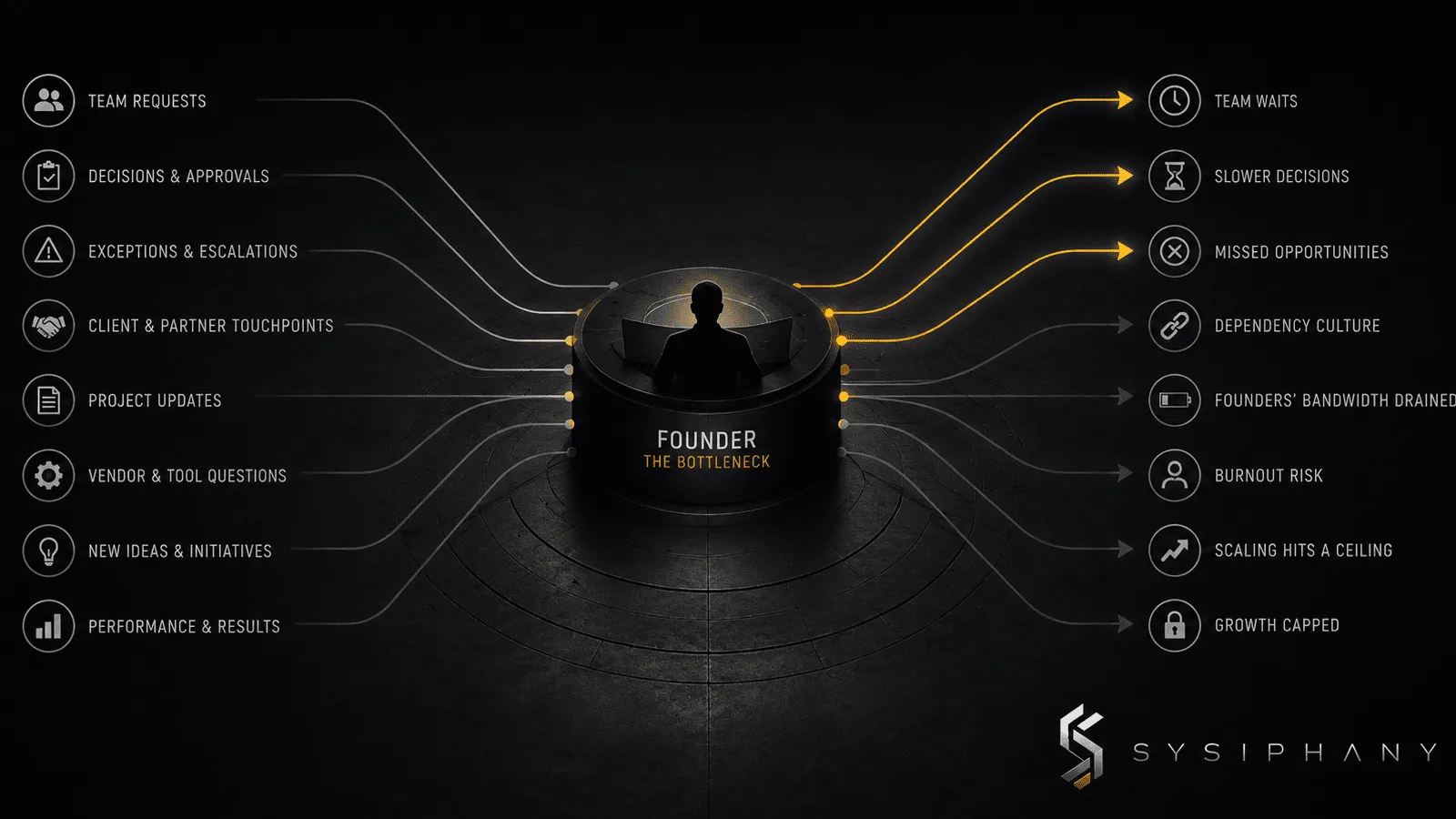
The dependency shows up in four common layers:
- Decisions: Most meaningful decisions route through the founder because nobody else has the authority, context, or confidence to act.
- Exceptions: Unusual cases, customer complaints, pricing questions, and scope changes pause every queue until the founder responds.
- Relationships: Key customers, vendors, and partners route through the founder because trust lives in the person rather than the team or system.
- Knowledge: Operating rules, customer history, decision patterns, and unwritten standards exist mostly in the founder’s memory. If your tech stack still depends on the founder as the source of truth, it constrains every substitution and automation decision.
These layers are not failures of will. They are predictable consequences of building fast without externalizing judgment.
Why do founders become the bottleneck?
Founders usually become the bottleneck because involvement worked early and nobody redesigned the operating system when the company got bigger.
When a founder makes a decision quickly, the work moves. When they resolve an exception personally, the customer stays. When they maintain the relationship, the account stays. Those wins reinforce the pattern. Over time the team learns that waiting for the founder is the fastest path. The founder learns that doing it themselves is faster than explaining it.
The result is an organization calibrated to one person’s bandwidth rather than to customer demand or market opportunity.
A secondary cause is unclear operating architecture. If rules, ownership, escalation paths, and source-of-truth systems are not explicit, the founder becomes the operating system by default. That is not a management failure in the traditional sense. It is a systems failure dressed up as performance.
What does founder dependency cost a business?
Founder dependency costs a business in ways that are hard to see until the pattern is named.
Speed. Every decision, exception, and review that waits for one person is a queue. The business can grow faster than one person can clear queues. At some point the queue length becomes the growth ceiling.
Quality. When the founder is the only check on quality, quality becomes inconsistent whenever the founder is unavailable. That unreliability is not visible inside the business because the founder usually fixes what they see. It is visible to customers who get different answers at different times.
Team capability. A team that cannot act without approval does not build judgment. It builds wait behavior. The cost is not only present throughput. It is also future capacity.
Transfer value. Founder dependency reduces the value of the business as an asset. If operations require the founder’s continued presence, the business carries execution risk that any buyer, investor, or partner will discount.
The Scaling Operations Without Adding Headcount article explores how dependency, unclear ownership, and manual coordination create hidden drag during growth. Founder dependency is one of the most common forms that drag takes.
How do you recognize founder dependency?
Founder dependency is easiest to see from outside the pattern. The following signals usually appear together rather than in isolation.
| Signal | What it means |
|---|---|
| Decisions stop when you stop | If the team can name decisions waiting for you right now, the business is operating inside your calendar, not inside a system. |
| Exceptions always reach you | Unusual cases, refunds, scope changes, and upset customers should have named owners and escalation rules. If they still reach your inbox first, exception ownership is missing. |
| Customers expect you | If key relationships cannot continue without your direct participation, trust is attached to you rather than to the team or account structure. |
| Repeated questions never get documented | If you answer the same internal questions more than twice, that knowledge should become a source of truth, not a personal FAQ. |
| Your calendar is the operating system | If the only way to know what is happening is to read your meetings, approvals, and messages, the company has no independent operating picture. |
| Quality slips when you travel | If work quality, customer response time, or decision consistency drops in your absence, the business is dependent on your presence as a control mechanism. |
| You are the worst bottleneck to have | Founder dependency is harder to fix than other bottlenecks because the constraint is also the person who built the system. Admitting the pattern does not require self-criticism. It requires system redesign. |
The Operational Drag Diagnosis Kit is a practical way to surface these patterns across decisions, handoffs, exceptions, and ownership gaps.
What should you fix first?
Do not start with delegation. Start with the architecture underneath it.
The first change is to make rules and decision rights visible. Write down what should happen for common decisions, exceptions, and customer scenarios so the team can act without asking. The goal is not to remove founder judgment. It is to remove the need for the founder to restate it constantly.
The second change is to separate ownership from approval. Approval is a moment. Ownership is ongoing accountability. If the founder is the only owner, delegation becomes permission theater. Name owners who can decide, escalate, and record outcomes.
The third change is to move relationships to systems and teams, not away from care but away from one person as the only trusted node. A customer should trust the account manager and the record, not only the founder.
The fourth change is to document decision rationale, not only procedures. Procedures tell people what to do. Decision rules tell people how to think when the case is unusual. That shift is what turns a waiting team into an operating team.
An operational audit before implementation can clarify whether the business is ready to redesign decision architecture or still needs stronger workflow foundations first.
When is founder dependency safe versus harmful?
Founder dependency is not always a crisis. In the earliest stage, a founder as operator is normal. The problem is duration and scope. Founder dependency becomes harmful when it persists past the point where one person’s capacity is the binding constraint on growth, quality, or team capability.
The business does not need to remove the founder from every decision. It needs to remove the founder from the decisions that other people should own, with clear rules about when to escalate back. That is a design problem, not a personality problem.
Can founder dependency affect AI readiness?
Yes. An AI readiness assessment should inspect founder dependency because it affects data quality, decision rules, exception handling, and review boundaries.
If the founder is the source of truth, the team cannot build clean datasets or stable automation rules. If the founder owns every exception, AI assistance will escalate falsely or silently bypass control. If the founder defines outcomes informally, measuring AI performance becomes guesswork.
For a structured look at how dependency, ownership, and workflow clarity affect AI readiness, read AI Readiness Assessment: Is Your Business Actually Ready for AI?.
What should a founder do today?
Pick one decision or exception category that currently routes to you.
Map how often it arrives, what information you use, what rule you are applying, who should own it, and what escalation should look like. Then transfer ownership with a clear boundary instead of a vague instruction.
Repeat that until the founder is designing the system rather than operating it.
FAQ
What is founder dependency in a small business?
Founder dependency is the condition in which a business cannot reliably complete decisions, exceptions, customer relationships, or strategic direction without the founder’s direct involvement.
Why is founder dependency a problem?
Founder dependency caps growth at one person’s bandwidth, creates inconsistent quality when the founder is unavailable, prevents the team from building decision capability, and reduces the transfer value of the business.
How does founder dependency affect scaling?
Founder dependency slows scaling because every additional customer, workflow, exception, and decision still routes through one approval layer. Scaling Operations Without Adding Headcount explains why dependency and unclear ownership become the hidden costs of growth.
Can a business remove founder dependency without losing control?
Yes. Removing dependency means transferring ownership with clear rules, not abdicating judgment. The founder shifts from operator to designer of the operating system.
What is the difference between founder dependency and founder leadership?
Founder leadership sets direction and standards. Founder dependency means the founder is still the only node through which direction is restated, approved, or rescued. Leadership should scale through the system, not through one person’s calendar.
How do you know if founder dependency is affecting AI readiness?
AI readiness requires stable decision rules, trusted data, named owners, and clear escalation paths. When the founder is the implicit rule engine, data owner, and exception handler, AI cannot be evaluated or implemented reliably. AI Readiness Assessment: Is Your Business Actually Ready for AI? explains how to test for these conditions.
Book a SYSIPHANY discovery call
Download the Operational Drag Diagnosis Kit
Use the Operational Drag Diagnosis Kit to inspect:
- Decision routing and approval bottlenecks
- Exception queues with no named owner
- Customer relationships concentrated in one person
- Knowledge trapped outside documented systems
- Source-of-truth confusion that makes delegation unreliable
- Workflow fractures that force founder intervention
Stop guessing. Start with the operating system first.