Most businesses are not unready for AI because the team lacks interest.
They are unready because the operating system is still unclear.
The founder wants leverage. The team wants relief. The tools look impressive. The demos are convincing. The promise sounds reasonable: automate the repetitive work, answer faster, summarize more, route better, remove friction, scale without adding unnecessary overhead.
But enthusiasm does not make a business AI-ready.
A business is ready for AI only when the work is clear enough for AI to support without creating more confusion.
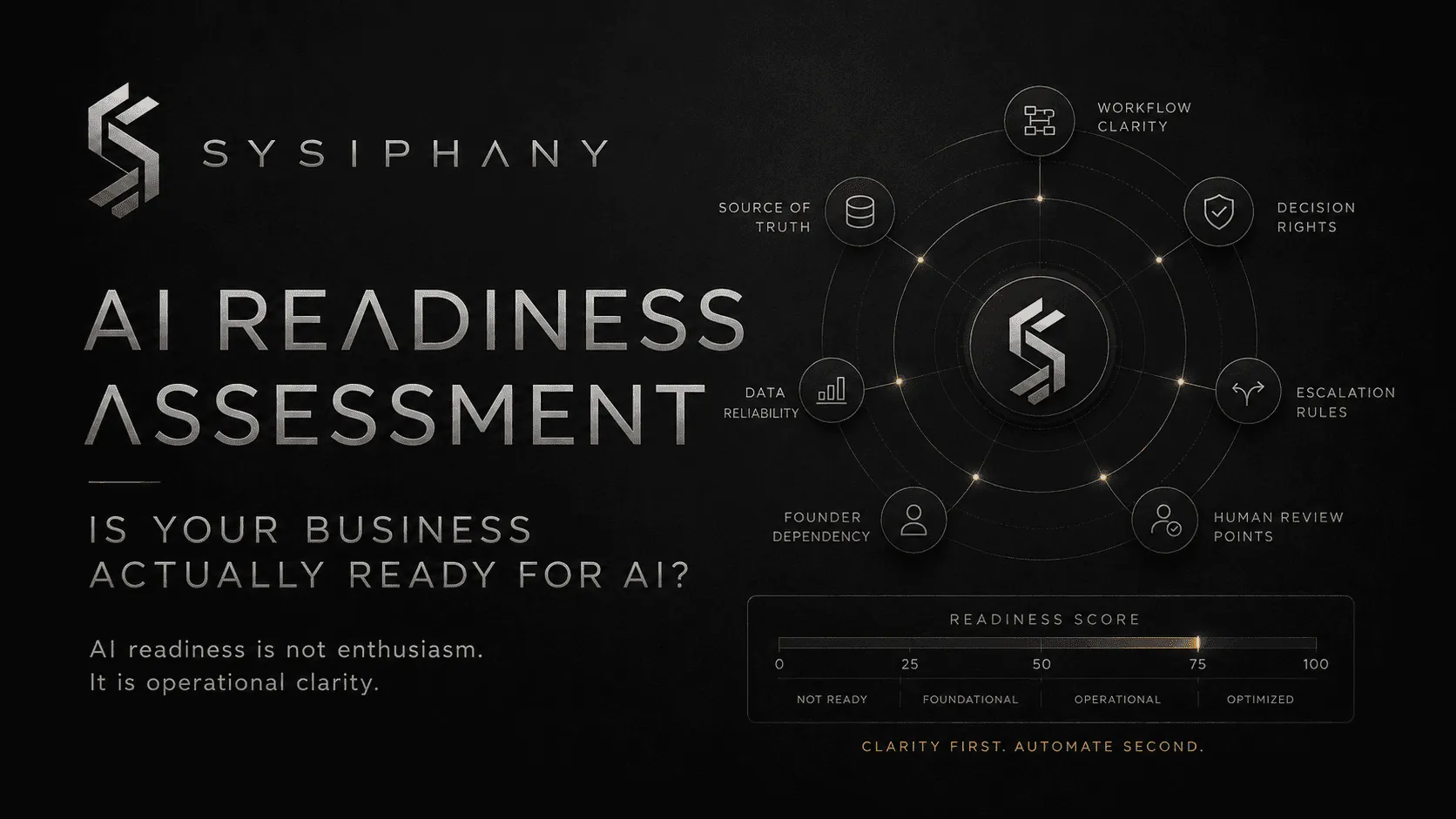
That means workflows have to be visible. Data has to be reliable enough to use. Decision rights have to be defined. The source of truth has to be known. Escalation rules have to exist. Human review points have to be deliberate.
Without those pieces, AI does not become leverage.
It becomes another layer of operational drag.
For the sequencing behind this, read Why an Operational Audit Must Come Before AI Implementation.
What is an AI readiness assessment?
An AI readiness assessment is a practical review of whether a business has enough workflow clarity, data reliability, decision structure, source-of-truth discipline, escalation rules, and human review points to use AI safely and effectively.
It is not a personality quiz.
It is not a vendor checklist.
It is not a question of whether the company is excited about AI.
It is a question of whether the business can explain how work actually moves, what information AI should trust, what AI can assist, what humans must still own, and what happens when the work does not fit the standard path.
AI readiness is operational readiness.
Not hype readiness.
Quick answer
Your business is ready for AI when workflows, data, ownership, decision rights, source of truth, escalation rules, and human review points are clear enough for AI to support work without adding more confusion.
If those pieces are unclear, start with operational clarity before AI implementation.
How do you know if your business is ready for AI?
You know your business is ready for AI when the workflow is clear, the source of truth is trusted, data is reliable enough to use, decision rights are visible, escalation rules exist, and human review is built into the system.
The test is not whether AI could technically perform a task.
Most tools can do something.
The test is whether the business can give AI a stable operating environment.
Can the team explain the workflow?
Can they name the source of truth?
Can they say who owns the output?
Can they define what AI should never decide?
Can they explain what gets escalated?
Can they identify where human review belongs?
If the answers are vague, the business is not ready for autonomous AI.
It may still be ready for assistive AI.
That distinction matters.
Assistant first.
Automation later.
Autonomy last.
What are the signs your business is not AI-ready?
The clearest signs your business is not AI-ready are unclear workflows, disputed data, tool confusion, founder-dependent decisions, weak handoffs, undefined escalation rules, and review processes that happen by instinct instead of design.
The symptoms usually show up before AI is ever discussed.
People ask where work lives.
Teams disagree about status.
The CRM and spreadsheet do not match.
Slack has the real context.
The founder reviews routine decisions.
Client handoffs lose important details.
Nobody knows which process is current.
Exceptions are handled from memory.
Approval depends on who is available.
Those are not just operational annoyances.
They are AI readiness risks.
AI can only work well inside the system you actually have.
If the system is unclear, the AI implementation inherits the confusion.
What should an AI readiness assessment inspect?
An AI readiness assessment should inspect the workflow, source of truth, data quality, ownership, decision rights, escalation rules, human review points, and founder dependency before AI is added.
Use this as an AI readiness checklist before buying another tool, automating a workflow, or asking AI to support customer-facing work.
| Readiness Area | What to Ask | Risk If Unclear |
|---|---|---|
| Workflow clarity | Can the team explain how work actually moves? | AI supports the wrong path |
| Source of truth | Which system wins when information conflicts? | AI retrieves or summarizes unreliable information |
| Data reliability | Is the information complete, current, and usable? | AI produces confident but weak outputs |
| Ownership | Who owns the workflow and final output? | AI creates work nobody is accountable for |
| Decision rights | What can AI draft, classify, recommend, or decide? | AI oversteps or escalates everything |
| Escalation rules | What conditions require human attention? | Risky exceptions get mishandled |
| Human review | What must be reviewed before action? | AI outputs become either unsafe or unused |
| Founder dependency | What judgment still lives only in the founder’s head? | AI cannot inherit invisible judgment |
This is the practical difference between AI interest and AI readiness.
Interest says:
“We should use AI.”
Readiness says:
“Here is where AI can safely support the operating system.”
Why does workflow clarity matter for AI?
Workflow clarity matters for AI because AI needs to know where work starts, what happens next, who owns each step, what information matters, and what counts as complete.
Without workflow clarity, AI may produce useful fragments but still fail operationally.
It can draft a response, but not know whether the response should be sent.
It can summarize a request, but not know where the request belongs.
It can classify an issue, but not know who owns the next step.
It can extract details, but not know which details matter.
It can recommend action, but not know the approval threshold.
That is why workflow mapping comes before AI workflow automation.
AI does not need a perfect process.
It needs a visible one.
Why does source of truth matter for AI readiness?
Source of truth matters for AI readiness because AI needs to know which information is authoritative when systems disagree.
Most SMBs do not have an information shortage.
They have a trust problem.
The CRM says one thing.
The project board says another.
The spreadsheet is more current.
The inbox has the client’s latest request.
Slack has the real explanation.
The founder remembers the exception.
AI cannot safely resolve that mess by guessing.
The business has to decide where truth lives.
For a deeper breakdown, read Your Tech Stack Isn’t the Problem. Your Source of Truth Is..
Once the source of truth is clear, AI has ground to stand on.
Before that, it has fragments.
How reliable does your data need to be for AI?
Your data does not need to be perfect for AI, but it does need to be reliable enough for the task AI is being asked to support.
That distinction matters.
A lightweight drafting assistant may not need perfect data.
A support triage system needs enough accuracy to route issues correctly.
A reporting assistant needs current and consistent records.
A customer-facing response system needs high trust inputs.
A pricing, refund, or compliance workflow needs stronger controls.
The more the output affects customers, money, safety, reputation, or trust, the higher the data standard needs to be.
A founder-led SMB does not need enterprise-grade data governance before using AI.
But it does need to know where poor data could create real risk.
What decision rights does AI need?
AI needs decision rights that define what it can draft, classify, recommend, route, summarize, approve, escalate, or leave untouched.
Most AI risk in small businesses comes from vague authority.
The business says:
“Let AI handle it.”
But handle what?
Draft the email?
Send the email?
Classify the request?
Assign the task?
Recommend the refund?
Approve the refund?
Escalate the complaint?
Close the ticket?
Each of those actions carries a different level of risk.
The readiness question is not whether AI can do the task.
The readiness question is what role AI should be allowed to play.
A safe starting point is usually:
Draft.
Summarize.
Classify.
Extract.
Route.
Recommend.
Not approve, send, decide, or close without review.
What should AI escalate to a human?
AI should escalate work to a human when the issue involves high trust, unusual exceptions, financial impact, legal exposure, client sensitivity, personnel issues, brand risk, low confidence, or anything outside the defined workflow.
Escalation rules keep AI from pretending every situation is routine.
Some work should not be handled like a standard task.
Client complaints.
Refund requests.
Pricing exceptions.
Contract ambiguity.
Employee issues.
Sensitive customer data.
Safety or compliance questions.
Unusual edge cases.
Anything involving reputation or trust.
AI can still help.
It can summarize the issue, gather context, classify the risk, prepare a draft, or recommend next steps.
But escalation keeps accountability where it belongs.
Why do human review points matter?
Human review points matter because AI-supported workflows need clear moments where people check, approve, correct, or override outputs before risk reaches the customer, team, or business.
Human review should not be accidental.
It should not happen only because nobody trusts the system.
It should be designed.
What gets reviewed?
Who reviews it?
What are they checking?
What level of risk requires review?
What can bypass review?
What gets sampled later for quality?
What happens when AI is wrong?
A good review system does not review everything forever.
It reviews intentionally.
The goal is to reduce unnecessary review while protecting the places where judgment still matters.
How does founder dependency affect AI readiness?
Founder dependency reduces AI readiness because routine judgment still lives in the founder instead of visible rules, examples, thresholds, and escalation standards.
This is one of the most common blockers in founder-led SMBs.
The founder knows what “good” looks like.
The founder knows when a client is sensitive.
The founder knows when to bend the rule.
The founder knows which promise creates risk.
The founder knows when a team member should escalate.
If that judgment stays invisible, AI cannot support it.
It can only guess, over-escalate, or produce outputs the founder still has to review.
For a related capacity lens, read Scaling Operations Without Adding Headcount.
AI readiness improves when founder judgment becomes operational language.
Rules.
Examples.
Thresholds.
Approval boundaries.
Escalation triggers.
Review standards.
That is not replacing the founder.
It is making the founder’s judgment usable by the system.
What does outside AI risk guidance say about readiness?
Outside AI risk guidance reinforces the same idea: AI should be managed through governance, mapping, measurement, and management, not only through tool selection.
The NIST AI Risk Management Framework is broader than a small-business AI readiness assessment, but its sequence is useful. It emphasizes understanding context, risks, measurement, and management before relying on AI systems.
For founder-led SMBs, the practical lesson is simple.
Do not start with the tool.
Start with the operating context.
Outside reference: NIST AI Risk Management Framework.
What is the difference between assistive AI, automation, and autonomy?
Assistive AI supports human-owned work, automation executes defined steps, and autonomy makes or completes decisions within boundaries.
This distinction helps reduce confusion.
Assistive AI
Assistive AI helps people do work faster or better while humans still own the outcome.
Examples:
- summarizing calls
- drafting emails
- extracting details from documents
- classifying requests
- generating first-pass checklists
- preparing handoff notes
This is usually the safest starting point.
Automation
Automation runs a defined workflow step based on clear rules.
Examples:
- routing a request based on category
- creating a task from a form submission
- sending an internal notification
- updating a record when a status changes
- generating a standard follow-up draft
Automation needs stable rules and clear exceptions.
Autonomy
Autonomy allows AI or an AI-enabled system to decide or complete work with limited human involvement.
Examples:
- sending customer responses without review
- approving refunds
- resolving complaints
- changing project status
- making recommendations that affect money, people, or trust
Most founder-led SMBs should reach autonomy slowly.
Not because autonomy is impossible.
Because autonomy requires operational clarity first.
What should you do if your business is not AI-ready yet?
If your business is not AI-ready yet, start with the workflow, clarify the source of truth, define ownership, write decision boundaries, create escalation rules, and choose one low-risk assistive AI use case.
Do not turn readiness gaps into shame.
Most small businesses are not fully AI-ready.
That does not mean they should ignore AI.
It means they should start in the right place.
A practical sequence:
- Pick one workflow.
- Map how it actually works.
- Identify the trusted source of truth.
- Name the owner.
- Define what AI can assist.
- Define what AI cannot decide.
- Add human review points.
- Test with a low-risk use case.
- Improve the system before expanding.
This is how AI becomes part of the operating system instead of another experiment sitting beside it.
How do you run a simple AI readiness assessment?
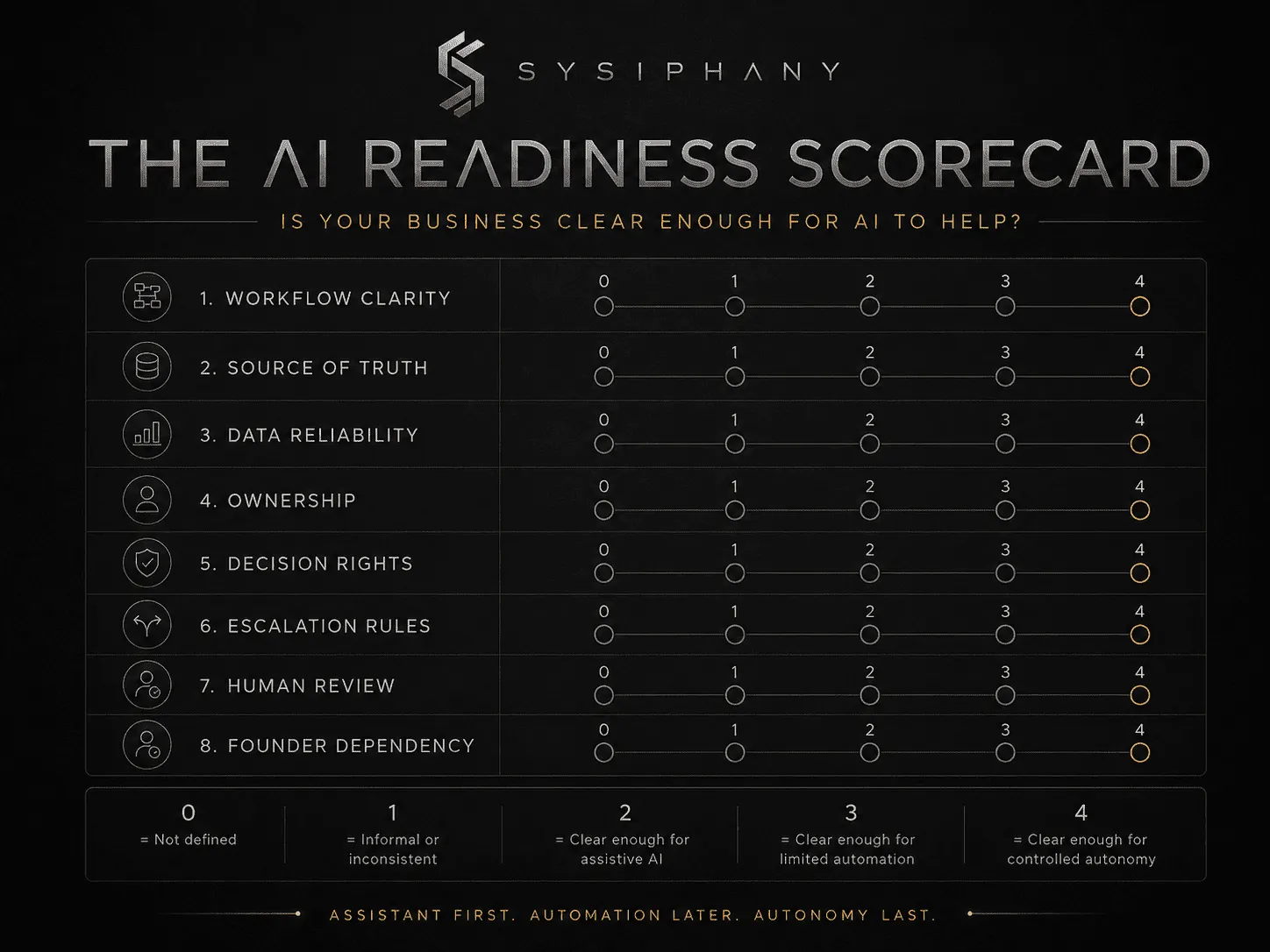
You run a simple AI readiness assessment by scoring one workflow across workflow clarity, source of truth, data reliability, ownership, decision rights, escalation rules, human review, and founder dependency.
Start with one workflow where AI is being considered.
Then score each area:
| Score | Meaning |
|---|---|
| 0 | Not defined |
| 1 | Informal or inconsistent |
| 2 | Clear enough for assistive AI |
| 3 | Clear enough for limited automation |
| 4 | Clear enough for controlled autonomy |
A workflow does not need all 4s to start using AI.
But it should not be treated as autonomous if the foundations are mostly 0s and 1s.
If workflow clarity, source of truth, ownership, and review points are weak, start with assistive AI.
If decision rights and escalation rules are clear, limited automation may be possible.
If the workflow is stable, monitored, and well-governed, controlled autonomy becomes more realistic.
The assessment should guide the role AI plays.
Not just whether AI is allowed.
How do you diagnose operational drag before AI?
You diagnose operational drag before AI by inspecting disconnected systems, manual coordination, duplicated work, unclear ownership, workflow fragmentation, founder dependency, source-of-truth confusion, and AI readiness risk.
The Operational Drag Diagnostic Kit helps founder-led teams find the drag before they automate it.
Use it before you buy another tool.
Use it before you ask AI to handle a workflow.
Use it before you mistake repeated work for ready-to-automate work.
The kit helps inspect:
- disconnected systems
- manual coordination
- duplicated work
- unclear ownership
- workflow fragmentation
- founder dependency
- source-of-truth confusion
- AI readiness risk
If your business is interested in AI but the operating system still feels unclear, start with the diagnosis.
Download the Operational Drag Diagnostic Kit.
FAQ
What is an AI readiness assessment?
An AI readiness assessment is a review of whether a business has enough workflow clarity, data reliability, decision structure, source-of-truth discipline, escalation rules, and human review points to use AI safely and effectively.
How do I know if my business is ready for AI?
Your business is ready for AI when the workflow is clear, the source of truth is trusted, ownership is defined, decision rights are visible, escalation rules exist, and human review points are deliberate.
What makes a business not ready for AI?
A business is usually not ready for AI when workflows are unclear, data is unreliable, tools disagree, handoffs lose context, escalation rules are undefined, and routine decisions still depend on the founder.
Does my data need to be perfect before using AI?
Your data does not need to be perfect before using AI, but it does need to be reliable enough for the task. Higher-risk workflows require stronger data quality and review standards.
Should small businesses start with AI automation?
Most small businesses should start with assistive AI before automation. Drafting, summarizing, classifying, extracting, and routing are usually safer starting points than autonomous decision-making.
What should AI never decide without review?
AI should not decide high-trust, high-risk, sensitive, financial, legal, personnel, compliance, or brand-sensitive issues without clear rules and human review.
What should I do before implementing AI?
Before implementing AI, inspect the workflow, source of truth, data reliability, ownership, decision rights, escalation rules, human review points, and founder dependency.