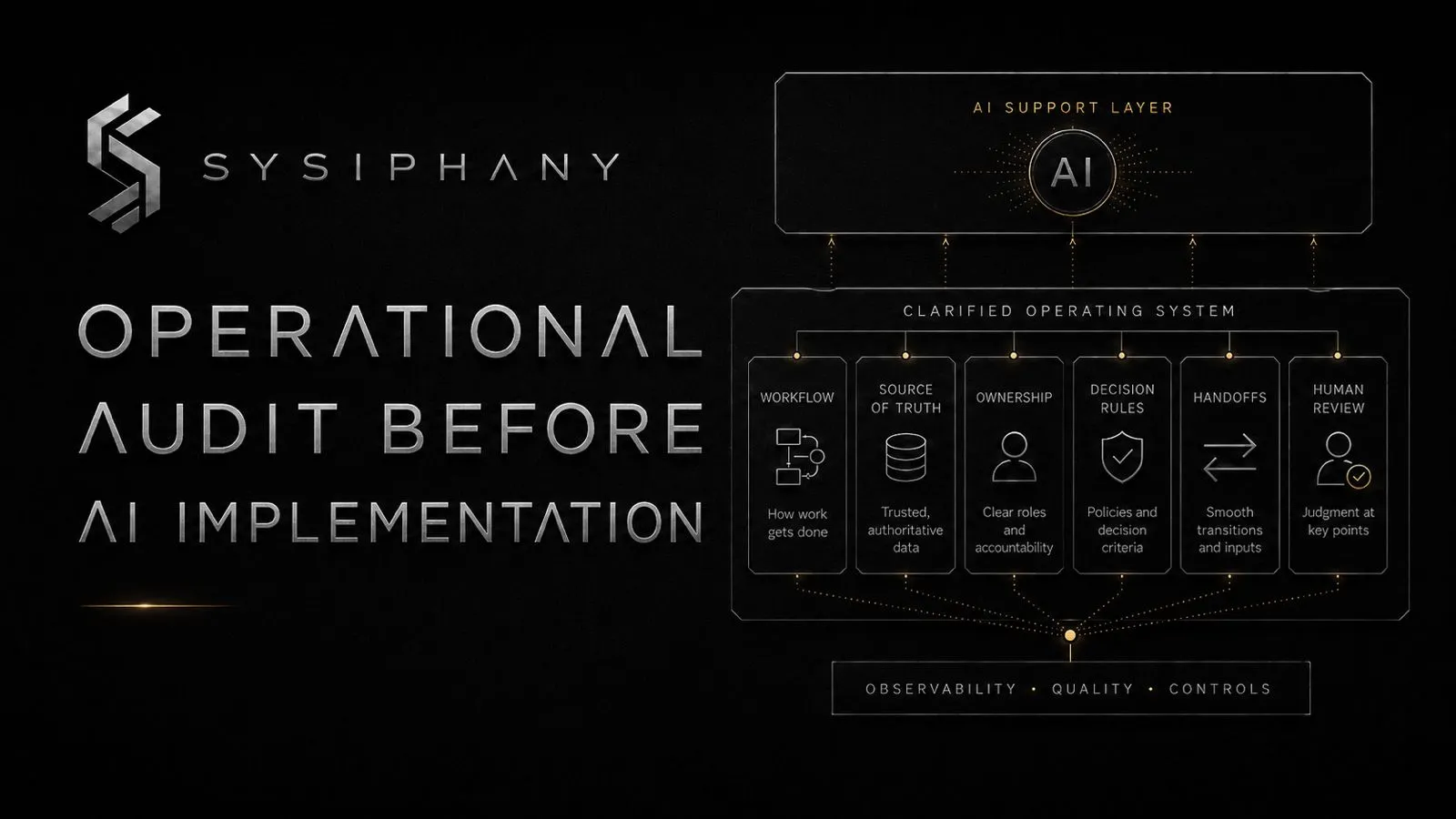
Most AI implementation problems start before the tool is ever selected.
Not in the demo.
Not in the prompt.
Not in the model.
They start inside the operating system the AI is being asked to support.
The workflow is unclear. The source of truth is disputed. The approval rule lives in someone’s head. The handoff loses context. The team already works around the official system. The founder is still the final interpreter of what should happen next.
Then AI gets added.
The expectation is leverage.
The result is often faster confusion.
AI can help a clear business move faster. But it cannot reliably fix an operating system the business has not clarified.
For the broader foundation, read Operational Drag Is the Hidden Cost of Scaling.
What is an operational audit before AI implementation?
An operational audit before AI implementation is a structured review of workflows, systems, handoffs, ownership, decision rules, data sources, and human review points before adding AI or automation.
It is not a long consulting theater exercise.
It is a practical inspection.
Where does work enter?
Where does it wait?
Who owns each step?
Which system holds the truth?
What decisions need review?
Where do exceptions go?
What information does the team trust?
What work should never be automated without a human?
Those answers determine whether AI has stable ground.
Without them, AI does not reduce operational drag.
It joins it.
Quick answer
AI implementation should come after an operational audit because AI cannot safely support unclear workflows, disputed data, weak handoffs, hidden decision rules, or founder-dependent judgment.
If the business is clear, AI can create leverage.
If the business is unclear, AI can make the confusion faster, louder, and harder to control.
Why should an operational audit come before AI implementation?
An operational audit should come before AI implementation because AI depends on clear inputs, clear rules, clear workflows, and clear review points to produce useful work.
AI does not operate in isolation.
It sits inside the business.
It receives information from people, forms, documents, systems, inboxes, chats, CRMs, spreadsheets, project boards, customer records, SOPs, and institutional judgment.
If those inputs are fragmented, the AI inherits fragmentation.
If the process is vague, the AI inherits vagueness.
If the team does not agree which system holds truth, the AI has no stable source to trust.
That is why the audit comes first.
Not to slow the business down.
To prevent the business from automating its own confusion.
What goes wrong when you add AI before auditing operations?
When AI is added before auditing operations, the business often automates unclear work, amplifies bad data, creates new review burdens, and adds another tool layer for the team to manage.
The symptoms are predictable.
AI drafts responses nobody trusts.
AI summarizes information from the wrong source.
AI routes work to the wrong person.
AI creates outputs that still need founder review.
AI adds a new approval queue instead of removing work.
AI becomes another tab, another login, another process, another thing to check.
That does not mean AI failed.
It means the system underneath it was not ready.
The tool may be fine.
The operating model was not.
What should an operational audit inspect before AI?
An operational audit should inspect workflows, sources of truth, ownership, handoffs, decision rules, data quality, exception paths, and human review requirements before AI is added.
The audit does not need to inspect everything at once.
It needs to inspect the part of the business where AI is being considered.
Customer intake.
Sales follow-up.
Client onboarding.
Support triage.
Internal reporting.
Proposal drafting.
Document review.
Task routing.
Complaint handling.
Operations coordination.
Pick the workflow.
Then inspect the system around it.
| Audit Area | What to Check | AI Risk If Unclear |
|---|---|---|
| Workflow | How work actually moves from request to completion | AI speeds up the wrong path |
| Source of truth | Which system wins when information conflicts | AI uses unreliable information |
| Ownership | Who owns each step and outcome | AI routes work into ambiguity |
| Decision rules | What can be drafted, recommended, escalated, or approved | AI crosses boundaries or over-escalates |
| Handoffs | What context must pass between people or systems | AI transfers incomplete work faster |
| Exceptions | What happens when work does not fit the standard path | AI mishandles edge cases |
| Human review | What must stay human-owned | AI creates unsafe or untrusted outputs |
This table is the difference between tool selection and operational readiness.
Tool selection asks, “What can AI do?”
Operational readiness asks, “What should AI do inside this system?”
Those are different questions.
How do unclear workflows break AI implementation?
Unclear workflows break AI implementation because AI cannot reliably support work when the business has not defined where the work starts, where it moves, who owns it, and what completion means.
A workflow can look simple from the outside.
A customer submits a request. Someone reviews it. Someone responds. Someone updates the system. Someone follows up.
Inside the business, the actual path may be different.
The request comes through email, form, Slack, text, or a client portal. The owner changes depending on who sees it first. The status gets updated in one tool but discussed in another. The founder gets pulled in when the team is unsure.
AI cannot solve that by being smart.
It needs the path.
Without the path, AI may produce output, but the team still has to interpret where that output belongs.
That is not automation.
That is another coordination layer.
Why does source-of-truth clarity matter for AI?
Source-of-truth clarity matters for AI because AI needs reliable ground for retrieving, summarizing, routing, or generating work.
If the business already has source-of-truth confusion, AI will not magically resolve it.
The CRM says one thing.
The spreadsheet says another.
The project board is half-updated.
Slack has the real context.
The founder remembers the exception.
Which one should AI trust?
If the business cannot answer that question, the AI implementation is not ready.
For a deeper breakdown, read Your Tech Stack Isn’t the Problem. Your Source of Truth Is..
AI becomes useful when the business can tell it where truth lives.
Not where information exists.
Where truth lives.
What decision rules does AI need?
AI needs decision rules that define what it can draft, recommend, classify, route, summarize, approve, escalate, or leave untouched.
This is where many AI projects quietly fail.
The business says it wants AI to “handle” a workflow.
But handle can mean many things.
Should AI draft a response?
Should it send the response?
Should it classify urgency?
Should it recommend a next step?
Should it assign the task?
Should it approve a refund?
Should it flag a complaint?
If those lines are unclear, the AI system will either be too risky or too timid.
Too risky, and it acts where humans should decide.
Too timid, and everything still needs review.
The answer is not “make AI autonomous.”
The answer is to define the boundary.
What can AI assist?
What can AI prepare?
What can AI decide?
What must humans approve?
That boundary is an operational asset.
How do handoffs affect AI readiness?
Handoffs affect AI readiness because AI often sits between people, tools, or steps, and weak handoffs cause context loss no matter how advanced the technology is.
AI can help prepare a handoff.
It can summarize a client call, extract next steps, draft a project brief, classify an issue, or generate a follow-up checklist.
But if the business does not know what a complete handoff requires, AI has no clear standard.
A weak handoff says:
“Here is the client.”
A strong handoff says:
“Here is what was promised, what matters, what is due, what could go wrong, where files live, who owns the next step, and what decision is needed if this changes.”
AI can help with the second version.
It cannot infer standards the business has never defined.
Why founder dependency blocks AI implementation
Founder dependency blocks AI implementation because too much judgment still lives inside one person instead of inside visible rules, thresholds, examples, and escalation standards.
This does not mean the founder should disappear.
Founder judgment matters.
But if routine work still depends on the founder’s interpretation, AI has no durable judgment system to support.
The founder knows when a client issue is sensitive.
The founder knows which exception is acceptable.
The founder knows when a promise sounds risky.
The founder knows when a team member should escalate.
The founder knows what “good enough” looks like.
If that judgment stays invisible, AI can only guess or defer.
Neither creates leverage.
For a related capacity lens, read Scaling Operations Without Adding Headcount.
Before AI can support the business, some founder judgment has to become operational language.
Rules.
Thresholds.
Examples.
Escalation triggers.
Review standards.
Approval boundaries.
That is how the business stops asking AI to replace judgment and starts using AI to support judgment.
What should stay human-owned?
High-trust decisions, sensitive client communication, legal or financial exposure, personnel issues, unusual exceptions, and final accountability should stay human-owned unless the business has explicit rules and review standards.
AI can support these areas.
It can prepare, summarize, classify, draft, compare, and surface issues.
But support is not the same as ownership.
A founder-led SMB should be especially careful with workflows involving:
- client complaints
- refunds or concessions
- employee issues
- legal exposure
- pricing exceptions
- contract interpretation
- sensitive customer data
- brand reputation
- safety or compliance concerns
- final approvals that affect trust
The right question is not whether AI can touch these workflows.
The right question is what role AI should play.
Assistant.
Drafting layer.
Classifier.
Research helper.
Routing support.
Review prep.
Decision support.
Not owner by default.
What does a good pre-AI audit sequence look like?
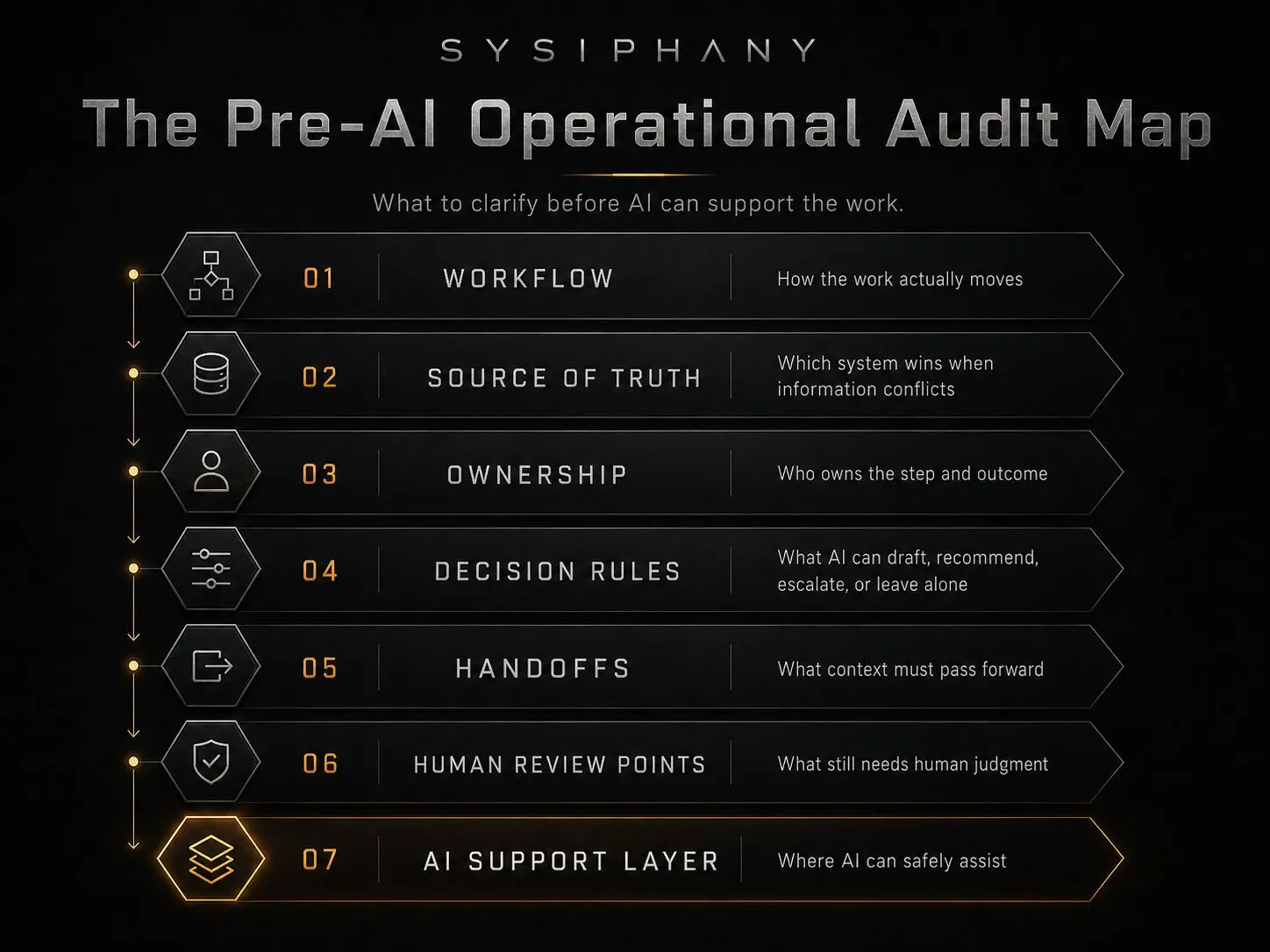
A good pre-AI audit sequence starts with the workflow, then clarifies the source of truth, ownership, decision rules, handoffs, exception paths, and human review points before selecting the AI tool.
Use this order.
1. Pick one workflow
Do not start with “implement AI across the business.”
Start with one workflow that is repetitive, valuable, and currently heavy.
Customer inquiries.
Sales follow-up.
Client onboarding.
Internal reporting.
Support triage.
Document intake.
Project status updates.
One workflow is enough.
2. Map how the work actually moves
Do not map the ideal process.
Map the real one.
Where does the request enter?
Who sees it first?
Where is it recorded?
What happens next?
Where does it wait?
Who checks it?
Who approves it?
Where does status live?
What happens when something is unusual?
AI should support the real workflow or the redesigned workflow.
Not the imaginary one.
3. Identify the source of truth
Decide which system wins.
If client status lives in the CRM, say that.
If delivery status lives in the project board, say that.
If invoice status lives in accounting, say that.
If files live in a shared drive, say that.
AI does not need access to everything.
It needs access to the right things.
4. Clarify ownership
Every AI-supported workflow still needs human ownership.
Who owns the output?
Who reviews exceptions?
Who handles errors?
Who updates the rule when the process changes?
Who monitors quality?
Who decides when the AI should stop and escalate?
If nobody owns the workflow, AI will not fix the accountability gap.
5. Define decision boundaries
List what AI can do and what it cannot do.
Can it draft?
Can it classify?
Can it summarize?
Can it recommend?
Can it assign?
Can it send?
Can it approve?
Can it close?
Most SMBs should start with assistive AI before autonomous AI.
That usually means draft, summarize, classify, route, extract, and recommend before approve, send, decide, or close.
6. Set human review points
Human review is not a weakness.
It is part of the system design.
The goal is not to review everything forever. The goal is to decide which outputs need review based on risk, confidence, client sensitivity, financial impact, or exception status.
Review should be deliberate.
Not accidental.
7. Choose the tool last
Only after the workflow is clear should the business select the AI tool.
Otherwise, the tool selection process becomes guesswork.
A tool demo can show what is possible.
An operational audit shows what is appropriate.
What is AI readiness?
AI readiness is the degree to which a business has enough workflow clarity, data reliability, ownership, decision structure, and review discipline for AI to support work without creating more operational drag.
Readiness is not enthusiasm.
It is not budget.
It is not whether someone on the team has used ChatGPT.
It is not whether competitors are adopting AI.
Readiness means the business can answer operational questions clearly enough for AI to work inside the system.
Where does the work start?
What data should AI use?
Which source is trusted?
Who owns the output?
What should AI never decide?
What requires human review?
How do errors get caught?
How will the system improve?
If those answers are missing, the business may still use AI.
But it should start carefully.
Assistant first.
Automation later.
Autonomy last.
What should you do before buying an AI tool?
Before buying an AI tool, audit the workflow it would support, define the source of truth, identify ownership, write decision boundaries, and decide where human review belongs.
This protects the business from buying a tool that looks useful but has nowhere stable to live.
A tool can be powerful and still be wrong for the current operating system.
The question is not:
“Can this tool do impressive things?”
The question is:
“Can this tool support the next clear step in our operating model?”
If the answer is no, the tool will likely become another subscription, another tab, another experiment, another reason the team asks what changed.
That is not implementation.
That is tool accumulation.
How does an operational audit reduce AI risk?
An operational audit reduces AI risk by making the workflow, data, ownership, decision rules, escalation paths, and review points explicit before AI is allowed to affect real work.
Risk does not disappear.
It becomes visible enough to manage.
The business can decide which workflows are safe for AI assistance, which need human review, and which should remain manual for now.
That is a better posture than either extreme.
Not “AI everywhere.”
Not “AI nowhere.”
AI where the system is ready.
Humans where judgment still matters.
What outside AI risk framework supports this sequencing?
The outside reference point is NIST’s AI Risk Management Framework, which frames AI risk management around governance, mapping, measurement, and management instead of tool selection alone.
The practical lesson for founder-led SMBs is simple: before AI can be managed well, the business has to map the context it is entering.
NIST’s framework is broader than a small-business operations audit. It addresses AI risks to people, organizations, and society, and it is not a replacement for legal, security, or compliance review.
But the sequencing matters.
Govern.
Map.
Measure.
Manage.
That order supports the same operating principle this article is built around.
Do not start with the AI layer.
Start with the system it will affect.
Outside reference: NIST AI Risk Management Framework.
How do you diagnose operational drag before AI implementation?
You diagnose operational drag before AI implementation by inspecting disconnected systems, manual coordination, duplicated work, unclear ownership, workflow fragmentation, founder dependency, and AI readiness risk.
The Operational Drag Diagnostic Kit helps founder-led teams identify where AI may create leverage and where it would simply add another layer to an unclear system.
Use it before you select the tool.
Use it before you automate the workflow.
Use it before you ask AI to handle decisions the business has not defined.
The kit helps inspect:
- disconnected systems
- manual coordination
- duplicated work
- unclear ownership
- workflow fragmentation
- founder dependency
- source-of-truth confusion
- AI readiness risk
If your team is considering AI but the operating system still feels unclear, start with the drag.
Download the Operational Drag Diagnostic Kit.
FAQ
What is an operational audit before AI implementation?
An operational audit before AI implementation is a review of workflows, systems, ownership, handoffs, decision rules, data sources, and human review points before adding AI or automation.
Why should businesses audit operations before adding AI?
Businesses should audit operations before adding AI because unclear workflows, disputed data, weak handoffs, and hidden decision rules make AI harder to trust, review, and deploy safely.
Can AI fix broken business processes?
AI can support clear processes, but it usually cannot fix broken processes by itself. If the process is unclear, AI may make the confusion faster instead of reducing it.
What should be clarified before AI implementation?
Before AI implementation, clarify the workflow, source of truth, ownership, decision boundaries, exception handling, data quality, escalation rules, and human review points.
What is AI readiness?
AI readiness means the business has enough operational clarity for AI to support work without creating more confusion, risk, or manual review burden.
Should small businesses use AI before they have perfect systems?
Small businesses do not need perfect systems before using AI, but they do need enough clarity to know where AI fits, what information it should trust, and what humans must still review.