Growth is supposed to make a business stronger. Sometimes it just makes the drag harder to ignore.
The team gets bigger. The tool stack expands. More work moves through more hands. More processes get documented, more meetings appear, and more people are involved in every decision that used to move quickly.
From the outside, it looks like scale.
Inside the business, it feels heavier than it should.
The founder is still pulled into routine decisions. The team still asks where the real answer lives. Sales, delivery, finance, and customer service still operate from slightly different versions of reality.
The systems technically exist, but the company still runs on memory, clarification, and human glue.
That is operational drag.
What is operational drag?
Operational drag is the hidden friction created when disconnected systems, unclear ownership, manual coordination, duplicated work, and workflow fragmentation slow down a scaling business.
It is not just inefficiency.
It is the weight of a company that has outgrown the way work used to get done.
Quick answer
Operational drag is the hidden friction that appears when a growing business relies on disconnected tools, unclear ownership, manual coordination, and founder judgment to keep work moving.
How do you know if your business has operational drag?
You know your business has operational drag when routine work depends on repeated clarification, manual coordination, unclear ownership, conflicting systems, or founder judgment.
Operational drag in scaling companies usually starts quietly.
A team member checks Slack before trusting the CRM. A manager keeps a spreadsheet because the official system does not tell the whole story. Delivery asks sales what was promised because the handoff does not carry enough context.
None of this feels dramatic at first. It feels normal, which is why it survives.
Most founder-led companies do not break because one giant system fails. They slow down because small points of friction repeat every day across people, tools, and decisions.
A client status gets updated in one place but not another.
A task moves forward, but ownership is fuzzy.
A process exists, but exceptions still require founder judgment.
A tool was added to save time, but now someone has to maintain it manually.
The pattern is easy to miss because no single moment looks expensive.
Operational drag is rarely one obvious bottleneck. It is usually a network of small operational bottlenecks that compound as the business grows.
Why do tools make operational drag worse?
Tools make operational drag worse when they spread unclear ownership, duplicate data, and hidden decisions across more places instead of making the operating system clearer.
When operations feel heavy, the instinct is usually to add something.
A better project management tool.
A cleaner dashboard.
A new automation.
A new AI tool.
Another hire.
Another meeting.
Another SOP.
Sometimes the business does need one of those things.
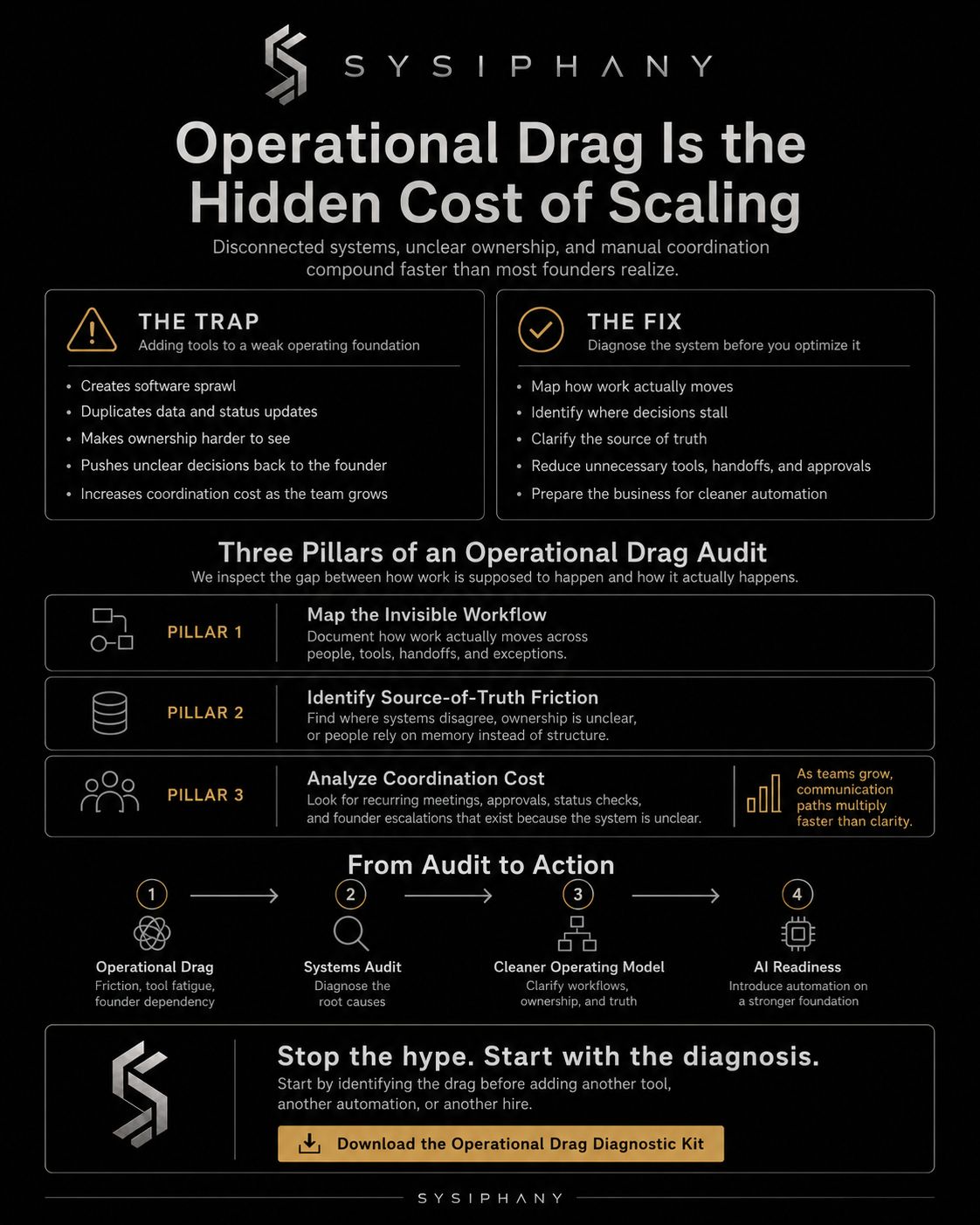
But adding tools to a weak operating foundation usually creates more places for confusion to hide.
A project management tool does not clarify ownership by itself. A CRM does not decide which status is the source of truth. An automation platform does not know when an exception should escalate. AI does not understand a workflow the business has never mapped.
Tools without architecture become operational noise.
That is the trap.
The company thinks it is modernizing. In practice, it may be spreading the same ambiguity across more systems.
The result is familiar:
- Software sprawl
- Duplicate data entry
- Conflicting status updates
- Unclear handoffs
- More work routed back to the founder
- More coordination around work that should already be clear
The team may be capable. The system is asking them to operate inside too much uncertainty.
What is a business systems audit?
A business systems audit is a structured review of how work, decisions, data, tools, and handoffs move through a company so the real bottlenecks can be diagnosed before new systems or automation are added.
SYSIPHANY starts from a simpler premise.
Before you add another tool, inspect the operating system.
Not the software stack.
The actual operating system of the business: how work enters, moves, changes hands, gets approved, gets completed, and gets measured.
A useful business systems audit looks at the work underneath the tools.
Where does information split?
Where does ownership blur?
Where do people wait?
Where does the founder get pulled back in?
Which tool does the team trust when systems disagree?
Those questions matter because most operational problems are misdiagnosed at first.
A workflow problem gets treated like a hiring problem.
A source-of-truth problem gets treated like a software problem.
A decision-rights problem gets treated like a training problem.
A strategy problem gets treated like an automation opportunity.
That is how companies spend time and money fixing the wrong layer.
Diagnosis prevents that by slowing the business down just long enough to see where the drag actually lives.
What operational drag looks like in the wild
Operational drag rarely looks sophisticated.
It looks like Tuesday.
A client asks for an update, and three people check three different places before answering.
A salesperson closes a deal, but delivery has to ask what was actually promised.
A team member writes a client email, then sends it to the founder for approval because they are not sure whether it is safe to send.
A spreadsheet stays alive because nobody fully trusts the official system.
A project is “almost done,” but no one can say exactly what still needs to happen.
A process exists, but the real process depends on the one person who knows how the exceptions work.
That last one matters.
In founder-led companies, operational drag often collects around the person with the most context. Usually, that is the founder. Sometimes it is an operations lead, a senior account manager, or the one employee who has been around long enough to remember why things work the way they do.
Either way, the pattern is the same.
The business has people, tools, and process.
But the real operating system is still trapped in someone’s head.
That is fragile scale.
The founder becomes the human integration layer
Founder dependency is one of the clearest signs of operational drag.
The founder knows which client promises matter. The founder knows when a deadline can move. The founder knows which tool to trust when the data disagrees. The founder knows whether an exception is harmless or risky.
That knowledge is valuable.
It is also a ceiling.
Tasks can be delegated quickly. Judgment takes more work to transfer.
This is why founders can feel surrounded by help and still stuck in the middle of everything. The team is not asking because they are incapable. They are asking because the system has not made the judgment visible enough for them to act without checking.
That distinction matters.
You do not fix founder dependency by telling people to “take more ownership.”
You fix it by defining what ownership means inside the workflow.
What can the team decide without approval?
What needs review?
What must escalate?
Which source of truth wins?
What does “done” actually mean?
Those are operating questions.
Until they are answered, the founder remains part of the infrastructure.
Three pillars of an operational drag audit
A good operational drag audit does not start with recommendations.
It starts with visibility.
The goal is to inspect the gap between how work is supposed to happen and how it actually happens.
1. Map the invisible workflow
Most companies have two workflows.
The official one and the real one.
The official workflow is what the SOP says. The real workflow is what people do when the client changes scope, the deadline moves, the data is missing, or the tool does not have the full context.
Operational drag lives in the gap.
Mapping the invisible workflow means documenting how work actually moves across people, tools, handoffs, approvals, exceptions, and workarounds.
The point is not to create a perfect diagram.
The point is to find where work gets stuck.
2. Identify source-of-truth friction
When two systems disagree, which one wins?
If nobody knows, the team will create its own answer.
That answer might be a spreadsheet. It might be a Slack thread. It might be a private note. It might be a habit of asking the founder.
Source-of-truth friction shows up when people do not trust the system enough to act from it.
A business systems audit should identify which system owns which decision, where duplicate data lives, where status information conflicts, and which tools are being maintained out of habit.
This is often where subtraction becomes useful.
Not every tool needs to stay. Not every field needs to be tracked. Not every handoff needs to exist.
Some of the best systems work is removal.
If the drag seems to live inside the tool stack, read Your Tech Stack Isn’t the Problem. Your Source of Truth Is..
3. Analyze coordination cost
Coordination cost is the tax a team pays when the system does not communicate clearly enough.
It shows up as status meetings, approval loops, manual reminders, clarification messages, and repeated check-ins.
Some coordination is healthy.
Too much coordination means the system is not carrying enough weight.
This is why hiring alone rarely fixes operational drag. A new person can add capacity, but if ownership, workflow, and source of truth are unclear, that person also adds another point of coordination.
As teams grow, communication paths multiply faster than clarity.
That is how scaling creates drag instead of leverage.
From audit to action
A business systems audit should not end with a prettier process map.
It should create a cleaner operating model.
That usually means moving through four stages.
1. Name the operational drag
First, identify where the friction lives.
Is work slowing down because of tool fatigue, unclear ownership, manual coordination, duplicated work, or founder dependency?
Name the drag before choosing the fix.
2. Diagnose the root cause
Then determine what kind of problem you are actually dealing with.
A workflow problem needs a workflow fix.
A source-of-truth problem needs authority assigned to the right system.
A decision problem needs clearer thresholds.
A tool problem may need consolidation.
A training problem may need better handoff and adoption.
The wrong diagnosis creates the wrong project.
3. Build a cleaner operating model
Once the drag is visible, the business can simplify.
Clarify workflows. Assign ownership. Define the source of truth. Remove unnecessary handoffs. Turn repeated founder judgment into usable decision rules.
This is where the business starts to feel lighter.
Not because people are working harder.
Because the system is finally carrying more of the work.
What is AI readiness?
AI readiness is the point where workflows, trusted data, ownership, and review rules are clear enough for AI to improve work without amplifying confusion.
Why doesn’t AI fix operational drag by itself?
AI does not fix operational drag by itself because unclear workflows, disputed sources of truth, and hidden decision rules usually get amplified when they are automated.
AI belongs at the end of this sequence, not the beginning.
That does not make AI unimportant. It means the order matters.
AI is useful when the workflow is clear, the source of truth is trusted, and the business knows what good output looks like. If those things are missing, AI usually makes the mess faster.
Systems precede AI.
That is not a slogan; it is the order of operations.
What a lower-drag business feels like
A lower-drag business is not buried in process.
It is easier to run.
The team knows where truth lives. The next step is visible. Ownership is clear. Routine decisions do not require founder approval. Exceptions have escalation rules. Tools support the work instead of becoming the work.
AI, when used, stays in its place. It quietly removes friction from a system that already makes sense.
Operational clarity does not add weight. It removes the weight people have been carrying manually.
What should you do before adding AI or automation?
Before adding AI or automation, map how work actually moves, identify where decisions stall, clarify the source of truth, and remove unnecessary coordination.
If your business is growing but still feels harder than it should, do not start by asking which tool to buy.
Start by asking where the drag lives.
Where does work slow down?
Where does information split?
Where do people wait?
Where does ownership blur?
Where does the founder get pulled back in?
Those answers will tell you more than another demo call because they show which layer of the system is carrying too much weight.
They will show whether you need a source-of-truth cleanup, a workflow map, an approval threshold, a process redesign, a systems audit, or eventually an automation layer.
The right fix depends on the drag.
Diagnose first. Then build.
Operational Drag Diagnostic Kit
The Operational Drag Diagnostic Kit helps founder-led teams identify where work is getting stuck before adding another tool, automation, AI system, or hire.
Use it to inspect:
- Disconnected systems
- Manual coordination
- Duplicated work
- Unclear ownership
- Workflow fragmentation
- Founder dependency
- AI readiness risk
Stop the hype.
Start with the diagnosis.
FAQ
What is operational drag?
Operational drag is the hidden cost of disconnected systems, manual coordination, duplicated work, unclear ownership, and workflow fragmentation. In scaling companies, it is the friction that compounds when the business grows faster than its operating system.
What causes operational drag in scaling companies?
Operational drag is often caused by unclear ownership, disconnected tools, duplicate data, manual coordination, weak handoffs, hidden founder judgment, and workflows that have changed faster than the systems supporting them.
Is operational drag the same as inefficiency?
No. Inefficiency is usually visible waste. Operational drag is deeper. It is the friction created when workflows, tools, ownership, and decision rules no longer match how the business actually operates.
Can a business systems audit reduce operational drag?
Yes, if it focuses on how work actually moves. A useful business systems audit identifies bottlenecks, source-of-truth issues, unclear ownership, duplicated work, and coordination costs before recommending tools or automation.
Should we add AI to fix operational drag?
Not first. AI can help when the workflow is clear and the source of truth is trusted. If the system is unclear, AI usually reveals and amplifies the friction that already exists.
What should we do before adding another tool?
Map how work actually moves, identify where decisions stall, clarify the source of truth, reduce unnecessary coordination, and diagnose whether the real problem is workflow, ownership, tools, training, or strategy.