Using AI to reduce workload only works when the work actually leaves someone’s week. A fast draft leaves workload untouched when the founder must reopen every source, correct every exception, repair failed actions, and answer the same questions afterward.
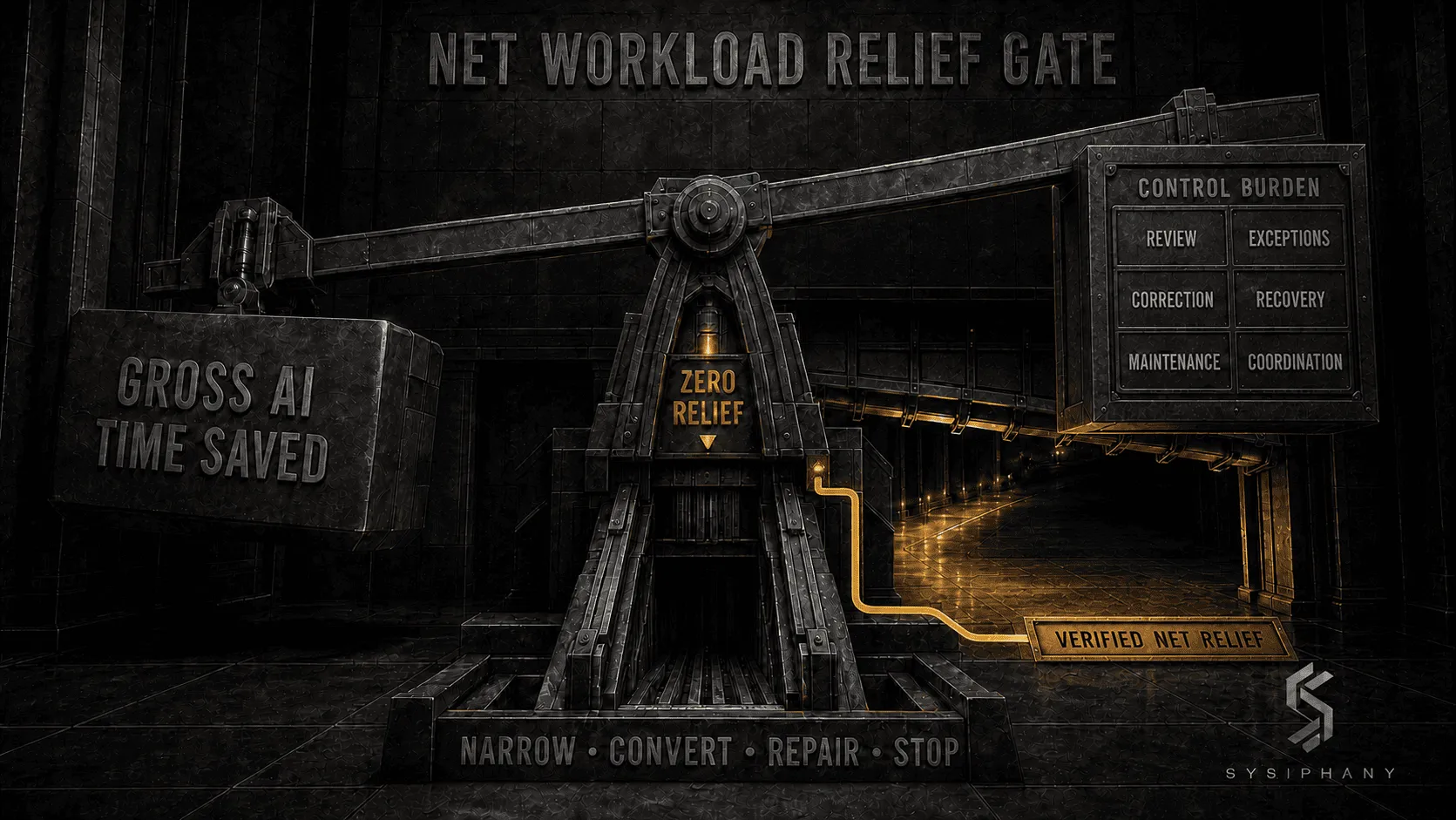
The useful measure is net human workload. Count the time saved, then subtract the review, correction, exception, monitoring, and recovery work the AI use creates. Keep consequential authority with a named person, and make unusual cases visible. Routine outputs do not need permanent manual supervision once their operating boundary has earned trust.
Quick answer: How can you use AI to reduce workload without losing control?
Audit one selected or already running AI-assisted workflow. Compare the manual baseline with the full human effort after AI is added, including review, exceptions, correction, recovery, maintenance, and work returned to the founder.
The evidence will support one of five dispositions. Keep a use case that removes work reliably. Narrow its eligibility when only some cases create relief. Convert stable rules to fixed automation. Repair unclear ownership or inputs before adding AI. Stop when control work consumes the claimed savings.
Control remains intact when the business can see what happened, identify the accountable owner, stop the system, override an output, and recover a failed case.
If you have not chosen a workflow yet, start with AI Automation for Small Business to identify where AI may fit. The audit here begins after one candidate has been selected or one AI-assisted path is already running.
AI speed and workload relief are different measures
AI can shorten production time while moving effort into less visible parts of the workflow.
A weekly update may appear in seconds, yet the operator still checks three systems because no authoritative record exists. A reply draft may be quick, yet a founder reviews every sentence because the output can introduce a price or delivery promise. A document extractor may save typing, yet failed cases arrive without an owner or usable error reason.
Research supports real productivity gains in bounded contexts. In “Experimental evidence on the productivity effects of generative artificial intelligence,” published by Science / American Association for the Advancement of Science (AAAS), 453 college-educated professionals completed midlevel writing tasks in a randomized experiment. Access to ChatGPT reduced average completion time by 40% and increased assessed quality by 18%.
That result is useful and specific. The experiment measured defined writing tasks completed by its study population. A live operation adds review, system updates, exceptions, commitments, and recovery, so the 40% figure cannot be applied to an entire small-business role.
The ledger has to answer a harder question:
How much human work disappeared after the result moved through the real workflow?
The Workload-Control Ledger
A Workload-Control Ledger records the full cost and authority boundary of one recurring unit of work.
Use a unit narrow enough to observe. Replace “manage customer follow-up” with something measurable: “prepare a follow-up draft after a completed service visit using the approved job record.”
| Ledger field | What to record |
|---|---|
| Manual baseline | Typical hands-on minutes before AI and the expected completed outcome |
| AI handling | What the system prepares or performs and how long human setup takes |
| Human review | Minutes spent checking the output and the evidence required to approve it |
| Exceptions | Frequency and handling time for cases outside the normal boundary |
| Correction and recovery | Time spent fixing wrong outputs, failed actions, duplicates, or incomplete records |
| Monitoring and maintenance | Ongoing checks, prompt or rule updates, and source maintenance |
| Founder returns | Cases that still come back to the founder and why |
| Outcome quality | Whether the final result is complete, accurate, timely, and recorded in the right place |
| Decision authority | What AI may prepare or execute and what remains human-owned |
| Net workload removed | Baseline effort minus every new human workload category |
Do not hide elapsed waiting time inside hands-on effort. A workflow can reduce labor while making customers wait longer in an unattended queue. It can also shorten turnaround while consuming the same staff time. Track both.
Calculate net workload reduction
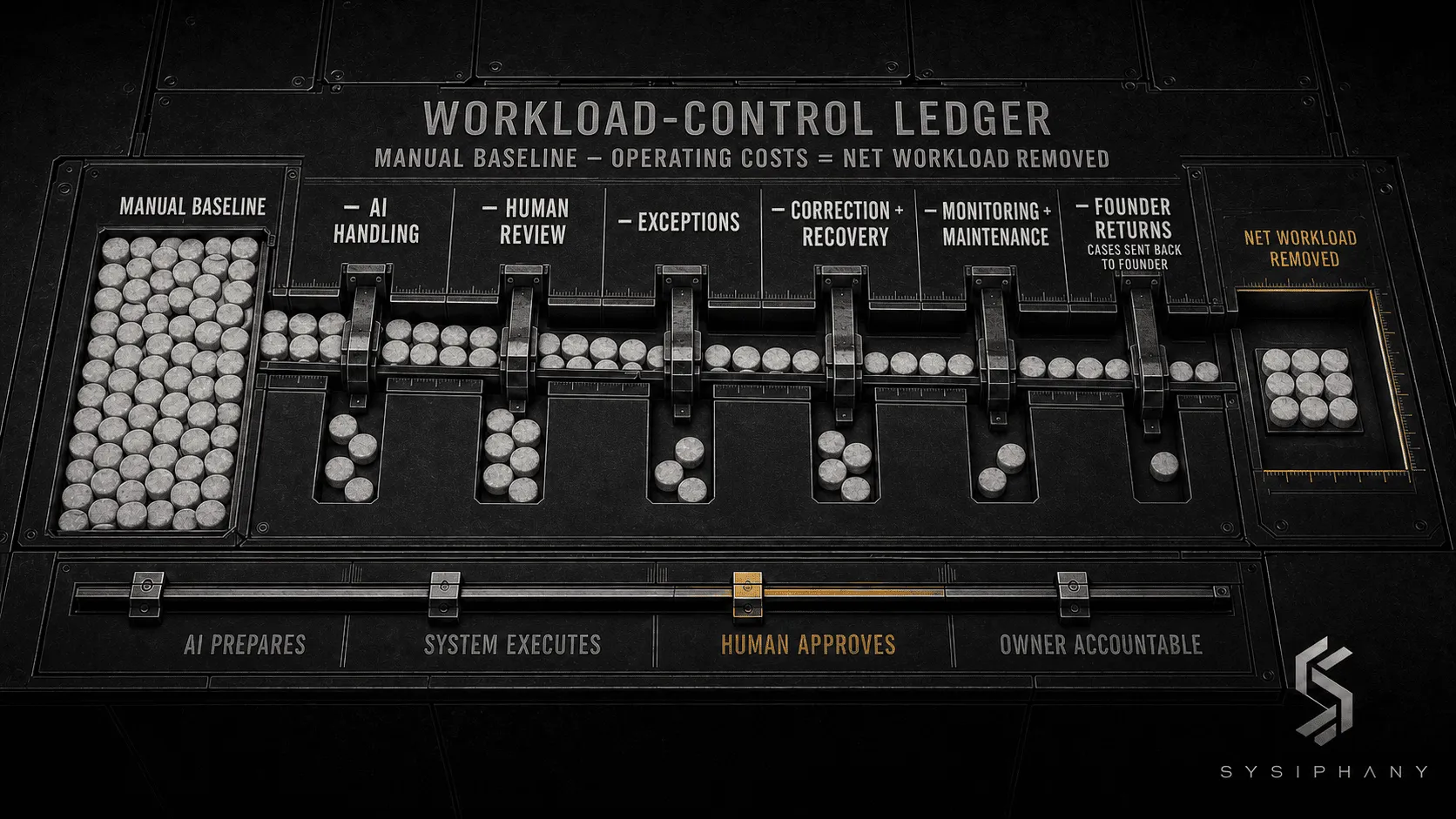
Use the manual baseline as the starting point, then subtract every human burden created by the AI-assisted path.
Net workload reduction = manual baseline − AI setup − human review − exception handling − correction and recovery − monitoring and maintenance − new coordination work
Suppose a person previously spent 22 minutes preparing and recording one standard project update. AI reduces preparation to four minutes. Review takes five minutes, exceptions average three minutes per case, and monitoring plus corrections average two minutes.
After all operating costs, eight minutes remain. Start with the 22-minute manual baseline and subtract four minutes of AI-assisted handling, five minutes of review, three minutes of averaged exception work, and two minutes of monitoring and correction.
That may still be valuable at sufficient volume. It is also honest enough to compare with a simpler rule, a removed step, or a better source record.
Averages can hide the case that matters. Ten easy cases may sit beside one exception that consumes an hour and returns to the founder. Record the exception rate, the longest recovery, and the reason work returns.
Before measurement starts, define the case set and review period. Include at least one complete operating cycle and the exception types the team already knows about. Separate one-time setup from per-case handling, record both the typical case and the worst recovery, and decide in advance what result would justify keeping, narrowing, or stopping the use case.
The six control requirements
Keeping control requires explicit authority, visibility, and recovery. Routine low-consequence outputs can proceed without permanent founder approval once the operating boundary has passed real cases and recovery tests.
A workable control boundary has six parts:
A bounded output
Name what AI may produce. Replace “help with operations” with an enforceable output: “summarize the approved project record and prepare unresolved items for the weekly owner review.”
An authoritative source
State which record the system may use and which source wins when records disagree. If the answer is scattered across email, a spreadsheet, and memory, AI cannot reliably resolve the conflict until the business defines which record has authority. Resolve that first with the source-of-truth guide. Otherwise, the model may turn conflicting records into confident prose without settling which record wins.
Consequence-based authority
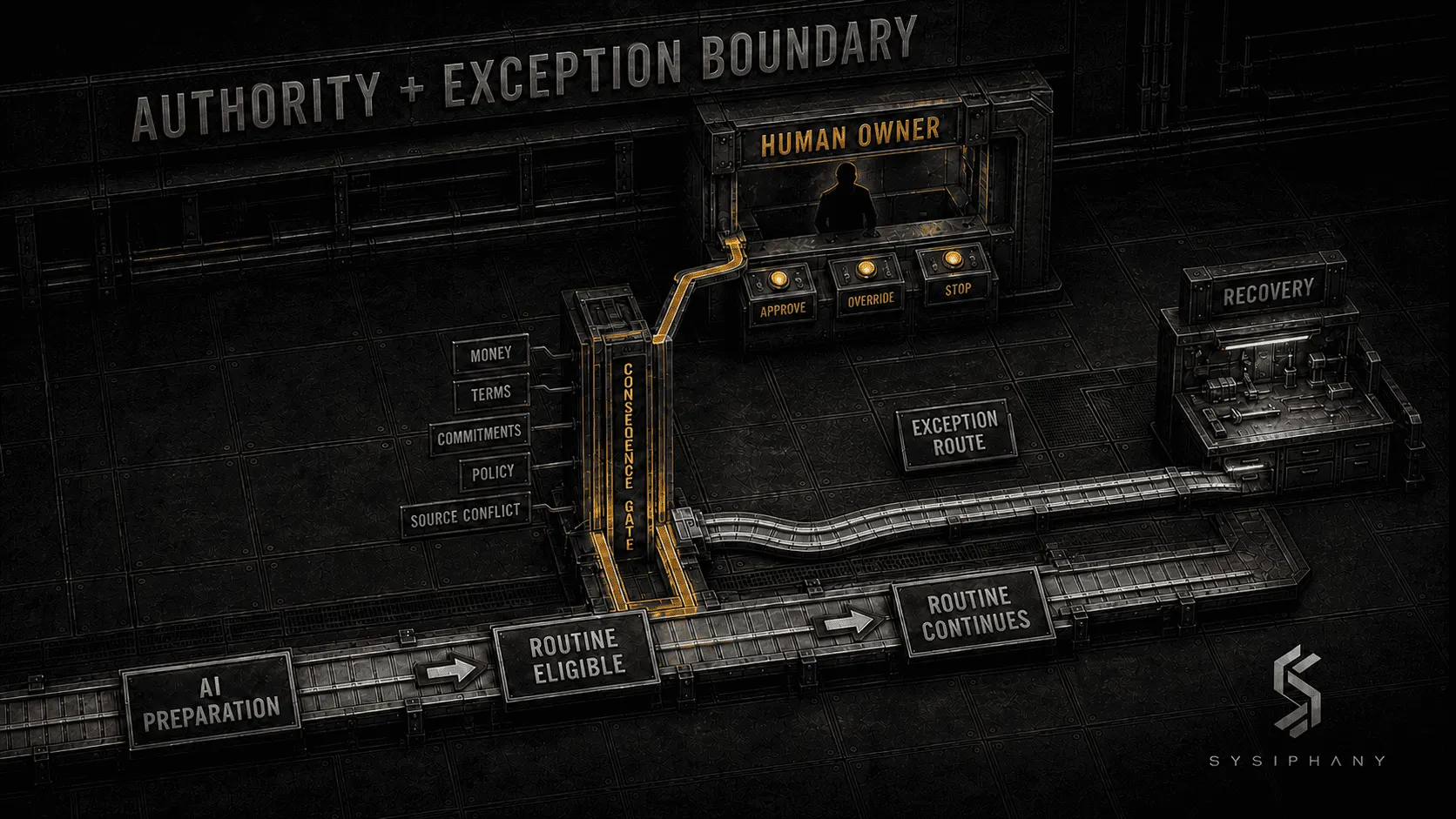
Separate preparation from decisions. AI may assemble evidence, classify an input, compare it with a written rule, summarize history, or draft a response. Unless the business has explicitly delegated limited authority with enforceable controls, a named person should retain decisions involving money, terms, commitments, employment, policy, legal or safety interpretation, sensitive exceptions, and hard-to-reverse record changes.
An exception owner
Give every paused or failed case one role responsible for moving it to the next valid state. An alert channel only announces the work. Assign someone to clear the queue within a defined service expectation.
Evidence and visibility
Preserve enough information to understand the input, source, output, review state, final action, and failure reason. Evidence should scale with consequence. A private first draft needs less than a customer commitment or financial update.
Override, stop, and recovery
The owner must be able to reject an output, stop the use case, correct the authoritative record, and resume or close a failed case without pretending the work completed.
The European Union / EUR-Lex Regulation (EU) 2024/1689 (Artificial Intelligence Act) provides a strong legal example for high-risk AI systems: Articles 14 and 26 address qualified human oversight, monitoring, override or reversal, stop authority, and support for the people assigned to oversight. Those provisions do not automatically govern every ordinary small-business AI task. The practical lesson travels well: the person overseeing a system needs the authority and controls to act when something goes wrong.
For the general architecture connecting triggers, inputs, rules, ownership, exceptions, monitoring, and recovery, use Workflow Automation for Small Business. The ledger here measures whether one such controlled path actually removes human work.
Reduce review without surrendering authority
Move from universal review to review by consequence and exception only after the boundary has earned it.
Begin with universal review for a predefined learning batch. Log why each output needed a change, then group the reasons into failure classes such as missing source data, unsupported requests, commitment language, low-confidence extraction, conflicting records, and out-of-scope cases.
Use those findings to tighten eligibility. Do not move to sampling until the team has named the observed failure classes, confirmed that exceptions pause visibly, and completed at least one recovery test. Record the sampling rate, who reviews the sample, and which event sends the workflow back to universal review. Routine cases may then progress when the source is present, the output is bounded, the action is reversible, and no consequential term changes. Everything else pauses with a visible reason and a named owner.
This preserves authority while reducing habitual review. The reviewer sees the cases that require judgment instead of reconstructing every easy case.
Treat confidence as one signal, never as permission. A confident output can still rely on the wrong source or exceed its authority. Eligibility must also account for source availability, case type, consequence, reversibility, and exception conditions.
For systems that choose actions across several tools, first define permissions, tool access, budgets, and stop conditions in AI Agents for Small Business; then use the ledger here to test whether the controlled system removes work.
Choose a disposition from the ledger
Make the decision from the completed ledger.
| Decision | Evidence |
|---|---|
| Keep | Net workload falls, quality holds, exceptions are owned, and recovery works |
| Narrow | Some cases create relief, but broad eligibility causes excessive review or risk |
| Convert to fixed automation | Valid cases follow stable rules and do not require interpretation |
| Repair the workflow first | Ownership, authoritative inputs, completion criteria, or escalation rules are unclear |
| Stop | Review, correction, recovery, or monitoring consumes the savings, or outcomes remain untrustworthy |
Expand only after enough real cases, including recovered failures, show sustained workload relief.
For the implementation sequence, use How to Automate a Business Process. For candidate selection, use What Business Processes Should I Automate?. The workload decision here starts after one candidate has been chosen or one AI-assisted path is already running.
When the work still returns to the founder
Repeated founder returns show where the workload moved. Record the reason every time. The reviewer may lack decision authority, or an exception threshold may exist only in the founder’s head. Sources may conflict without anyone else empowered to choose. Sometimes the system prepares information while no role owns completion. Customer commitments may exceed the written boundary, recovery may depend on founder memory, or missing evidence may leave the team unwilling to trust the result.
AI may still reduce preparation around those cases. It cannot transfer authority the business has never defined. If those decisions still depend on one person, use Founder Dependency: When You Are the Bottleneck to redesign decision rights, exception authority, relationships, and knowledge transfer.
When the ledger exposes recurring ownership gaps, disputed records, or hidden exception work across several workflows, Download the Operational Drag Diagnostic Kit. Use it to locate the operating drag before adding another AI layer.
FAQ
Can AI reduce workload without automating an entire process?
Yes. AI can reduce a bounded preparation step such as classification, extraction, comparison, summarization, or drafting. The business can retain the final decision and still remove meaningful work, provided review and exception costs do not consume the savings.
How long should I measure an AI-assisted workflow?
Measure enough real volume to include ordinary cases and credible exceptions. A time period is less useful than a representative case set. Record baseline effort before the change, then keep the same definitions while the AI-assisted path runs.
What if reviewing AI output takes as long as doing the work manually?
Narrow or stop the use case. The output may be too broad, the source may be unreliable, or the work may follow rules better handled by fixed automation. Reconstructing every output preserves the old effort under a new label.
Should a human review every AI output?
Review every output initially when the failure classes are unknown, and always review consequential cases. Routine low-consequence work may move to sampling after eligibility rules, evidence, exception routing, and recovery have passed in real operation.
Does human oversight make an AI workflow safe?
Not by itself. The reviewer needs authority, useful evidence, clear thresholds, time to act, and working override and stop controls. A ceremonial approval step can add workload without controlling the result.
How do I know whether AI or fixed automation is better?
Use fixed automation when the valid input, rule, and action are stable. Use AI when inputs vary and interpretation helps produce a bounded, reviewable artifact. If an AI use repeatedly produces the same deterministic decision, convert that portion to a rule.
Is saving employee time the same as reducing headcount?
No. A bounded task-level gain does not establish that a role can be removed. Workload reduction should first improve capacity, turnaround, quality, or resilience. Staffing decisions require a broader view of responsibilities, demand, risk, and service levels.
Reduce the workload, keep the authority
Look at the queues after AI has done its part. If the reviewer, exception owner, and founder still carry the same volume in new forms, the system has simply moved the work.
Keep the use case when the ledger shows less human handling and the people responsible can intervene when needed.
If the workload crosses teams or systems, depends on disputed records, or carries consequential customer, financial, legal, or policy risk, Book a SYSIPHANY discovery call. We will trace where the work travels, who must decide, and how a failed case returns to service before the shortcut adds another operation to supervise.