

A business process bottleneck is the point where work cannot move forward at the pace the rest of the process requires.
It may look like a crowded queue, a delayed approval, a handoff waiting for missing information, a specialist receiving every exception, or a founder pulled back into routine decisions. The most visible frustration is not automatically the bottleneck.
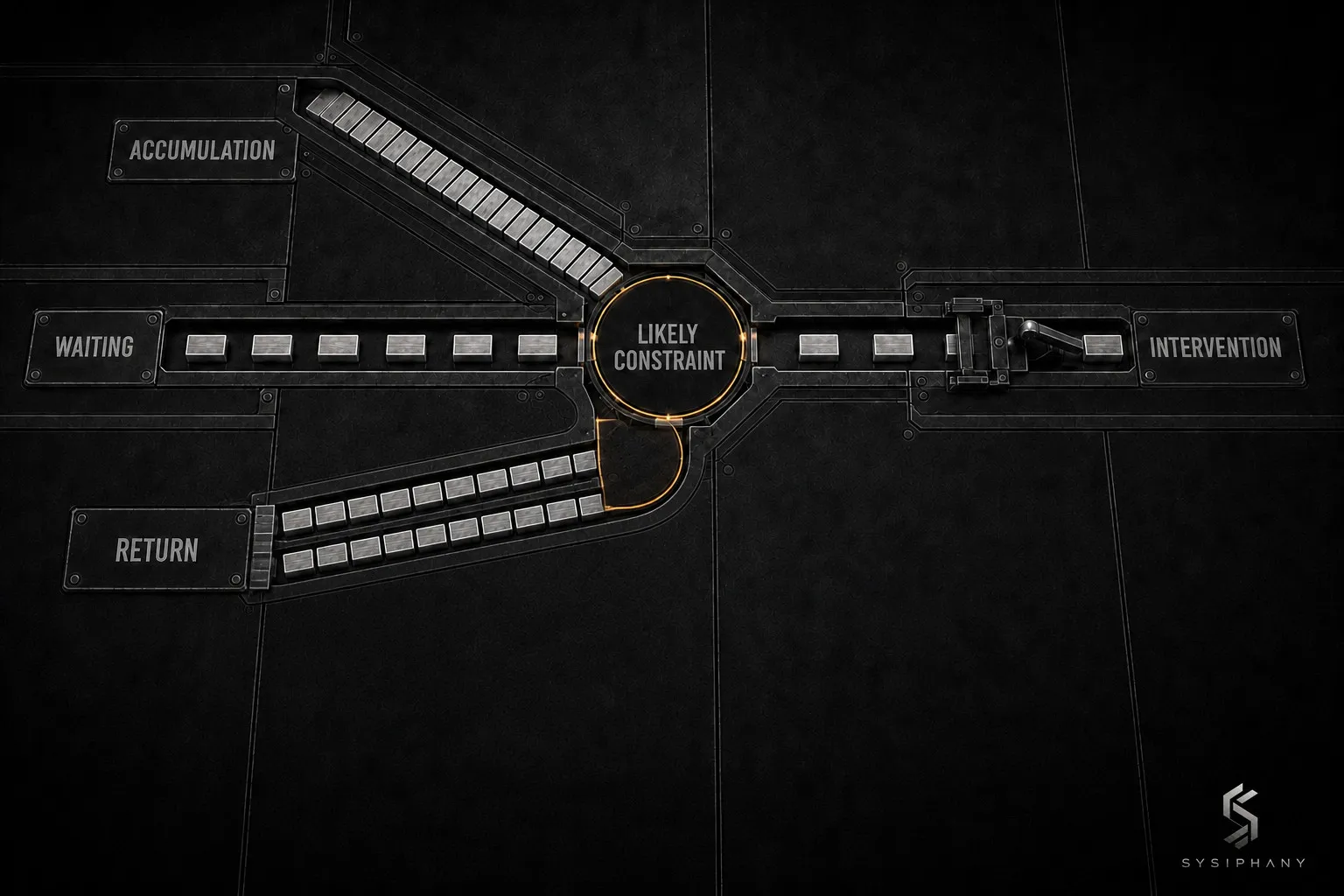
To identify one, trace real work from request to completed outcome. Look for the stage where work waits, accumulates, returns, or repeatedly needs intervention. Treat that stage as a likely constraint to investigate, not as proof that you already know the cause or solution.
Quick answer: How do you identify bottlenecks in a business process?
Choose one process with a clear start and completed outcome. Follow several real pieces of work through the current path, including ordinary cases and cases that stalled.
For each stage, observe four things:
- Where work waits
- Where work accumulates
- Where work returns or is reopened
- Where someone repeatedly has to intervene for work to continue
The stage with the strongest persistent signal is the likely bottleneck. Record what you observed, which cases showed it, and what remains unknown. The next action is to inspect that stage more closely, not immediately add people, automate it, redesign it, or assign blame.
A bottleneck is a constraint in flow. It is not necessarily a person, a software tool, or a root cause.
Start with one process, not the whole business
“Operations are slow” is too broad to diagnose.
Choose one process that begins with a recognizable request and ends with a recognizable completed result. Examples include:
- a customer inquiry becoming a confirmed response;
- a completed job becoming an invoice;
- a purchase request becoming an approved order;
- a new hire becoming ready to work;
- a service issue becoming a resolved customer case.
Keep the first review narrow enough that someone can describe the actual path without inventing an idealized version.
A useful process statement has this form:
When [a defined request or trigger] occurs, work moves through [the current stages] until [a completed outcome] is reached.
For example:
When a service visit is completed, the job record is checked, billing information is prepared, an invoice is reviewed, and the invoice is sent.
Do not begin by rebuilding the workflow or naming the perfect future state. The question here is narrower: where does work currently stop moving?
The Lean Enterprise Institute’s “Value Stream Mapping Overview” describes value-stream mapping as diagramming the material and information flows needed to deliver a product or service. Its current-state-first sequence is useful here: observe how the work actually moves before designing how it should move.
If the team cannot agree on the current steps, sources, or completion point, record that uncertainty. The process may need a usable current-state record before diagnosis can continue. That belongs to the forthcoming article, How to Document a Business Process So Your Team Can Use It, rather than this bottleneck investigation.
What signals reveal where work is constrained?
A bottleneck leaves observable traces in the process: waiting, accumulation, return, and repeated intervention.
| Observable signal | What you can see | What it may indicate |
|---|---|---|
| Waiting | A case sits before the next stage despite being ready to move | The next stage may be unable to accept, decide, verify, or complete it |
| Accumulation | A queue grows in one location while downstream work has less to do | Work may be arriving faster than that stage can release it |
| Return or rework | A case moves forward, then comes back for missing details, correction, or clarification | The stage may be passing incomplete work or relying on an unstated standard |
| Repeated intervention | The same person, role, or channel repeatedly unblocks cases | The process may depend on scarce judgment, approval, information, or authority |
These signals tell you where to look. They do not prove why the constraint exists.
A billing queue, for example, may grow before invoice review. That does not prove the reviewer is underperforming. The queue may contain incomplete job records, disputed pricing, missing customer details, or requests requiring a founder decision. The observed constraint is the review stage. Why work concentrates there remains a diagnostic question.
How do you trace a bottleneck without blaming the busiest person?
Follow real cases through the process and identify the earliest recurring point where work loses its ability to advance.
Choose a small set of completed, delayed, and reopened items. Trace each from its start to its present or final state using the records people actually rely on: the inbox, shared tracker, job system, chat thread, calendar, form, or customer record.
For each case, ask:
- What started the work?
- What happened next?
- What had to be true before the next stage could begin?
- Who or what received it?
- Where did it wait?
- Did it return? If so, why?
- Who had to intervene?
- What counted as complete?
This is not a judgment about whether every step should exist. It is an observation of how work moves now.
A process description that says “the team reviews the request” may hide three different realities. The request may wait for missing information. The reviewer may need a decision they cannot make. Or the review may be complete while nobody accepts responsibility for the next step. All three can feel like “review is slow,” but they are different observed patterns.
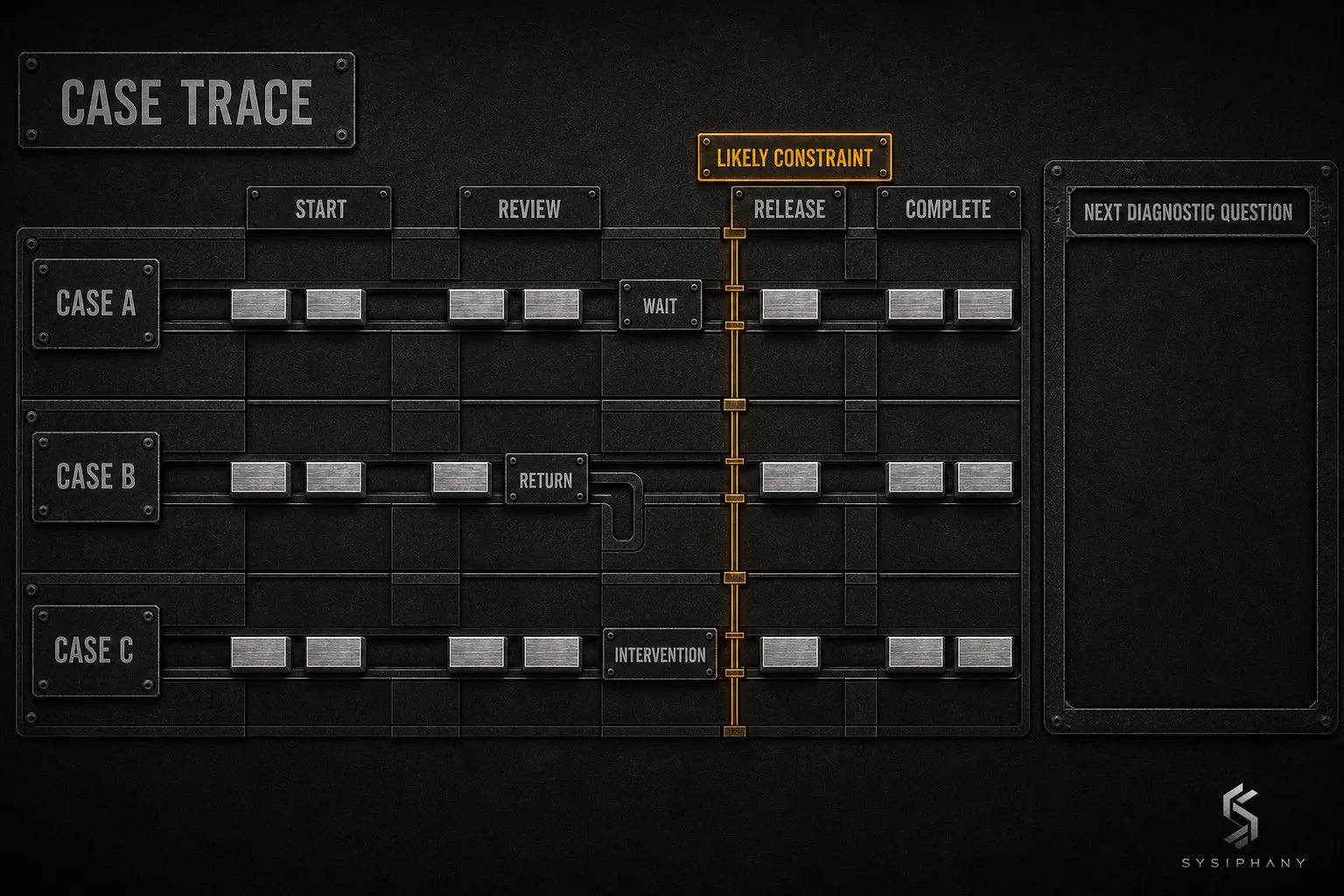
A short case trace keeps the conversation tied to evidence:
| Case | Current or final state | Where it waited or returned | What was needed to move it | Who intervened |
|---|---|---|---|---|
| Customer request A | Completed | Waited before proposal review | Scope clarification | Founder |
| Customer request B | Open | Returned after draft | Missing pricing detail | Sales lead |
| Customer request C | Completed | Waited before send | Approval for a nonstandard term | Founder |
The goal is not a complete performance baseline. It is to notice whether different cases repeatedly collect at the same point and require the same kind of release.
If no visible record shows where cases are, that is a finding: work may be moving through memory, private messages, or informal follow-up. Record the evidence gap rather than pretending the flow is known.
Find the stage where work cannot be released
A likely bottleneck usually has two conditions: work arrives there or waits immediately before it, and work cannot leave consistently without an additional action, decision, clarification, or intervention.
The constraint may sit inside a formal step such as quality review. It can also sit at a boundary, such as the moment a completed job must transfer from service delivery to billing.
Ask across the case traces:
At what point does the process repeatedly lose its ability to move work forward?
That question is more useful than “Who is busy?” A person may have a full day and still release work steadily. Another role may appear less busy while holding the only approval, authoritative information, or specialized judgment that lets cases advance.
Before a decision or approval
Work waits because the person with authority is unavailable, the decision rule is unclear, or many case types go to the same approver.
Next diagnostic action: List the exact decision each delayed case required. Establish whether delay concentrates around one decision type, one authority boundary, or incomplete evidence. The forthcoming decision-rights article owns how to redesign those limits.
At a handoff
Work is declared “sent,” but the next person cannot begin because context, files, instructions, or acceptance conditions are missing.
Next diagnostic action: Compare what the sending stage considered ready with what the receiving stage actually needed. The forthcoming handoff article owns repair of the transfer contract.
At a verification or review stage
Work returns because records are incomplete, outputs vary, or reviewers reconstruct the work before releasing it.
Next diagnostic action: Record the stated reason for each return. Do not conclude that review should be removed or automated. First establish what reviewers repeatedly have to resolve.
At an exception path
Ordinary work moves, but unusual cases collect because nobody can decide, recover, or close them without escalation.
Next diagnostic action: Identify the case types entering the exception path and the role that releases them. The forthcoming exception-management article owns the operating loop that follows.
At an information boundary
Work waits because people cannot determine which record is current, complete, or authoritative.
Next diagnostic action: Record the sources that conflicted in affected cases and which source was ultimately used. The broader governance problem belongs to the source-of-truth guide.
Do not confuse the bottleneck with the loudest problem
The loudest problem is often downstream from the constraint.
Customers may complain about slow replies because proposals wait for scope clarification. Finance may complain about late invoices because completed jobs arrive with incomplete records. A founder may feel buried in messages because exceptions have no defined route until they reach that person.
Each complaint is real. The operational question is where the flow first becomes unable to release work reliably.
Trace backward from the delayed, incomplete, or escalated outcome. Inspect the stage immediately before it and ask what prevented that stage from completing or accepting the work. Continue only until you find the first recurring point where cases begin to wait, accumulate, return, or require intervention.
This establishes a credible place to investigate, not a root cause.
Late customer updates may be visible at the communications stage. A backward trace could show that communications is waiting for reliable project status. The likely constraint then sits at the status handoff, not in writing the customer message. The next question is why status information does not reach communications, not whether the communications person should work faster.
Separate a likely constraint from a root cause
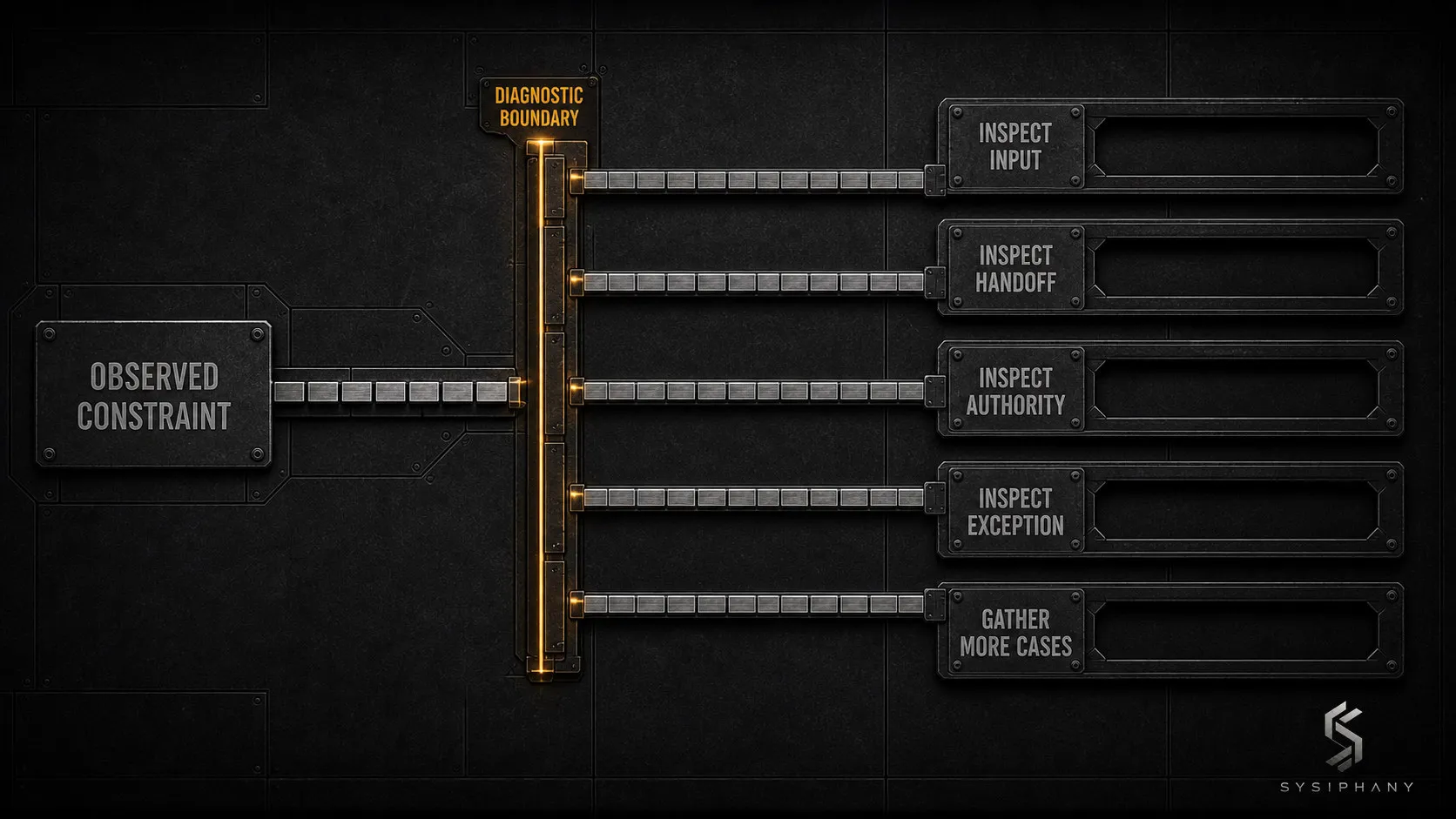
A bottleneck diagnosis should end with a disciplined statement of what is known, what is not known, and what to inspect next.
Use language such as:
Observed constraint: Completed jobs repeatedly wait before invoice preparation.
Evidence: In the reviewed cases, billing could not begin until missing job details were clarified.
Not yet established: Whether the underlying issue is the job record, handoff, decision rule, workload distribution, or something else.
Next diagnostic action: Review return reasons and required information at the delivery-to-billing boundary.
This prevents the first plausible explanation from being mislabeled as the root cause.
“Too many approvals,” “the team needs training,” “we need a new tool,” and “the founder is the bottleneck” may turn out to be true. A queue alone does not earn any of those conclusions. Causal validation belongs to the later root-cause article; this investigation stops at the next fact to verify.
A five-step bottleneck diagnostic
Use this sequence for one process.
1. Name the process and its completed outcome
State what starts the work and what counts as complete. Keep the scope narrow.
Example: “A completed service visit becomes a sent and recorded invoice.”
2. Trace real recent cases
Follow a small set of ordinary, delayed, and returned cases through the actual path. Consult the records and conversations that governed the work.
3. Mark visible flow signals
For each case, note where it waited, accumulated, returned, or required intervention. Leave proposed solutions out of the record.
4. Identify the strongest recurring point of constraint
Look for the stage or boundary where those signals recur and work consistently needs something extra before it can progress.
5. Write the next diagnostic action
State what must be inspected next to distinguish the likely constraint from its cause.
A useful output is short:
The likely constraint is invoice preparation after service completion. Work repeatedly arrives without the details billing needs, so it waits or returns to delivery. Next, inspect the information required at that boundary and the reasons cases return.
That statement is enough to begin a better investigation. It is not a redesign plan.
What should you do after locating the likely bottleneck?
Choose the next diagnostic path from the observed pattern; do not let the constraint automatically select a remedy.
| If you observed… | Your next diagnostic action | Do not jump to… |
|---|---|---|
| A persistent queue before one stage | Inspect what the stage needs to release work and which cases enter it | Hiring or adding a tool |
| Repeated returns for missing information | Review return reasons and information available at the boundary | Blaming the receiving team |
| Founder intervention on recurring cases | Record the decision or exception that returns to the founder | Assuming the founder should simply approve less |
| Conflicting records | Identify which sources disagreed and which record governed the final action | Automating reconciliation |
| A stage that feels slow but shows no repeated signal | Gather more case traces before naming it the bottleneck | Redesigning around an anecdote |
A capacity or hiring decision that spans the business belongs to Scaling Operations Without Adding Headcount. If the question becomes whether this process is suitable for automation, use What Business Processes Should I Automate?. If the process is already clear and approved for implementation, How to Automate a Business Process owns the build sequence.
Locate before you fix
A business can make a bottleneck harder to see by reacting too early.
Another meeting may increase coordination around a delay without releasing work. A new tool can create another place for cases to wait. More headcount may help temporarily while incomplete work continues to reach the constrained stage. Automation may accelerate work into an unresolved queue.
The order matters:
Observe the flow → locate the likely constraint → define what is unknown → choose the next diagnostic action.
That gives the team a shared account of where work is getting stuck before it decides whether the next job is measurement, root-cause analysis, documentation, ownership clarification, handoff repair, redesign, or automation.
When queues, returns, disputed records, and escalations appear across several workflows, Download the Operational Drag Diagnostic Kit. It helps make those operating patterns visible before the business commits to a change.
FAQ
What is a bottleneck in a business process?
A bottleneck is the stage or boundary that limits the process’s ability to move work forward. It often appears as recurring waiting, accumulation, returned work, or repeated intervention. A bottleneck is an observed flow constraint, not automatically the root cause.
Is the busiest person always the bottleneck?
No. A busy person may release work steadily and therefore not constrain overall flow. Trace real cases and look for the point where work repeatedly waits for a particular decision, input, review, or authority before drawing a conclusion about a person.
Can a handoff be a bottleneck?
Yes. A handoff can constrain flow when the receiving stage cannot begin because the transferred work lacks context, required information, a clear owner, or an accepted definition of ready. The bottleneck may sit at the boundary rather than inside either team.
Is a queue always a bottleneck?
No. A short queue can be normal, and a queue alone does not explain its cause. It becomes stronger evidence when work consistently accumulates at the same stage, downstream work waits for it, and cases need repeated additional effort before release.
What is the difference between a bottleneck and a root cause?
A bottleneck is where flow is constrained. A root cause explains why a recurring process problem occurs. Locating the bottleneck tells you where to investigate; it does not prove the cause.
Should I automate a bottleneck?
Not until you understand the observed constraint well enough to know what work would be accelerated. Automation can move incomplete work faster into the same unresolved boundary. Locate the constraint first, then assess automation suitability separately.
How many cases should I trace?
Start with a small mixed set that includes ordinary, delayed, returned, and escalated cases. The exact count matters less than whether the same constraint signal appears across different real cases. If the evidence conflicts, gather more cases instead of forcing a conclusion.
Turn a recurring constraint into an operating decision
If the likely bottleneck crosses teams or systems, depends on disputed records, involves consequential customer or financial decisions, or repeatedly returns to founder judgment, Book a SYSIPHANY discovery call. We will trace where the work loses flow and what must become clear before a remedy is designed.