

AI customer service automation for a small business should begin with triage and preparation, not unrestricted automated replies. Let AI classify messages, retrieve approved information, summarize context, and draft responses. Keep refunds, policy exceptions, customer commitments, repeated failures, and uncertain cases with an authorized person.
The useful design question is not, “Can AI answer this?” It is, “What may the system do with this request, and who owns the result when the normal path breaks?”
Quick answer: How should a small business control AI customer service automation?
Classify each request, assign a permitted AI action, bind the answer to an authoritative source, define the review or escalation trigger, give the receiving queue an owner and response window, preserve the evidence used, and specify recovery before allowing automatic sending.
Intake, classification, retrieval, and drafting are sensible starting actions because they remove preparation work without transferring customer authority. Automatic sending belongs only to narrow request classes where the source is current, the wording cannot create a new commitment, mistakes are easy to detect and reverse, and an owner monitors the result.
This guide assumes you have already selected customer service as the workflow to improve. If you are still deciding which process deserves attention, use What Business Processes Should I Automate?. If you need the general build sequence, How to Automate a Business Process owns that job. If ownership, policy authority, or review capacity is still unclear, use the AI Readiness Assessment before granting customer-facing authority.
This is not a vendor comparison or chatbot setup guide. It defines the operating controls a tool must obey after one service workflow has been selected.
Where does AI help in a customer service workflow?
AI helps most when the input varies but the permitted operating response is clear. It can interpret a message, gather the right context, and prepare the next step faster than a person starting from an empty screen.
The National Bureau of Economic Research working paper “Generative AI at Work” studied the staggered deployment of a conversational assistant across 5,179 customer-support agents. The authors report that access increased issues resolved per hour by 14 percent on average, with larger gains among less-experienced workers. That is evidence for assistance inside a service operation. It is not evidence that the system should own refunds, promises, or exceptions.
Separate the work into three layers:
| Layer | Suitable work | Operating rule |
|---|---|---|
| Deterministic automation | Create a ticket, attach an account record, detect duplicates, route by known product or region, send receipt confirmation | Use fixed rules where the same input should produce the same action |
| AI assistance | Classify free text, summarize history, retrieve approved knowledge, draft a reply, suggest an escalation reason | Treat output as an interpretation that must stay inside defined sources and authority |
| Human judgment | Approve refunds, change terms, resolve policy exceptions, respond to threats or legal claims, repair repeated service failure | Give the case to a person who has the authority and context to own the outcome |
This division matters because a customer service workflow mixes administrative movement with relationship judgment. Buying one “AI support” product does not make those jobs interchangeable.
How should customer requests be classified before automation acts?
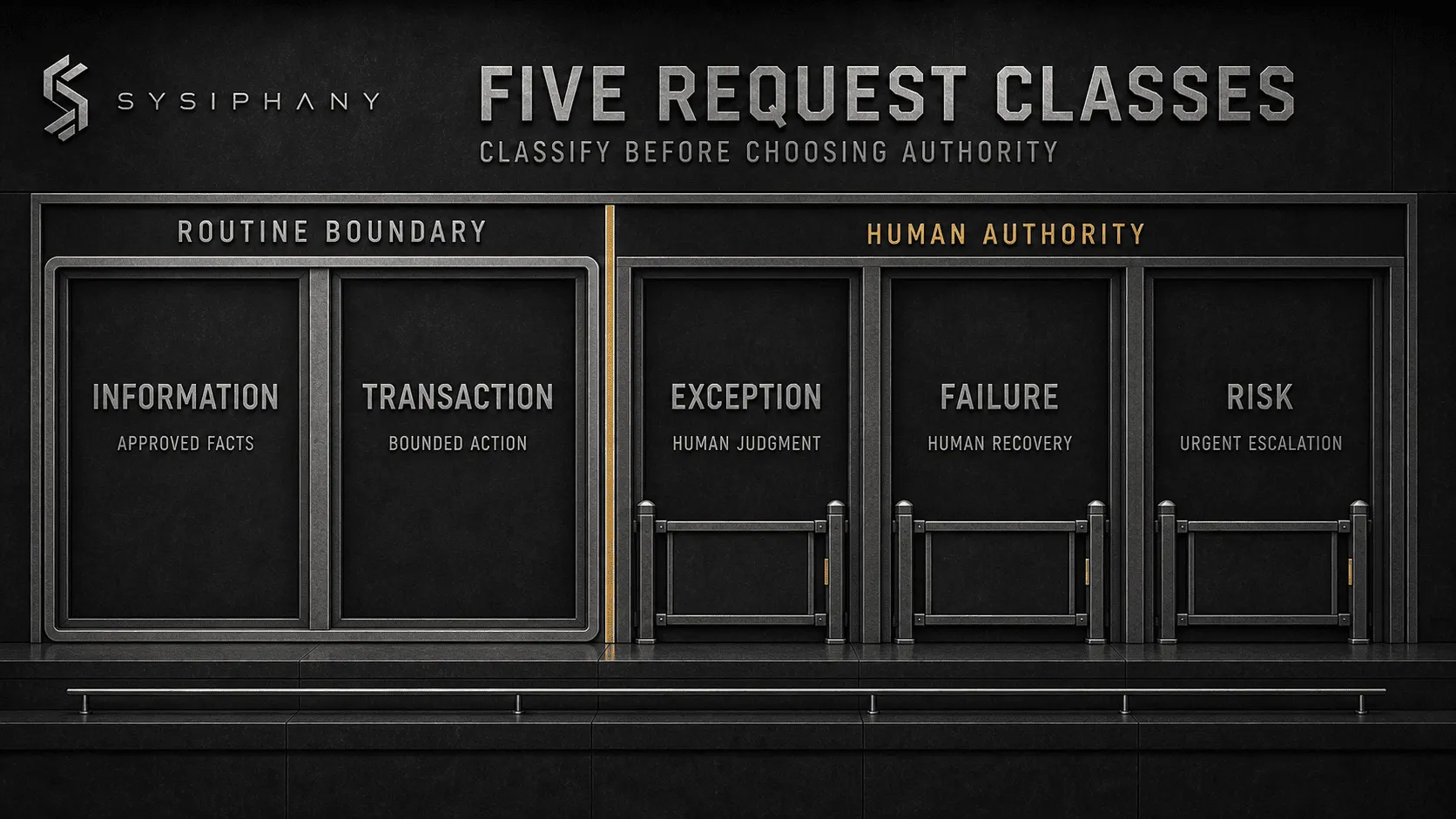
Classify requests by consequence and required authority, not topic alone. “Billing” is too broad: a copy of an invoice is routine; a disputed charge may require investigation; a credit or refund changes money and policy.
Use a request taxonomy that the support owner can maintain:
| Request class | Example | Default AI role | Required human boundary |
|---|---|---|---|
| Factual retrieval | Store hours, shipment status, existing appointment details | Retrieve and prepare or send from an authoritative record | Escalate when records conflict or the request seeks a new promise |
| Guided procedure | Password reset, document submission, standard return steps | Provide the approved procedure and collect required information | Escalate when identity, eligibility, or policy conditions are uncertain |
| Diagnosis | “Why did this fail?” or “Which option fits?” | Summarize evidence and propose troubleshooting steps | Review when diagnosis is uncertain, repeated attempts failed, or harm could result |
| Complaint | Service was late, incomplete, or poor | Acknowledge, summarize, and route with full context | A person owns remedy, tone, commitment, and follow-through |
| Financial request | Refund, credit, charge dispute, changed payment term | Gather the record and prepare a recommendation | Authorized person decides and records the outcome |
| Policy exception | Request outside published terms | Collect facts and identify the governing policy | Decision remains with the named exception owner |
| Sensitive or urgent | Safety issue, legal threat, privacy request, harassment, severe distress | Stop normal handling and route immediately | Specialist or senior owner takes control within a written response window |
Do not depend on sentiment alone. A polite message can contain a serious billing dispute. An angry message can still be a routine status request. Escalation should consider request class, consequence, account context, uncertainty, prior contacts, and known risk indicators.
What should AI be allowed to send without approval?
AI should send a customer-facing response without approval only when the request class, source, wording, and consequence are tightly bounded. “Routine” is not a control. Write the boundary so a support lead and a system administrator would enforce it the same way.
An auto-send rule should answer all of these:
- Which request class is eligible?
- Which authoritative record supplies the answer?
- Which approved response components may be used?
- Which conditions force review instead?
- What system action is prohibited?
- Who monitors sent responses and failed cases?
- How can the business correct the record and contact the customer after an error?
A shipment-status response can be eligible if it quotes the current carrier and order record, makes no new delivery promise, and routes conflicting status to a person. A return request should not auto-approve if eligibility depends on product condition, a special contract, prior credits, or facts the system cannot verify.
Use an authority ladder instead of a yes-or-no automation decision:
- Classify: AI identifies likely intent and confidence.
- Retrieve: AI gathers customer, order, and approved knowledge context.
- Prepare: AI drafts a response or internal recommendation.
- Send: the system communicates externally within a narrow approved class.
- Change: the system updates an account, order, entitlement, or service state.
- Commit: the business promises an outcome, changes money or terms, or accepts risk.
Move up one rung at a time. A workflow that classifies accurately has not earned authority to send. A workflow that drafts useful replies has not earned authority to issue credit.
What belongs in a customer service automation control matrix?
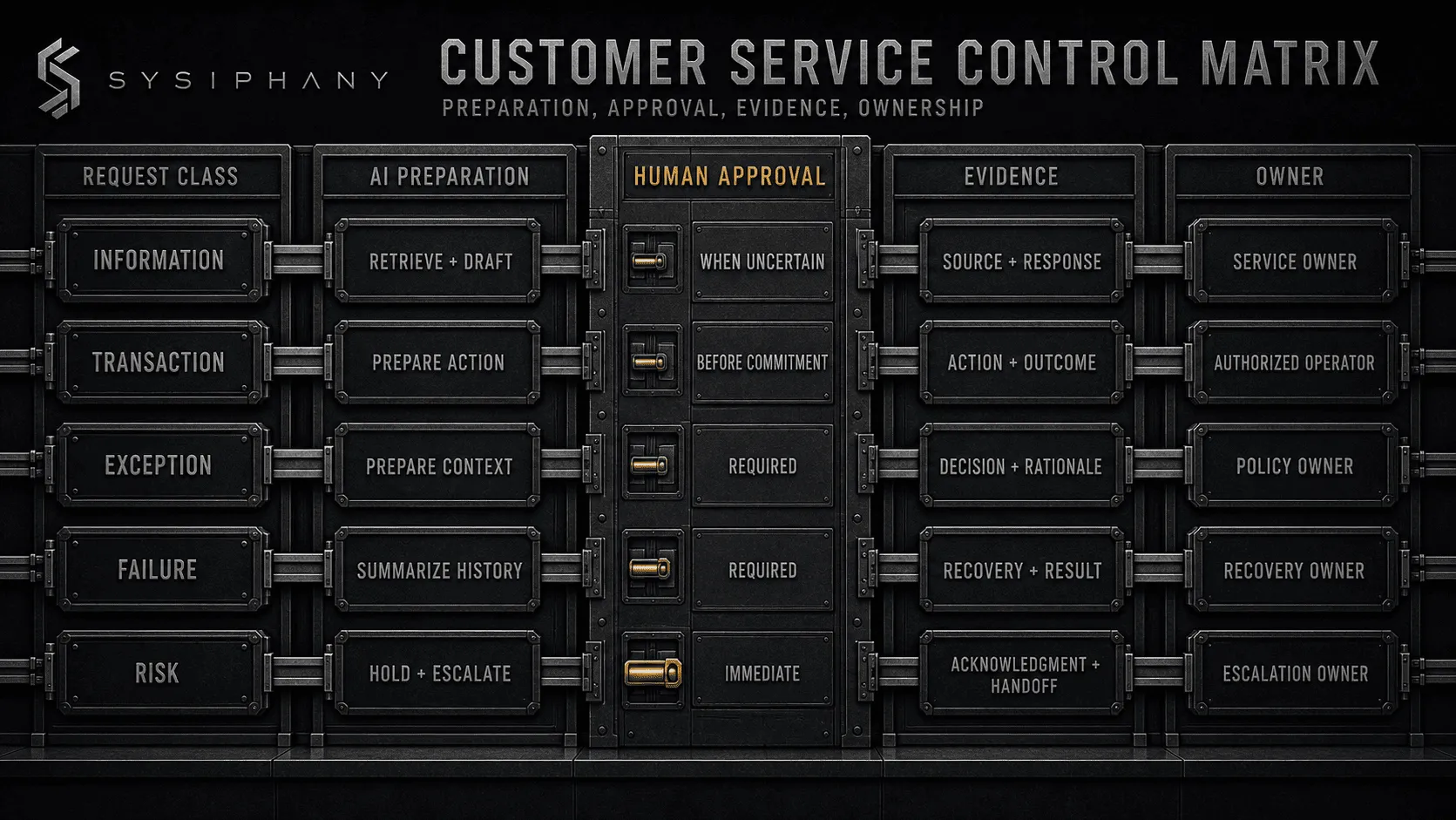
A customer service automation control matrix turns general caution into operating instructions. Build one row for each request class before configuring prompts or integrations.
| Request class | Winning source | Permitted AI action | Review trigger | Owner and response window | Recovery |
|---|---|---|---|---|---|
| Shipment status | Current order record plus current carrier event | Retrieve, compare, draft; auto-send only when records agree and no promise is added | Conflicting status, lost-package indicator, missed promised date, low confidence | Support queue owner; operations backup after two business hours | Stop auto-send, preserve evidence, correct the ticket and customer response |
| Product complaint | Ticket history, order record, approved product and remedy policy | Classify, summarize history, retrieve policy, prepare reply | Repeated contact, safety signal, requested remedy, unclear cause | Senior support owner within one business hour | Review affected cases, correct any bad guidance, record the accepted remedy |
| Refund request | Order, payment, return, and approved exception records | Gather evidence and prepare a recommendation | Every refund decision; missing record; exception request | Authorized financial or service owner within the published service level | No financial action until approval; reconcile payment and ticket after decision |
| Privacy, legal, or safety issue | Original message and the approved specialist procedure | Detect, preserve, acknowledge with approved wording, route | Always | Named specialist immediately, with backup escalation | Stop normal automation, preserve all evidence, identify affected records, follow the specialist response plan |
For any row, also record the trigger, prohibited actions, handoff evidence, definition of done, and the person allowed to change the rule. The shipment-status row, for example, must forbid invented dates, shipping-service changes, and compensation promises; its handoff should carry the customer message, order record, carrier events, prior contacts, draft, and reason for escalation.
The winning source deserves special care. A knowledge article may describe policy while an order record describes the customer’s actual state. The workflow needs to know which source answers which question and what happens when the two disagree. Synchronizing both into an AI tool does not settle the conflict.
Before automating a request class, remove duplicate acknowledgments, redundant queue moves, unnecessary approvals, and status messages nobody uses. A cleaner service path needs fewer controls and creates fewer places for a customer to disappear.
If your support team cannot agree on those fields, pause configuration. The Operational Audit Before AI Implementation will be more useful than another vendor demo.
How should escalation and human handoff work?
Escalation works only when the next person receives ownership, enough context to act, and a deadline. Moving a ticket into a queue is routing. It is not accountability.
Every escalation path needs:
- a primary owner or role;
- a backup owner if the first does not respond;
- a response window based on consequence;
- the reason the system stopped;
- the original customer message;
- the relevant account, order, policy, and prior-contact context;
- actions already taken;
- the draft or recommendation, clearly labeled as unapproved;
- a resumption rule after the person decides.
The system should never treat reviewer silence as approval. At timeout, it should reassign, alert a named backup, or preserve the case in an unresolved state. It should not send the draft simply because a service-level clock expired.
A useful escalation matrix combines consequence with uncertainty:
| Condition | Route | Response expectation |
|---|---|---|
| Known request, trusted source, no commitment | Routine queue or bounded auto-response | Normal service level |
| Low confidence or missing information | Human review queue | Review before any substantive response |
| Repeated contact or failed prior resolution | Senior support owner | Review full history and own the next commitment |
| Refund, credit, changed term, or policy exception | Authorized decision owner | Decision recorded before communication |
| Safety, legal, privacy, or severe relationship risk | Urgent specialist route | Immediate acknowledgment under approved wording; substantive response stays human-owned |
This is where small teams often expose founder dependency. Every unusual case returns to the founder because only the founder knows what the company is willing to promise. The long-term repair is to make the decision thresholds, examples, and authority visible. Automating the handoff without extracting that judgment only makes the founder’s queue fill faster.
How do you keep the knowledge AI uses accurate?
Give the system a small, governed body of approved knowledge with an owner and review date. Do not treat the entire shared drive, inbox history, and chat archive as one helpful knowledge base.
For each source, record:
- the questions it is allowed to answer;
- the system or document that wins when facts conflict;
- the content owner;
- the approval date and next review date;
- which customer segments, products, regions, or contract versions it covers;
- which statements are informational and which could create a commitment.
Expired knowledge should fail closed. If the policy is past its review date or the account record conflicts with the general article, the workflow should request human review rather than blend the sources into a plausible answer.
The same applies to customer history. A model-generated summary can reduce reading time, but the underlying ticket and account records remain the evidence. For a deeper treatment of competing records, see Why Your Tech Stack Has No Source of Truth.
How should a small business test AI customer service automation?
Test one request class in shadow mode before AI communicates with customers. Let the system classify, retrieve, and draft while the team handles the case normally. Compare the proposed route, evidence, and reply with the actual resolution.
The full pilot and rollout method belongs in How to Automate a Business Process. For customer service, the promotion gate should concentrate on the failures that reach a customer or strand a case:
- classification accuracy by request class, not one blended average;
- missed escalation for refunds, complaints, repeated failures, privacy, legal, and safety cases;
- unsupported commitments per customer-facing response;
- wrong-customer, wrong-order, or wrong-policy retrieval;
- material edits to AI drafts;
- repeat-contact and reopen rates;
- queue acceptance and timeout rates;
- correction and recovery time.
A draft is not ready for automatic sending because agents accept it often. It is ready only when the eligible request class has a trusted source, no missed consequential escalations in the test set, no unsupported commitments, acceptable correction rates set by the service owner, and a proven rollback path.
Picture one ticket. A customer asks where an order is. The system retrieves a delayed carrier event and drafts a routine status reply. Then it sees that the business already promised delivery yesterday and that this is the customer’s third contact. The case is no longer routine. The correct result is a senior owner receiving the history, broken promise, draft, and response deadline—not a faster fourth status message.
Do not measure deflection alone. A customer who gives up is not a resolved case. A fast answer that causes a second contact increased workload.
How should quality assurance work after launch?
Quality assurance should sample the cases most likely to hide customer harm, stop automation when a written threshold is crossed, and feed defects back into the request taxonomy, knowledge sources, and exclusion rules. A dashboard without a named QA owner is only a record of drift.
| QA control | Owner | Evidence | Stop condition | Corrective action |
|---|---|---|---|---|
| Mandatory case review | Support lead | Every refund, exception, repeated failure, privacy, legal, and safety case | Any such case bypasses the required human route | Disable the affected route, review exposed cases, repair the rule and test set |
| Routine sample | QA owner or rotating senior agent | Weekly sample by request class, channel, and customer segment | Error or material-edit rate exceeds the owner’s written limit | Increase review, correct source or wording, retrain staff, narrow eligibility |
| Escalation audit | Queue owner | Missed escalations, queue age, timeouts, reassignments | Consequential miss or unowned case; repeated SLA breach | Stop auto-send for the class, assign backup ownership, repair handoff logic |
| Knowledge regression | Content owner | Tests tied to every changed policy, source, prompt, model, or integration | Wrong source, unsupported statement, expired policy, or inconsistent result | Roll back the change and reapprove the source and test cases |
| Customer recovery review | Service owner | Affected cases, corrections sent, records repaired, root cause | The team cannot identify who received incorrect information or prove correction | Keep the route disabled and investigate from preserved evidence |
Choose the sample size and thresholds before launch, based on volume and consequence. Review every high-consequence class. For routine classes, sample often enough to catch change between policy reviews; low volume may justify checking every case. The denominator matters: “two missed escalations” means something different out of twenty eligible cases than out of twenty thousand.
After a taxonomy, policy, prompt, model, or integration changes, rerun a fixed regression set that includes normal cases, exclusions, conflicting records, repeated contacts, and prior defects. The support owner—not the model vendor—authorizes re-promotion after rollback.
What are the failure modes to plan for?
Plan for operational failures, not only inaccurate wording.
Wrong request class. A complaint is treated as a status request, or a privacy request is buried in a long message. Recovery must reclassify the case, alert the right owner, identify other cases processed by the same faulty rule, and review anything already sent.
Correct class, wrong customer context. The answer comes from the wrong account, order, contract, region, or product version. Identity and record matching need deterministic checks before AI interprets the content.
Stale knowledge. The workflow cites an expired policy or superseded procedure. Stop customer-facing use when the source expires.
Unsupported commitment. A helpful draft invents a date, remedy, eligibility decision, or refund expectation. Commitment language should trigger review even when the rest of the answer is routine.
Partial action. The message is sent but the ticket is not updated, or a task is created without an owner. Define done across every required system state.
Queue abandonment. The automation escalates correctly, but nobody accepts the case. Monitor unassigned age, not merely escalation count.
Automation loop. A customer reply triggers another canned response without recognizing that the prior answer failed. Repeated contact should increase human ownership, not increase automated volume.
No recovery evidence. The team knows something went wrong but cannot reconstruct the source, draft, system actions, or approval state. Preserve the evidence needed to correct the customer and the record.
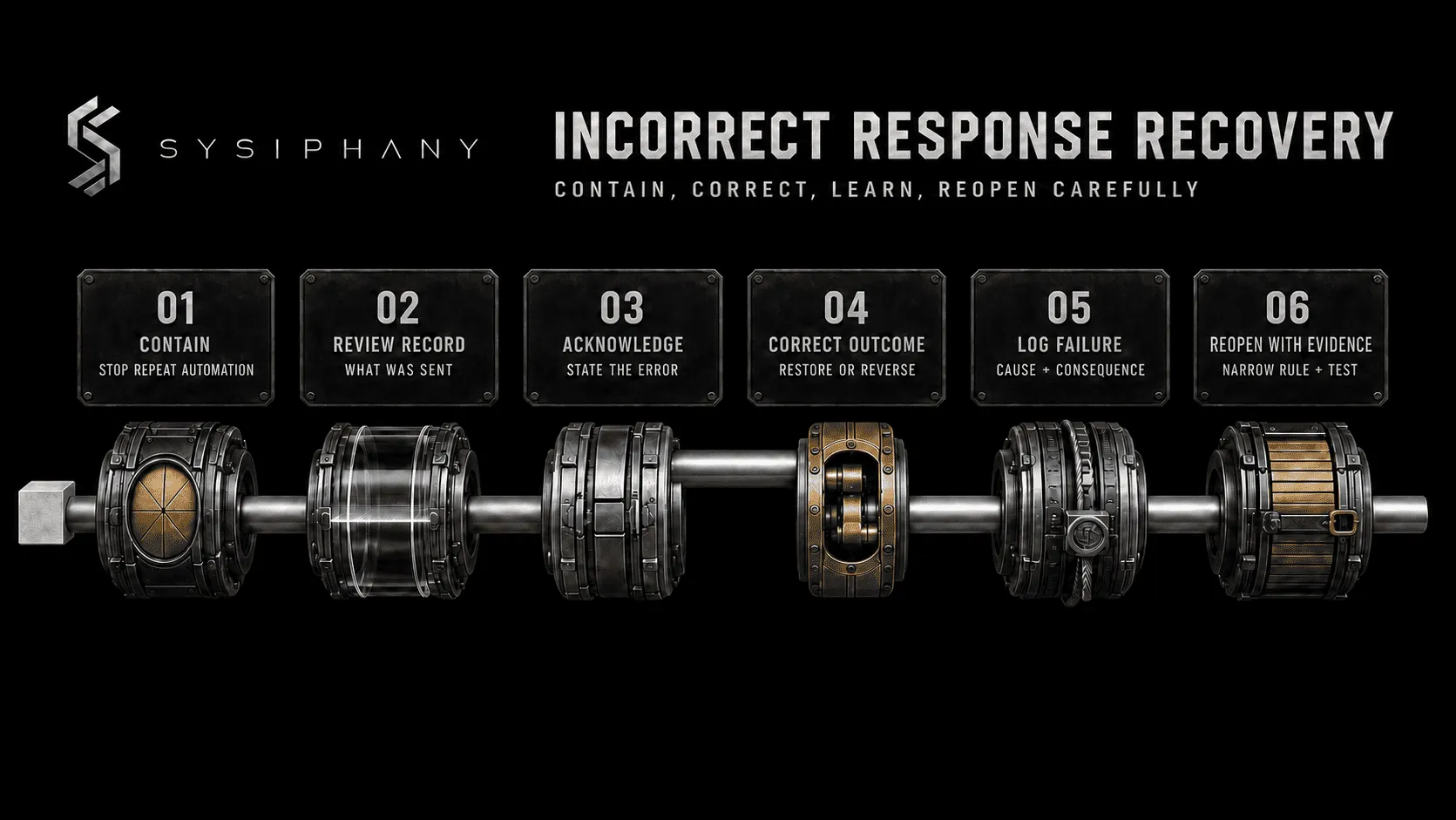
When an incorrect response reaches a customer, stop the affected auto-send route first. Preserve the source material, generated response, system actions, and approval state. Identify every case exposed to the same defect, correct the underlying records, contact affected customers with an accurate explanation, and repair the rule or knowledge source. Reactivate only after the fixed cases pass regression review and the service owner records approval.
The general workflow architecture for monitoring and recovery belongs in Workflow Automation for Small Business. Customer service adds one constraint: recovery may require repairing trust, not only restoring system state.
When should a small business avoid automating the customer response?
Avoid automated substantive responses when the business cannot verify the customer, trust the source, define the authority, or reverse the consequence.
Keep the response human-owned when:
- the customer asks for money, changed terms, eligibility, or an exception;
- the issue involves safety, legal exposure, privacy, harassment, or severe distress;
- records disagree;
- the customer has contacted the business repeatedly about the same unresolved issue;
- the response could be understood as a promise;
- the case depends on undocumented founder judgment;
- nobody owns the escalation queue;
- the business cannot audit what the system used or did.
AI can still prepare these cases. It can assemble the history, retrieve the policy, summarize the dispute, and draft options. Preparation removes work while the accountable decision remains where it belongs.
If the system needs to choose actions across several tools, read AI Agents for Small Business before granting broader permissions. Agentic capability does not change the customer-service authority boundary.
A practical first move
Choose one high-volume request class and build its control-matrix row. Do not begin with the worst complaint or the broadest inbox.
Use a class where the winning source is known, the normal answer creates no new commitment, and a mistake can be corrected without material harm. Run classification and drafting in shadow mode. Count the review work and repeat contacts. Expand only when the operation improves after oversight is included.
If customer service problems span disputed records, unclear ownership, and founder-only exception judgment, locate the operating gap before another tool is added. Download the Operational Drag Diagnostic Kit to structure that first review.
FAQ
Can a small business let AI answer customer emails automatically?
Yes, but only for narrow request classes grounded in a current authoritative record and approved response policy. Start with classification and drafting. Auto-send after the business has measured accuracy, written exclusion rules, assigned an owner, and built a correction path. Refunds, exceptions, commitments, disputed records, and uncertain cases should pause for human review.
Is a chatbot the same as customer service automation?
No. A chatbot is one customer-facing channel. Customer service automation also includes email and form intake, ticket creation, classification, routing, knowledge retrieval, account lookup, drafting, review, escalation, follow-up, quality assurance, and recovery. The planned chatbot guide will address website conversation boundaries specifically.
Should customer service automation use sentiment analysis?
Sentiment can support prioritization, but it should not control escalation by itself. Combine it with issue class, consequence, customer context, uncertainty, prior failed contacts, and explicit risk indicators. A calm message can be high risk, and an angry message can still be routine.
What should a business do after an AI response gives a customer incorrect information?
Stop the affected automated route, preserve the evidence, identify every case exposed to the same defect, correct the customer and authoritative record, and repair the operating cause. Do not reactivate the route until the fixed cases pass regression testing and the service owner approves it.
How often should approved customer service knowledge be reviewed?
Set the review interval according to how often the policy, product, price, or procedure changes, and review immediately after any material change or observed defect. Every source needs an owner, approval date, next review date, and expiration behavior. Once expired, it should no longer support an automatic customer response.
Bring one customer service workflow into review
If the workflow crosses several channels, systems, policies, or approval owners, bring one request class into review. Book a SYSIPHANY discovery call. We will map the authority boundary, handoff, evidence, and pilot gate before discussing platforms.
A reliable customer service system does not remove people from every conversation. It removes preventable preparation and routing work so people can own the moments where the business is making a decision, a promise, or a repair.