Most founders reach for headcount too early.
Not because they are careless.
Because the business feels heavy, the team is tired, and hiring looks like the most obvious way to relieve pressure.
There are more clients to serve. More details to track. More messages to answer. More handoffs to manage. More exceptions to interpret. The founder looks at the team and sees people working hard, but the work still does not move cleanly.
So the question appears:
Do we need another person?
Sometimes the answer is yes.
But sometimes the business does not have a capacity problem. It has operational drag.
For the broader operating-system view, read Operational Drag Is the Hidden Cost of Scaling.
What is scaling operations without adding headcount?
Scaling operations without adding headcount means increasing the business’s capacity by improving workflows, ownership, handoffs, tools, and decision rules before hiring more people.
It is not about squeezing more work out of the same team.
That is how good people burn out.
It is about removing the avoidable friction that makes normal work heavier than it needs to be.
Quick answer
Before hiring more people, inspect whether the team is overloaded by true workload or by operational drag created through unclear ownership, manual coordination, duplicated work, weak handoffs, and founder dependency.
If the work is genuinely too much, hire.
If the work is unclear, duplicated, or constantly re-clarified, fix the operating system first.
How do you know if you need systems before headcount?
You need systems before headcount when the team is busy because work is unclear, duplicated, delayed, rechecked, or routed through the founder instead of moving through a reliable operating model.
The fastest clue is repetition.
The same questions keep coming back.
The same handoffs keep breaking.
The same status updates happen in multiple places.
The same approvals land on the founder’s desk.
The same client issues require someone to reconstruct what happened.
That is not always a staffing gap.
It may be a system failing to carry enough of the work.
Hiring into that environment can help for a while, but it rarely creates clean scale. The new person enters the same unclear workflow, asks the same questions, depends on the same tribal knowledge, and adds another communication path the business has to manage.
Capacity improves for a moment.
Then the drag returns.
Should you hire or fix operations first?
You should fix operations before hiring when the team is overloaded by unclear workflows, duplicated work, manual coordination, tool confusion, or founder-dependent decisions.
Hiring makes sense when volume has outgrown a clear system.
It gets expensive when the system itself is unclear.
Before posting the job description, ask what kind of pressure the team is actually feeling. If the bottleneck is real work volume, headcount may be the right move. If the bottleneck is rework, unclear ownership, manual checking, tool confusion, or repeated approval loops, the business may need operational clarity before another person enters the system.
The point is not to avoid hiring.
The point is to hire into clarity.
Why hiring does not always fix operational drag
Hiring does not fix operational drag because adding people increases coordination unless the company has clear workflows, ownership, decision rights, and sources of truth.
A new employee can add skill, energy, and availability.
They can also add more handoffs, more training needs, more status updates, more questions, and more places for information to split.
That does not mean hiring is wrong.
It means hiring is not a substitute for operational clarity.
If the team already knows where work lives, who owns each step, what “done” means, and which system holds the truth, headcount can create leverage.
If those things are unclear, headcount often creates a larger version of the same problem.
More people.
Same drag.
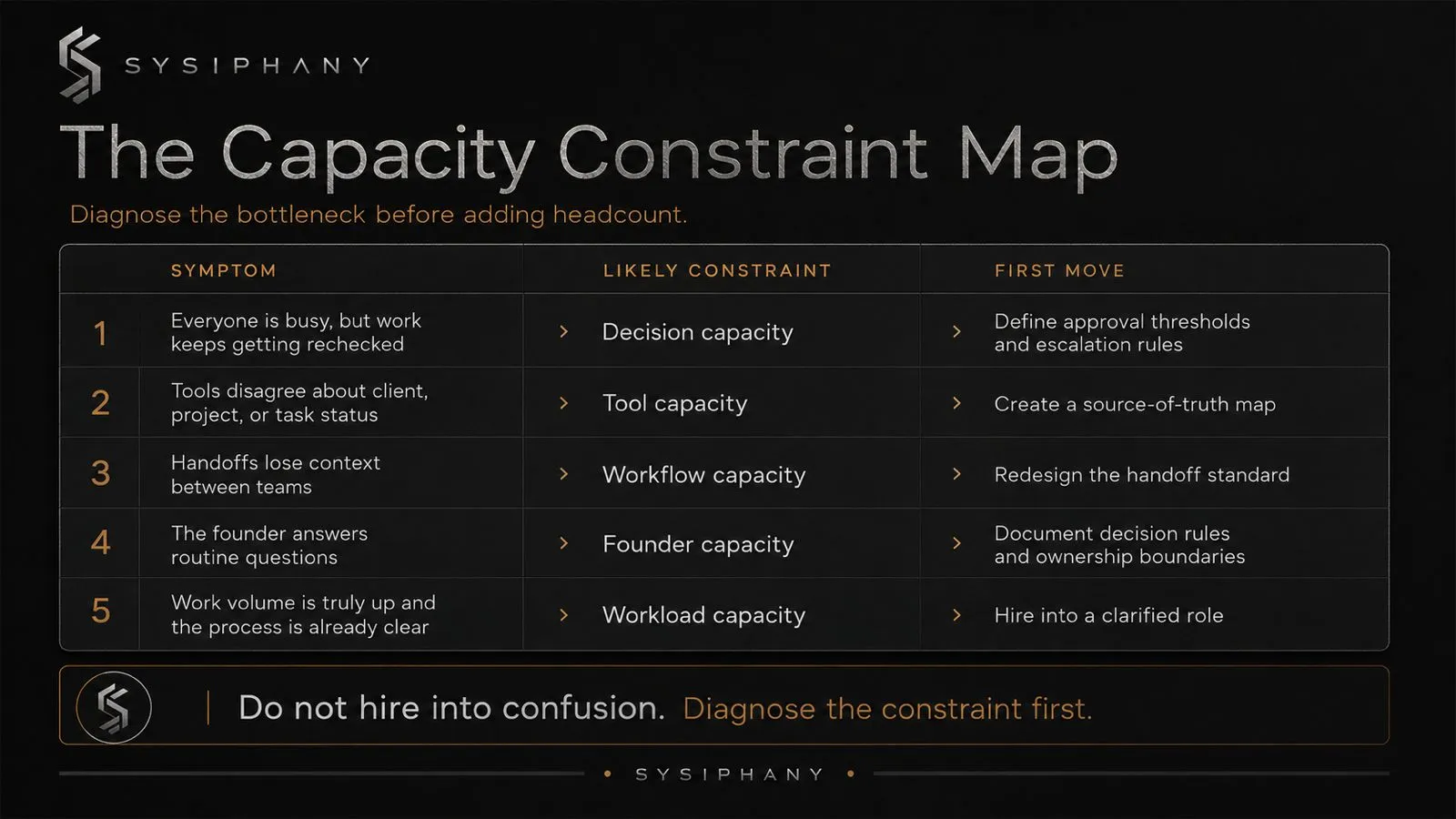
What kind of capacity problem do you actually have?
Not all capacity problems are the same, and each type needs a different fix.
| Symptom | Likely Constraint | First Move |
|---|---|---|
| Everyone is busy, but work keeps getting rechecked | Decision capacity | Define approval thresholds and escalation rules |
| Tools disagree about client, project, or task status | Tool capacity | Create a source-of-truth map |
| Handoffs lose context between teams | Workflow capacity | Redesign the handoff standard |
| The founder answers routine questions | Founder capacity | Document decision rules and ownership boundaries |
| Work volume is truly up and the process is already clear | Workload capacity | Hire into a clarified role |
1. True workload capacity
The team has too much legitimate work for the number of people available.
Clients are being served. Revenue-producing work is growing. The process is clear, but the volume has outgrown the team.
This is the cleanest case for hiring.
If the workflow is stable and the team knows how to train someone into it, headcount may be the right move.
2. Workflow capacity
The team is busy because work moves through too many steps, tools, approvals, or handoffs.
The work itself may not be excessive. The path is.
This is where process mapping helps. Not a theatrical wall of sticky notes. A simple look at how work actually moves from request to completion, including the informal workarounds people use to survive the day.
If a task passes through five people when two would do, hiring the sixth person is not scale.
It is avoidance.
3. Decision capacity
The team is waiting because too many decisions require founder judgment or senior approval.
This looks like a people problem from the outside. Inside the business, it feels like caution.
Nobody wants to be wrong. So they ask.
A client email needs review. A scope exception needs approval. A deadline needs interpretation. A pricing question needs a founder call.
The fix is not telling people to “take ownership.”
The fix is defining ownership.
What can they decide?
What needs review?
What must escalate?
What source of truth wins?
What risk thresholds matter?
Decision capacity improves when judgment becomes visible enough for the team to use.
4. Tool capacity
The team spends too much time reconciling tools instead of doing the work.
The CRM says one thing. The project board says another. Slack has the context. A spreadsheet has the real status. Someone keeps a backup tracker because nobody fully trusts the official system.
That is not a headcount problem first.
It is source-of-truth friction.
If your tools are creating more doubt than clarity, adding another person gives the business one more person to reconcile the stack.
For a deeper breakdown, read Your Tech Stack Isn’t the Problem. Your Source of Truth Is..
5. Founder capacity
The founder is still the router, interpreter, reviewer, and institutional memory for routine work.
This is the most common capacity ceiling in founder-led SMBs.
The team may be capable. The tools may be decent. The process may exist.
But the founder still knows how the business really works.
That knowledge has to move into the operating system before the company can scale cleanly.
What is operational capacity?
Operational capacity is the amount of work a business can reliably handle without depending on heroic effort, repeated clarification, or one person holding the system together.
Capacity is not just hours.
It is clarity.
A team with clear workflows, clean ownership, and trusted systems can handle more work with less noise. A larger team with unclear systems may handle less work than expected because so much effort goes into coordination.
That is why capacity should not be measured only by how busy people are.
Busy is not the same as effective.
Busy can be a sign that the system is asking humans to compensate for unclear architecture.
How do you find hidden capacity inside the business?
You find hidden capacity by identifying where work is duplicated, delayed, over-coordinated, manually reconciled, or escalated unnecessarily.
Start with the work that feels heavier than it should.
Not the whole company.
One recurring bottleneck.
Pick the place where people keep asking for updates, waiting for approval, checking multiple tools, or routing normal decisions back to the founder.
Then ask:
- What work is being repeated?
- What decision is being delayed?
- What information has to be checked manually?
- What handoff loses context?
- What approval exists because nobody trusts the rule?
- What tool is being updated only because it was once important?
- What would happen if this step disappeared?
The goal is not to make the team faster by pressure.
The goal is to remove work that should not exist.
Some capacity is created by hiring.
Some capacity is created by subtraction.
SYSIPHANY usually starts with subtraction.
What should you do before hiring another operator?
Before hiring another operator, map the workflow, identify the source of delay, clarify ownership, remove duplicated work, and decide whether the bottleneck is volume, process, tools, decisions, or founder dependency.
This is the practical sequence.
1. Map the actual workflow
Do not start with the official SOP.
Start with the real path.
How does work enter the business?
Where does it get assigned?
Where does it wait?
Who touches it?
What tool holds the status?
Where does the founder get pulled in?
What happens when the work does not fit the standard path?
The real workflow is where the truth lives.
2. Mark every handoff
Handoffs are where capacity often disappears.
Sales to delivery.
Delivery to finance.
Support to operations.
Founder to team.
Team to client.
Tool to tool.
A handoff should carry enough context for the next person to act.
If every handoff requires a follow-up message, the handoff is not finished. It is just transferred confusion.
3. Identify repeated founder judgment
Look for decisions that keep coming back to the founder.
Not the strategic ones. Those should come back.
Look for the routine ones.
Client email approvals. Small discount requests. Delivery exceptions. Timeline changes. Priority calls. Scope questions. Tool conflicts.
Every repeated decision is a candidate for a threshold, rule, checklist, or escalation standard.
4. Remove low-value coordination
Coordination is useful when it creates alignment.
It becomes drag when it compensates for unclear systems.
Status meetings, manual reminders, repeated check-ins, and “just making sure” messages often reveal something the system should already make visible.
Do not attack the meeting first.
Find the uncertainty that made the meeting necessary.
5. Decide what kind of help you actually need
After the drag is visible, the hiring decision gets clearer.
You may need an operator.
You may need a project manager.
You may need a fractional systems lead.
You may need a workflow redesign.
You may need a source-of-truth cleanup.
You may need a simple automation.
You may need to stop doing work that no longer earns its place.
The point is not to avoid hiring.
The point is to hire into clarity.
Why “just hire someone” can get expensive
“Just hire someone” sounds practical until the new person inherits an unclear system.
Then the cost becomes bigger than payroll.
Someone has to train them. Someone has to answer edge cases. Someone has to explain the tools. Someone has to clarify exceptions. Someone has to tell them which spreadsheet matters, which process is outdated, and which client promise was never written down.
Usually, that someone is the founder.
This is how hiring intended to reduce founder load can temporarily increase it.
That is normal during onboarding. It becomes a problem when the onboarding never ends because the system was never clarified.
A good hire should eventually remove weight from the founder.
If the operating system is unclear, the hire may become another person the founder has to support.
What does good scaling look like?
Good scaling means the business can handle more volume without every new client, order, project, or team member creating disproportionate coordination.
It does not mean the founder disappears.
It does not mean the team never asks questions.
It means routine work has a reliable path.
The team knows where truth lives. Ownership is clear. Handoffs carry context. Exceptions have thresholds. Tools reduce doubt. The founder stays involved where judgment genuinely belongs, not where the system forgot to provide it.
That is what scale should feel like.
Not effortless.
Cleaner.
What role should AI play in scaling operations?
AI should support scaling operations only after the business has clarified the workflow, source of truth, decision rules, and human review points.
Used well, AI can remove low-value work.
It can summarize long notes, draft first-pass responses, classify requests, extract information from documents, route work, and help teams move faster inside a clear system.
Used too early, it becomes one more layer to manage.
If the source of truth is unclear, AI has no stable ground. If decision rights are hidden in the founder’s head, AI will not magically understand them. If the workflow is fragmented, AI can make the fragmentation move faster.
That is why systems come first.
Then AI.
How do you scale without burning out the team?
You scale without burning out the team by reducing avoidable friction before increasing volume, expectations, or tool complexity.
Burnout is not always caused by too much work.
Sometimes it comes from work that should have been simple but is constantly unclear.
People can handle hard work when the path makes sense. What wears them down is chasing status, reconciling tools, waiting for approvals, redoing work, and asking the same questions because the system keeps failing to answer them.
That kind of fatigue is preventable.
Not with a motivational post.
With better operational architecture.
Start with capacity diagnosis
If the team feels overloaded, do not assume the only answer is hiring.
Ask what kind of overload you are seeing.
Is there too much real work?
Is the workflow too tangled?
Are decisions waiting on the founder?
Are tools creating doubt?
Are handoffs losing context?
Is the team doing work the system should have removed?
Those answers change the next move.
Sometimes the right move is a hire.
Sometimes it is a systems audit.
Sometimes it is a source-of-truth cleanup, a clearer handoff, a decision threshold, or a simple reduction in duplicated work.
The best operators do not add capacity blindly.
They diagnose the constraint first.
How do you diagnose operational drag before hiring?
You diagnose operational drag before hiring by inspecting disconnected systems, manual coordination, duplicated work, unclear ownership, workflow fragmentation, founder dependency, and AI readiness risk.
The Operational Drag Diagnostic Kit helps founder-led teams identify where capacity is being lost before adding another hire, tool, automation, or AI system.
Use it to inspect:
- Disconnected systems
- Manual coordination
- Duplicated work
- Unclear ownership
- Workflow fragmentation
- Founder dependency
- AI readiness risk
If your team feels overloaded but you are not sure whether the business needs more people or better systems, start with the diagnosis.
Download the Operational Drag Diagnostic Kit.
FAQ
What is scaling operations without adding headcount?
Scaling operations without adding headcount means increasing capacity by improving workflows, handoffs, ownership, tools, and decision rules before hiring more people.
How do I know if I need to hire or fix operations first?
You likely need to fix operations first if the team is busy because of repeated clarification, duplicated work, unclear ownership, manual coordination, tool confusion, or founder dependency rather than true work volume.
Can better systems replace hiring?
Better systems do not replace every hiring need, but they can reduce unnecessary workload, clarify ownership, remove duplicate effort, and help the business hire into a cleaner operating model.
Why does hiring sometimes make operations feel more complicated?
Hiring can make operations feel more complicated when the new person enters unclear workflows, weak handoffs, disputed sources of truth, or decision rules that still live in the founder’s head.
What should I do before hiring another operator?
Before hiring another operator, map how work actually moves, identify where it slows down, clarify who owns each step, remove duplicated work, and decide whether the real bottleneck is workload, workflow, tools, decisions, or founder dependency.
Should I use AI to scale operations before hiring?
Only if the workflow, data, source of truth, ownership, and human review points are clear. If those pieces are unclear, AI usually adds another layer of operational complexity.