

Team handoffs break when one person believes the work has moved and the next person cannot actually use it. The card changes columns, the email is sent, or someone says “over to delivery,” yet the receiving team still has to find the current record, clarify what was promised, or ask who owns the next move.
Another meeting may make that confusion visible for an hour. It does not remove the ambiguity built into the transfer.
A better team handoff defines two states: ready to send and accepted by the receiver. Between them sits a small contract covering the required context, the controlling record, the acceptance test, the expected response, and the route for incomplete work. That contract lets people coordinate through the work itself instead of rebuilding context in recurring meetings.
Quick answer: how do you improve team handoffs?
Improve team handoffs by making the transfer conditions explicit. State what must be true before work leaves the sender, what information and evidence must travel with it, who can accept it, when ownership changes, how quickly the receiver should respond, and what happens if the work is incomplete.
Start with one repeated transfer, such as sales to delivery or support to engineering. Test the rules against live cases. Track where work is returned, waits for acceptance, or still needs clarification. Add a meeting only when the case requires a real decision or a change to the agreement—not because the handoff has no operating rules.
What makes a team handoff complete?
A team handoff is complete when the receiving person accepts a valid next state and assumes responsibility for the next move. A sent message, reassigned task, uploaded file, or completed sender checklist proves only that the sender acted.
This distinction prevents a familiar ownership gap. Imagine that sales marks a deal “closed won” and assigns an onboarding task. Delivery opens the record and finds no approved scope, no current contact, and no implementation constraint. Sales considers its step finished. Delivery cannot start. For several days, both teams can reasonably claim that the work belongs somewhere else.
The transfer needs a visible acceptance event. Depending on the work, that might be:
- a delivery lead marking the package accepted;
- a receiver confirming that named required fields are complete;
- a system status that only the receiving role can set after verification;
- or a returned state with a specific missing requirement and sender ownership restored.
The UK Health and Safety Executive’s “Shift handover” guidance addresses safety-critical and shift settings, not small-business workflow performance. Its narrow transfer pattern is still useful: outgoing personnel prepare the work, both sides exchange task-relevant information, and incoming personnel cross-check the information as they assume responsibility. The important mechanism is receiver verification during ownership transfer. This article does not extend the source into claims about meeting frequency or quantified business results.
A named acceptance state also clarifies where work sits while the receiver checks it. Until acceptance, the sender retains responsibility for correcting missing requirements. After acceptance, the receiver owns the next move. There is no invisible interval where everyone has touched the case but nobody is accountable for it.
Diagnose one failed handoff before changing the process
Choose one boundary where work repeatedly returns, stalls, or attracts founder intervention. Do not begin with a company-wide communication project. A specific transfer gives you evidence that a broad discussion cannot.
Review five to ten recent cases with the people on both sides. For each case, reconstruct the transfer rather than asking whether communication felt good.
| Evidence to inspect | What it may reveal |
|---|---|
| What the sender believed was complete | Sender and receiver use different definitions of ready |
| What the receiver actually received | Required context is missing, stale, or scattered |
| Which record each side trusted | The handoff has no controlling source of truth |
| When the receiver first acted | Work waits in an unowned or invisible state |
| Why a case was returned | Rejection criteria exist informally but are not stated |
| Who chased or clarified it | Coordination depends on a founder or experienced intermediary |
Look for a recurring condition, not one memorable mistake. If three onboarding packages came back because the approved scope was absent, the contract needs a scope requirement and a controlling location. If each failed for an unrelated reason, the process may be unstable or the cases may belong to an exception path.
When the team cannot agree what currently happens, capture the present workflow first with the business-process documentation guide. If competing methods are creating inconsistent inputs, the next job is to standardize the process. A handoff contract cannot stabilize work that has no shared sending state.
Build a ready-and-accepted handoff contract
The contract should fit on one page and govern one boundary between two stages. Its purpose is to make a valid transfer usable during ordinary work, not to document the whole process.
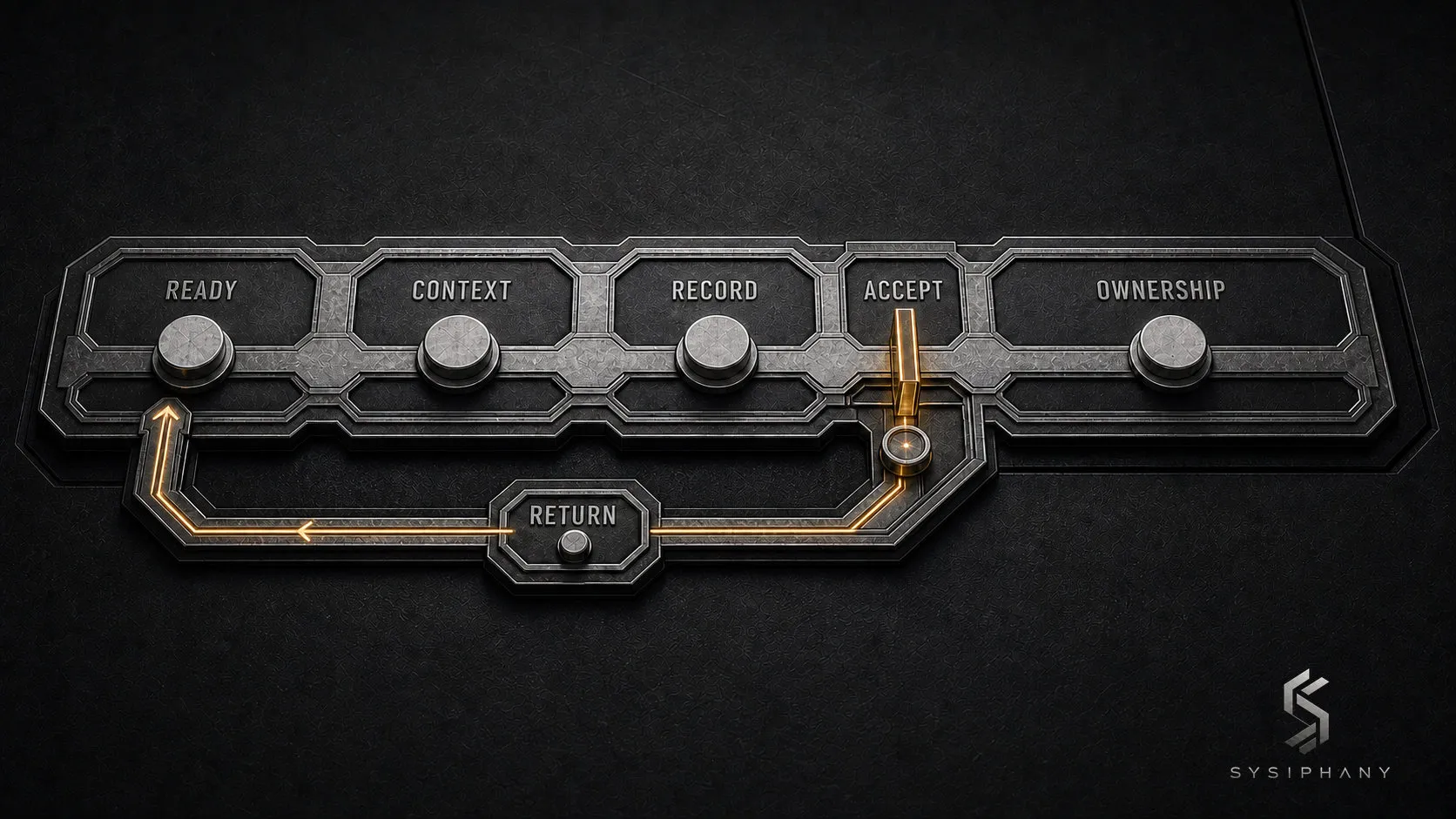
| Contract field | What to make explicit | Sales-to-delivery example |
|---|---|---|
| Sending and receiving roles | The role that prepares the transfer and the role authorized to accept it | Account lead → delivery lead |
| Trigger | The event that starts handoff preparation | Signed agreement recorded |
| Ready criteria | Conditions that must be true before submission | Scope approved, customer contact confirmed, constraints recorded |
| Required context and evidence | Information the receiver needs to make the next move | Scope, dates, stakeholders, dependencies, exceptions, signed agreement |
| Controlling record | The one location that governs the transfer | Current onboarding record linked from CRM |
| Acceptance test | What the receiver verifies | Package is complete, internally consistent, and deliverable as promised |
| Ownership-transfer moment | The observable action that moves accountability | Delivery lead changes status to Accepted |
| Response expectation | When the receiver accepts or returns the package | By the next business day |
| Return route | Required rejection reason and who owns correction | Return to account lead with one selected reason and note |
| Visible state | Where both sides can see waiting, accepted, or returned work | Shared onboarding queue |
A useful ready criterion is observable. “Provide enough context” will be interpreted differently by every sender. “Approved scope is attached, start date is confirmed, and any nonstandard promise is identified” can be checked.
The acceptance test should be equally concrete. The receiver is not approving the commercial decision again. They are confirming that the package meets the agreed entry conditions for their stage. If the transfer also requires a material approval, that decision belongs in a separate authority rule rather than being hidden inside acceptance.
Keep the contract as small as the work allows. Some transfers need six fields and one checklist. Others involve enough conditional judgment to justify a decision table. The guide to SOPs, process maps, and checklists can help select the smallest artifact that people will use at the point of transfer.
What should happen when a handoff is rejected?
A rejected handoff should return to a named owner with a visible reason and a clear route back to acceptance. Rejection should not send the case into chat, a private inbox, or an ownerless “blocked” state.
The receiver selects the failed criterion, adds only the context needed to correct it, and returns responsibility to the sending role. The sender fixes the requirement and resubmits through the same acceptance point. Both sides should be able to see whether the case is waiting for correction or waiting for receiver review.
This return rule is narrower than full exception management. It handles a failed entry condition at one transfer boundary. A nonstandard customer request, material risk, policy conflict, or case that cannot re-enter the normal path needs its own exception owner and decision route. Do not force consequential judgment into a rejection checklist merely to keep work moving.
Repeated rejection is evidence. If the same requirement fails again and again, inspect whether the criterion is unclear, the controlling record is hard to maintain, the sending standard is unrealistic, or an upstream decision has no owner. The answer may be a contract revision, not more reminders.
How do you reduce handoff meetings without losing visibility?
Move recurring clarification into explicit transfer criteria and visible acceptance states. Keep a meeting for decisions, trade-offs, and changes that genuinely require people to reason together.
A handoff meeting often carries several different jobs at once: finding the current record, discovering missing information, assigning ownership, reporting status, and resolving an unusual case. The first four can usually become part of the operating contract and shared queue. The unusual case may still need a focused conversation with the right decision-maker.
A simple asynchronous rhythm is enough for many transfers:
- The sender submits only when the ready criteria are met.
- The receiver sees new work in one agreed queue.
- The receiver accepts or returns it within the response expectation.
- Accepted work has a named owner and visible next state.
- Returned work shows the failed criterion and correction owner.
- A recurring pattern goes to a short contract review, not a permanent status meeting.
This does not mean “eliminate meetings.” It means meetings stop compensating for missing operational definitions. If people still need a daily call to locate work, identify the owner, or determine whether basic inputs exist, the transfer has not become explicit enough.
Test the contract with live handoffs
Pilot the agreement on one boundary for two to four weeks or a meaningful set of recurring cases. Tell both roles that the purpose is to test the contract, not audit individual performance.
Observe a small set of signals:
- accepted on the first submission;
- returned because a ready criterion failed;
- time waiting for receiver acceptance;
- clarification required outside the controlling record;
- work stalled with no accountable owner;
- and founder intervention needed to move the transfer.
These signals are diagnostic, not universal targets. A high-risk transfer may reasonably need more verification than a routine internal request. The point is to see whether the stated agreement predicts what valid work requires.
At the review, change one part of the contract when the evidence supports it. Add a requirement only if the receiver needs it to make the next valid move. Remove fields that nobody uses. Clarify a rejection reason that creates argument. If multiple systems carry conflicting versions, address the source-of-truth problem instead of adding another copy to the handoff.
Once the human transfer is stable, the wider workflow automation architecture can help with routing, reminders, status changes, and monitoring. Automation should enforce a sound contract, not turn an ambiguous send event into a faster ambiguous send event.
When the handoff is not the real problem
A handoff contract is useful only when the failure actually sits at the transfer boundary.
If nobody is accountable for the result across the whole path, define a process owner before expecting two teams to settle every cross-stage conflict themselves. The process owner governs the end-to-end outcome; the handoff contract governs one interface within it.
If work repeatedly returns to the founder because only they can interpret priorities or approve routine deviations, examine the broader founder-dependency pattern. A checklist cannot substitute for decision authority that has never been delegated.
If the transfer is merely where delay becomes visible, locate the actual constraint with the business-process bottleneck guide. The loudest handoff may be downstream of the real cause.
The boundary matters. Fixing the wrong layer produces more fields, more meetings, and more monitoring while the operating problem remains intact.
If your pilot exposes unclear records, conflicting definitions, ownerless work, and repeated founder rescue across several handoffs, Download the Operational Drag Diagnostic Kit. It helps separate one transfer defect from a wider operating-system problem before you add tools.
FAQ
What is a team handoff?
A team handoff is the transfer of work, context, and responsibility from one person, role, or workflow stage to another. A reliable handoff defines the state the work must be in, what information travels with it, who accepts it, and when ownership changes.
What should be included in a handoff?
Include the work’s current state, required context and evidence, the controlling record, relevant constraints or commitments, the acceptance criteria, the receiving owner, and the route for returning incomplete work. Include only information the receiver needs for the next valid move.
Who owns work during a handoff?
The sender retains responsibility until the receiving role accepts the work against the stated criteria. At the visible acceptance event, ownership transfers to the receiver. If the handoff is returned, correction ownership goes back to the sender.
How do you know a handoff is complete?
It is complete when the receiver verifies that the package meets the agreed entry conditions, records acceptance, and assumes responsibility for the next move. Sending an update or changing an assignee is not sufficient by itself.
Can better handoffs reduce meetings?
They can reduce meetings whose main purpose is to locate work, recover missing context, establish ownership, or report status. Meetings may still be appropriate for consequential decisions, trade-offs, unresolved exceptions, and changes to the handoff agreement.
What should happen when a handoff is rejected?
Return it through a visible route with the failed criterion, the correction owner, and the same resubmission and acceptance point. Do not leave rejected work in private messages or an ownerless blocked state.
Should team handoffs be automated?
Automate routing, reminders, and state changes only after the ready, accepted, returned, and owned states work in real cases. Automation can enforce explicit transfer rules, but it cannot decide what valid context or accountable ownership means for an unclear process.
Make one transfer ready and accepted
Choose one recurring handoff that creates return work or founder follow-up. Review recent cases, write the one-page contract, and test whether the receiver can accept a valid next state without rebuilding context in a meeting.
If the transfer cannot be isolated because several teams, systems, records, and decision boundaries are failing together, Book a SYSIPHANY discovery call. We can help distinguish a handoff defect from the operating design beneath it.