

A process owner is the person accountable for whether one end-to-end process produces its intended outcome reliably. They do not have to perform every step or manage every person involved. They make sure the process has a clear mandate, a valid definition of done, measures that show whether it is working, a way to handle exceptions, and a controlled way to change.
That distinction matters in a growing business. Tasks can all have assignees while the process still has no owner. Sales can send work, delivery can receive it, finance can invoice it, and the founder can resolve the friction between them. The work is staffed, but nobody owns the result from trigger to completion.
A process owner closes that gap. The role gives one person ongoing accountability for the operating path—not a meeting, not an alert queue, and not a title used to make a project feel governed.
Quick answer: what is a process owner?
A process owner is accountable for an end-to-end business process and its results. Their mandate should state the outcome the process exists to produce, where it starts and ends, what “done” means, how performance is measured, which changes they can approve, and which cases must be escalated.
The owner is not necessarily the team manager, the person who completes the most work, or the person who approves every exception. They are the named steward of the process as a whole. They notice when the work is not meeting its promise, convene the right people to correct it, and keep the standard aligned with reality.
BPMInstitute.org’s “Process Ownership” describes the role as focused on the effective management and improvement of an end-to-end business process, including cross-functional performance. That is the useful starting point. In a smaller company, the role only becomes real when its practical authority is visible at the point where work breaks.
What a process owner owns—and what they do not
A process owner owns the conditions that make a process dependable. This normally includes:
- The mandate: why the process exists, the customer or business outcome it must produce, and its boundary from trigger to completed result.
- The operating cadence: a repeatable rhythm for reviewing performance, recurring friction, unresolved changes, and open risks.
- The definition of done: the observable state that means the process has produced a valid outcome, including required evidence or acceptance where needed.
- Performance review: the few measures that reveal speed, quality, completion, rework, waiting, or customer impact.
- Change authority: the ability to approve bounded improvements to the standard, documentation, controls, or tooling—or to take larger changes to the right decision-maker.
- Exception visibility: responsibility for ensuring abnormal cases have a visible route, an owner, and a way to learn from recurring patterns.
That is different from owning every task. A process owner can be accountable for a sales-to-delivery process while a salesperson owns the submitted scope, a delivery lead accepts the work, and a coordinator updates the record. The process owner asks whether those pieces connect reliably and whether the overall outcome is achieved.
It is also different from owning people. A functional manager leads capacity, coaching, performance, and priorities inside a department. The process owner works across the path. Those roles can be held by the same person in a small business, but the responsibilities should not be confused.
Ownership is not an alert, task, or meeting role
Three substitutions create false process ownership.
An alert role receives a notification when something fails. That may be useful operationally, but receiving alerts does not grant authority to correct the underlying pattern.
A task role completes a step. Task ownership is necessary, yet it does not answer who is accountable when a handoff, record, or decision between steps fails.
A meeting role chairs a weekly review. Meetings can support governance, but a meeting without an owner who can make or sponsor change is only a place to describe the same problems again.
If the named owner cannot answer “what outcome am I accountable for, what may I change, and how will I know it improved?” the role is incomplete.

What authority does a process owner need?
Accountability without authority makes the owner a messenger. Give the role enough authority to keep the process usable, but do not use “process owner” as a back door to unlimited organizational power.
The right authority is specific to the process and its consequences. For a low-risk internal workflow, an owner may be able to change a template, clarify a required record, or revise a checklist after testing. For a process that affects price, contractual commitments, customer risk, financial controls, safety, or policy, the owner may recommend a change while a designated authority approves it.
A workable charter names four boundaries:
| Authority question | Charter answer |
|---|---|
| What may the owner change directly? | Bounded process documentation, sequencing, templates, and low-risk controls within stated limits |
| What must be consulted on? | Changes that alter another team’s work, system configuration, customer promise, or required evidence |
| What must be approved elsewhere? | Budget, policy, pricing, contractual, legal, safety, or material customer-impact changes |
| What must be escalated immediately? | Cases outside the standard that carry defined customer, financial, compliance, safety, or reputational risk |
This is not a full decision-rights design. The charter needs only enough clarity for the owner to act on ordinary improvement and to know when not to act alone. A separate decision-rights practice should define organization-wide authorities, approval thresholds, and delegated judgment in more depth.
A useful test: give the owner one recent recurring failure. Can they change the relevant part of the process, request the required input, or take a clearly defined escalation path? If they can only report it upward, the business has named an observer, not an owner.
How do you choose the right process owner?
Choose the person closest enough to the outcome to understand the work, but senior and credible enough to convene contributors across the full path. The best owner is rarely selected by job title alone.
Look for five conditions:
- Proximity to the outcome. They understand what a valid completed result means for the customer or business.
- End-to-end visibility. They can see work across stages rather than only inside one department.
- Cross-functional credibility. Contributors will bring them evidence and engage when the process fails between teams.
- Evidence discipline. They can separate one noisy case from a recurring pattern and avoid redesigning work from anecdotes.
- A real escalation sponsor. Someone with broader authority can resolve material resource, policy, or cross-functional conflicts the owner cannot settle.
The busiest subject-matter expert is not automatically the right choice. Neither is the department head with the largest team. Ask instead who can protect the process outcome, see the relevant evidence, sponsor bounded improvement, and escalate the rest without becoming a new approval bottleneck.
In a founder-led company, repeated founder interruptions are one signal that ownership may be trapped at the top. The broader diagnosis belongs to Founder Dependency. Here, the practical test is narrower: can the proposed owner maintain the end-to-end mandate without routing ordinary coordination back through the founder?
If the team has not agreed what currently happens, first use the process documentation guide to capture the trigger, path, records, and completed state. If several competing variants remain, standardize the process before treating legitimate variation as owner failure.
What should a process owner review?
A process owner needs a small, steady cadence. The cadence should fit the pace and risk of the work: a daily check for a customer-facing queue, a weekly review for recurring operational work, or a monthly review for a slower control process.
At each review, look at the process through five questions:
- Did work reach a valid done state? Not merely “was a task marked complete?” but did the promised outcome and required evidence exist?
- Where did work wait, return, or require clarification? Identify the point, not a person to blame.
- Which exceptions repeated? A repeated exception may indicate that the standard, input, record, or decision boundary needs revision.
- What changed around the process? New customers, systems, commitments, volume, or controls can make a previously sound standard obsolete.
- What one change has evidence behind it? Record a bounded decision, owner, due point, and expected signal rather than opening a general improvement project.
The owner does not need a dashboard full of decorative measures. Choose the smallest set that can show whether the process is producing its intended outcome. For a client onboarding process, that might be accepted handoffs, time from signed agreement to ready delivery, returned cases, and a sample of complete client records. The measures should lead to a conversation about work, not replace one.
How should a process owner handle exceptions and change?
The owner is responsible for making exception patterns visible and ensuring there is a known route when work leaves the normal path. They should not quietly absorb every unusual case or write a new rule after one noisy incident.
For each process, make the exit condition observable: missing required information, a value beyond an agreed limit, a conflicting record, a customer request outside the offer, or a risk signal. The normal path should state where that case goes next. The detailed exception queue—prioritization, response expectations, resolution records, and resumption logic—is a separate operating design, not a paragraph hidden in a charter.
Change works similarly. The owner should collect evidence from real cases, distinguish a one-off from a pattern, test a bounded adjustment where appropriate, and record what changed and why. They maintain the link between the current standard and the work people actually perform.
When the process needs a document, choose the smallest useful artifact. A map reveals the route; an SOP supports a stable task; a checklist protects a critical verification point; a decision table makes recurring conditional rules usable. SOP vs process map vs checklist explains that selection. The owner is accountable for keeping the artifact useful, not for producing more documentation than the work needs.
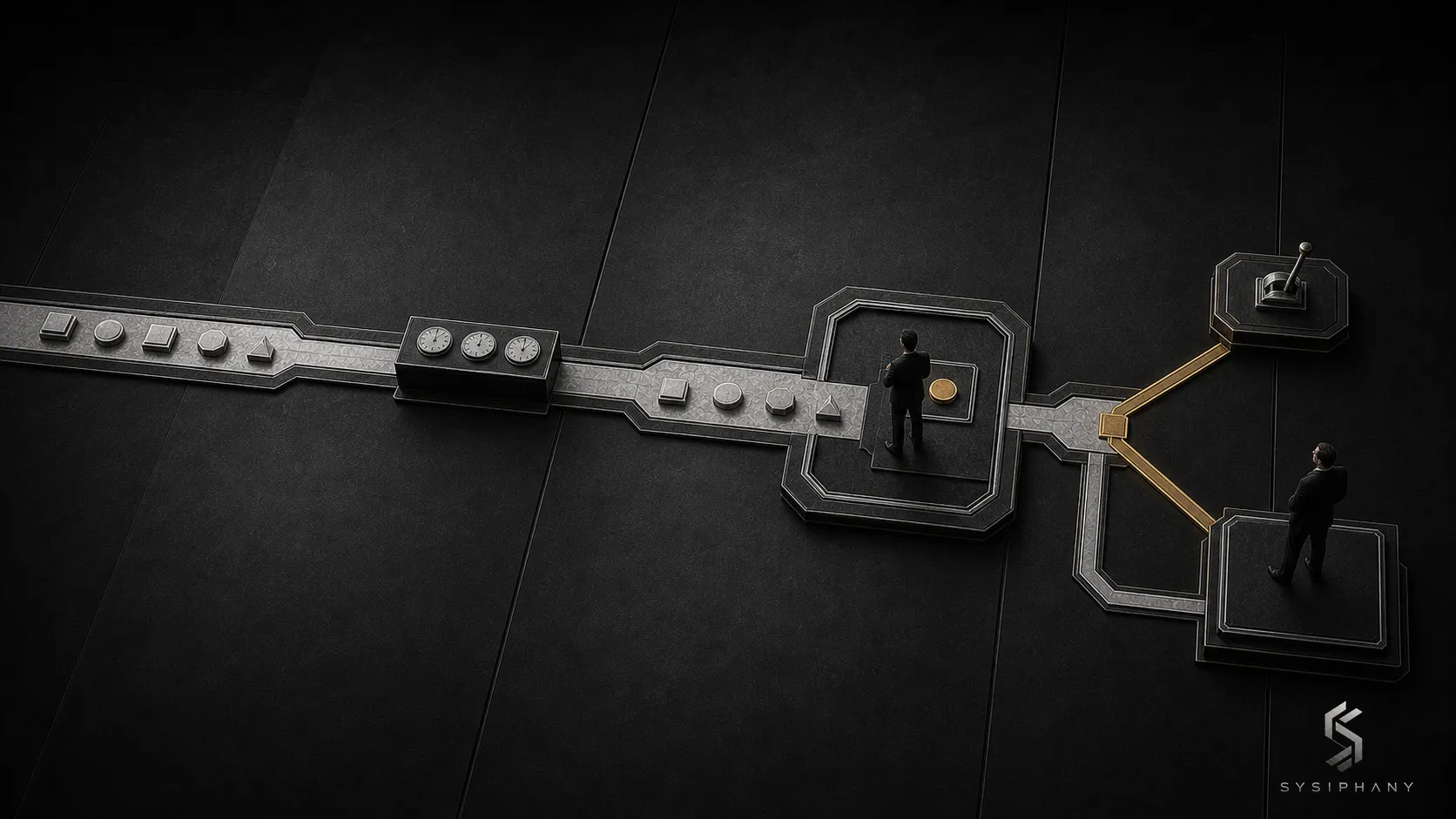
A one-page process owner charter template
Use this charter for one process, not for a whole department. Keep it short enough that the owner, contributors, and sponsor can use it during normal work.
Process owner charter
| Charter field | Complete it with |
|---|---|
| Process name and owner | The named end-to-end process and one accountable person—not a team or inbox |
| Mandate | The outcome the process must reliably produce and for whom |
| Boundary | The observable trigger, start point, completed outcome, and what sits outside the process |
| Definition of done | The outcome, acceptance condition, controlling record, and evidence that make completion valid |
| Participants and key interfaces | The roles that perform work or receive it; link to existing handoff agreements rather than duplicating them |
| Measures | Three to five signals for outcome, timeliness, quality, rework, or waiting |
| Review cadence | When the owner reviews performance, failures, recurring exceptions, and proposed changes |
| Direct authority | Changes the owner may make within stated guardrails |
| Consult / approve boundary | Changes requiring input or formal approval, and the named route |
| Exception signal and route | The observable condition that exits the normal path and where the case goes—not the full exception procedure |
| Change record | Where the current standard, decision rationale, and revision history live |
| Escalation sponsor | The person accountable for resolving cross-functional or material issues beyond the owner’s authority |
A completed charter might say: “Client onboarding begins when a signed agreement is recorded and is done when delivery accepts a complete, current client record and the customer receives a confirmed start plan.” Its owner might directly revise the intake checklist, consult sales and delivery before changing required scope information, and escalate any change to contract terms to the commercial lead.
That is specific enough to operate. “Own onboarding quality” is not.
Run the funnel test before you publish the charter
A charter should narrow ambiguity as work moves toward completion. Test it from the top down:
- Can a contributor identify the process’s one intended outcome?
- Can they tell whether a live case is inside or outside the boundary?
- Can they identify the next valid move and the controlling record?
- Can they see the observable condition that makes the case leave the normal path?
- Can the owner say who may approve a change and what measure should move if the change works?
- At the end, can an independent person verify that the process is done, not merely handed off or marked complete?
If the answer gets less clear as the test approaches completion, the charter is carrying slogans rather than operating rules. Tighten the wording, name the record, or narrow the process boundary.
When should you appoint a process owner?
Appoint one when a process crosses roles or systems, creates meaningful customer or financial consequences, repeats often enough to learn from, or repeatedly pulls the founder into clarification and rescue. Do not wait for a large transformation program. One painful, recurring process is enough to justify a bounded ownership experiment.
Begin with a 30-day test. Give the owner a charter, access to the people and records involved, a review cadence, and authority for modest improvements. Review whether the process reached done more reliably, whether recurring questions fell, and whether the owner could act without informal founder permission.
If the experiment exposes several unclear handoffs, disputed records, ownerless exceptions, or decision bottlenecks, Download the Operational Drag Diagnostic Kit. It helps make the underlying operating drag visible before you add more process governance.
FAQ
What is the role of a process owner?
A process owner is accountable for an end-to-end process producing its intended outcome. The role maintains the mandate, definition of done, performance measures, review cadence, change path, and visible route for work that leaves the normal process.
Is a process owner the same as a manager?
No. A manager normally leads people, capacity, and functional performance. A process owner is accountable for how work performs across an end-to-end process. One person can hold both roles, but the authority and accountability should be stated separately.
Can a process have more than one owner?
Name one accountable owner for the end-to-end outcome. Many roles can own tasks, records, controls, or parts of the path. Multiple end-to-end owners usually create a gap at the boundary where they disagree.
Does a process owner approve every exception?
Not necessarily. The owner makes the exception route visible and learns from recurring patterns. The charter should state which cases the owner can resolve, which require consultation, and which must go to a designated authority.
What authority should a process owner have?
They need authority to maintain and improve the process within clear guardrails, plus a named route for changes that affect policy, budget, customer commitments, risk, or another team. Accountability without this practical authority is not real ownership.
What is a definition of done for a business process?
It is the observable completed state that proves the process produced a valid outcome. It should name the outcome, any acceptance condition, the controlling record, and required evidence—not only that someone marked a task complete.
How often should a process owner review performance?
Match the cadence to the speed and risk of the work. Review often enough to see recurring waits, rework, exceptions, and changes before they become normal. A weekly cadence is a practical starting point for many recurring processes.
Make one owner accountable for one outcome
Pick a recurring process that currently depends on founder clarification or cross-functional rescue. Write the first one-page charter, name a single owner, and test whether they can see performance, define done, make a bounded change, and escalate the rest through a known route.
If a short charter cannot establish those minimum conditions because the underlying workflow is still unclear or materially risky, Book a SYSIPHANY discovery call. We can help separate a role-definition problem from the operational design work beneath it.