
You do not need an SOP for every recurring piece of work. Use a process map when people cannot see how work moves. Use an SOP when they need a stable method for performing a task. Use a checklist when they know the work but miss critical actions or conditions. Use a decision table when the next step changes according to repeatable rules.
Start with the smallest artifact that helps someone make the next valid move without asking. Add a second format only when it performs a different necessary job at a different point in the work.
That is the practical difference between an SOP, process map, checklist, and decision table. The best format is not the one that documents the most. It is the one that makes the relevant action, condition, handoff, or decision usable when someone needs it.
Quick answer: SOP vs process map vs checklist
Choose the format by the operating problem:
| If the real problem is… | Start with… | It should make visible… |
|---|---|---|
| People cannot see the end-to-end path or where work stalls | Process map | Sequence, decisions, handoffs, waiting, and completion |
| People know the path but perform a stable task differently | SOP | Method, prerequisites, controls, output, and referral point |
| Required actions, evidence, or checks are being skipped | Checklist | Observable conditions that must be completed or verified |
| The next action changes according to recurring conditions | Decision table | Condition, evidence, rule, action, and outside-table route |
| Two distinct point-of-use jobs remain | Minimal pair | Only the information each format is suited to carry |
Before choosing any format, make sure you understand the actual trigger, steps, decisions, records, handoffs, exceptions, owner, and done state. If those facts are still disputed, first document the current business process instead of formatting a guess.
What does each documentation format actually do?
Each format answers a different operating question. Treating them as interchangeable usually produces either a document that is too broad to use or one that leaves the important part of the work implicit.
A process map shows how work moves
Use a process map when the main problem is visibility across a sequence. It should show the trigger, major stages, meaningful decisions, handoffs, and the completed state. A high-level map helps a team see the whole path; a more detailed view may reveal loops, delays, or repeated movement in one part of it.
The Institute for Healthcare Improvement resource “Flowchart” describes a flowchart as a graphic representation of a process’s sequence of steps that helps people understand the process and develop improvement ideas. Its distinction between high-level and detailed flowcharts is useful here: the level of detail should match the question being investigated.
A process map is not a click-by-click instruction manual. It can reveal that sales hands work to delivery before scope is accepted, but it does not by itself define the acceptance contract. It can show a decision point, but it does not allocate decision authority.
An SOP explains how to perform stable work
Use an SOP when a person needs a repeatable method for completing a known task. At minimum, it should say when the procedure applies, what must be available before starting, which steps and controls matter, what valid completion looks like, and where nonstandard cases go.
An SOP is useful only after the team has enough agreement about the work to describe a reliable method. If three people use competing methods and nobody has decided which differences are legitimate, standardize the business process first. Writing one person’s preference into an SOP does not settle the operating question.
The common failure is expansion. Every exception, screenshot, policy note, and local variation gets added until the procedure becomes difficult to navigate and expensive to maintain. A stable SOP should make normal execution easier while clearly pointing beyond its own boundary.
A checklist protects critical execution and verification
Use a checklist when the process is understood but important actions, evidence, or conditions are being missed. A checklist belongs at a repeatable moment: before a proposal is released, when delivery accepts a handoff, or before a monthly invoice batch is sent.
Each item should be observable. “Customer scope is attached” can be checked. “Review carefully” cannot. The list should protect valid completion, not record every action someone already knows how to perform.
A checklist is not a substitute for teaching unfamiliar work. It is also a poor response to a process that nobody understands. When a checklist keeps growing after every failure, the accumulating items may reveal a deeper process defect rather than a memory problem.
A decision table makes repeatable rules usable
Use a decision table when known conditions lead to different legitimate actions. A compact table can state the condition, the evidence that proves it, the rule, the next action, and the route for a case that falls outside the stable rules.
For example, a refund request might be routed differently according to purchase date, amount, product condition, and available evidence. That is a conditional-routing problem. The table can make stable rules visible without burying them in several pages of prose.
Do not use a decision table to create false certainty. Consequential, ambiguous, or genuinely novel judgment should remain with an accountable person. A table may expose the recurring decisions, but the planned decision-rights article owns who may decide, the limits of that authority, and when founder approval is required.

How do you choose the smallest useful artifact?
Name the immediate failure before naming the document. Then use these seven questions to select the lightest format that can do the job.
- Can people see the path from trigger to completion? If not, begin with a process map.
- Is the path visible, but a stable task is performed inconsistently? An SOP can make the agreed method usable.
- Do people know the work but omit mandatory actions, evidence, or checks? Put a checklist at that control point.
- Does the next step change according to repeatable conditions? A decision table is likely the better interface.
- Does work cross roles, teams, or systems? Map the movement first. The map may reveal a weak handoff, but it does not repair the transfer itself.
- Would a missed action create material customer, financial, safety, legal, or quality consequences? Add a short verification list or a decision table only at the consequential point.
- Will the artifact change frequently? Prefer the lightest usable format. A comprehensive SOP carries a higher maintenance burden than a small map, table, or checklist.
The point-of-use question is decisive: What does the person need to see at the moment this artifact is opened? Someone learning a stable task may need an SOP. An experienced operator releasing a high-consequence output may need only a checklist. A manager investigating delay across several teams may need a map rather than either one.
When a minimal pair is justified
One format sometimes cannot carry two different jobs well. Four combinations are usually defensible:
- Map + checklist: work crosses a handoff, and the receiving condition must be verified.
- SOP + checklist: a stable task needs instructions plus critical final verification.
- Map + decision table: the route is unclear, and recurring conditions change the path.
- SOP + decision table: the method is stable, but a small set of conditions changes the permitted action.
Do not begin with all four. Add a second artifact only when the first cannot answer a different necessary question at the point of work. If the second merely repeats the first in another visual form, remove it.
When is an SOP the wrong choice?
An SOP is the wrong starting point when the problem is not stable task execution. Choosing another format first can prevent a large procedure from concealing unresolved work.
| What you discover | Better next move |
|---|---|
| People disagree about what currently happens | Return to current-state process documentation |
| Several variants exist and no default has been chosen | Standardize the process without freezing legitimate variation |
| The work has many cross-functional paths and hidden waits | Map the flow first |
| Experienced staff miss one critical verification point | Put a checklist at that point |
| Questions repeatedly take the form “if this, then what?” | Use a decision table for stable conditions |
| The choice is ambiguous, consequential, or outside repeatable rules | Preserve an explicit human decision boundary |
| The real question is how to implement software | Use How to Automate a Business Process after the work is clear |
An SOP may eventually support the chosen standard, but the document cannot make the strategic decision for the team. It records the stable method after that method is understood and agreed.
Three examples of choosing the right format
These examples show selection logic, not complete designs.
Sales-to-delivery handoff: process map plus checklist
Delivery repeatedly receives signed work without an agreed scope, owner, or start date. The primary failure is not that a salesperson lacks task instructions. Work is crossing a boundary without a visible accepted state.
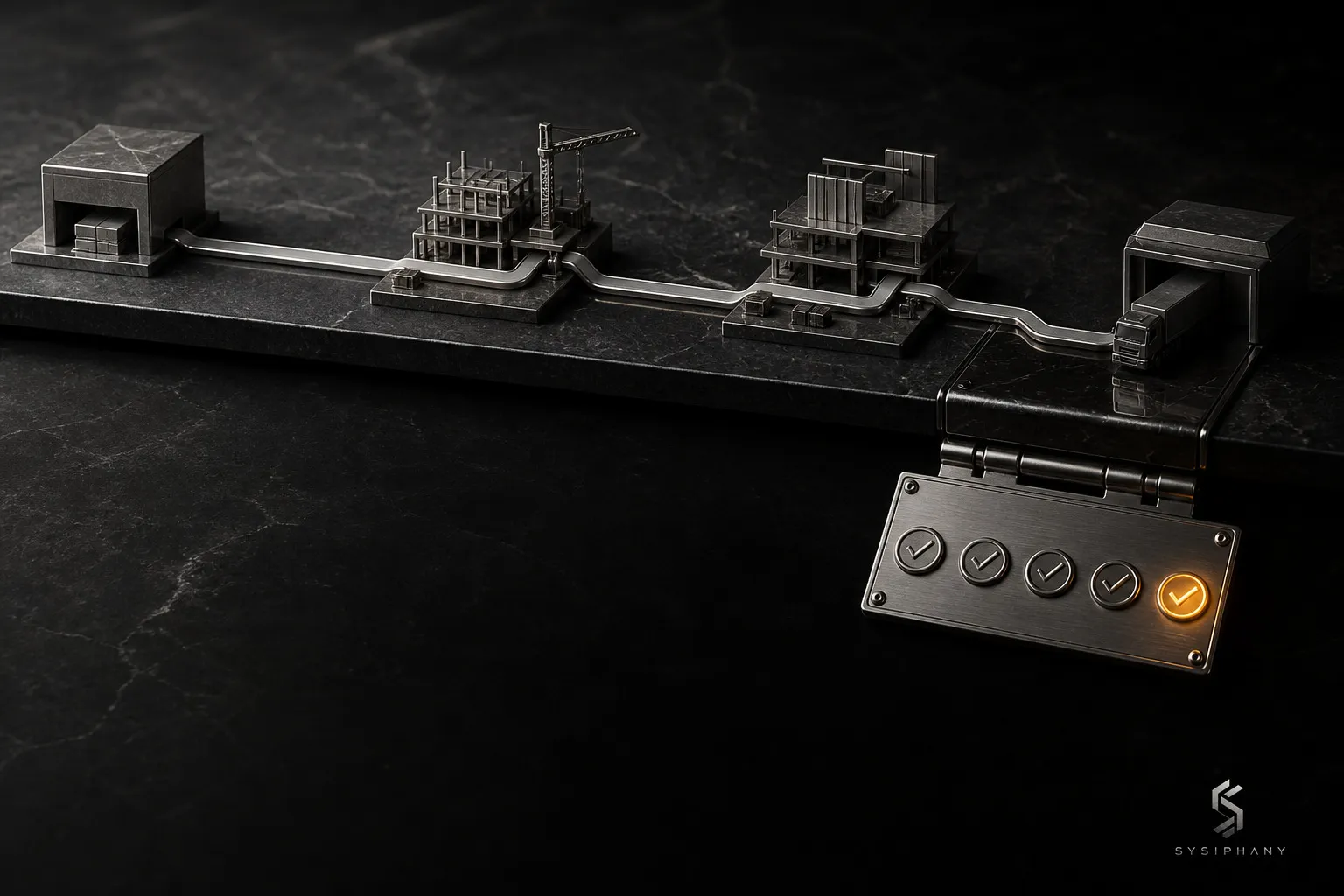
Start with a simple process map showing the movement from signed agreement to accepted delivery work. Add a short acceptance checklist at the transfer point for scope, owner, start date, controlling documents, and explicit receiving acceptance.
The map and checklist have different users and moments. The map helps the team understand the route; the checklist is used every time work transfers. A forthcoming handoff article will own the complete acceptance contract, rejected-handoff response, timing, and ownership transfer.
Customer refund review: decision table
Staff repeatedly ask the founder whether to approve, deny, or escalate a refund. If the recurring cases turn on known conditions, such as purchase date, amount, evidence, and product condition, start with a decision table. A short evidence checklist may support it if staff regularly omit required records.
The table is not permission to invent authority. It makes the repeated rule visible and exposes which cases remain outside it. If every difficult case still returns to the founder, Founder Dependency explains the broader operating condition; the decision-rights article will own authority thresholds and escalation design.
Monthly invoice release: checklist
Invoices are usually prepared correctly, but some leave with missing approval evidence or unreconciled changes. The path is known, and the team does not need another process diagram. A short release checklist at the final control point is the smaller and more useful artifact.
If new items are added every month, review the failures. The right answer may be a corrected upstream process, a trusted controlling record, or a changed approval rule rather than a twenty-line reminder list.
How do you make the chosen artifact usable instead of shelfware?
Give the artifact a named user, point of use, maintenance owner, review trigger, and usefulness test. Without those five details, even a well-designed document can sit outside the work it was meant to support.
| Operating detail | Question to answer |
|---|---|
| Named user | Who opens this artifact? |
| Point of use | At what event, stage, or decision is it used? |
| Maintenance owner | Who corrects it when the work changes? |
| Review trigger | Which change, failure, or repeated question causes review? |
| Usefulness test | What evidence shows the artifact helped? |
Test the artifact on five ordinary cases and one delayed, returned, or unusual case. Note where it cannot tell the user what to do next, which evidence controls, or when the work is complete. Revise only the gap the cases reveal.
This is not a full documentation or process-governance program. The maintenance owner here keeps one artifact usable. The forthcoming process-owner article will define the broader end-to-end role, authority, measures, and review cadence.
If the selection exercise exposes several hidden handoffs, disputed records, recurring exceptions, unclear ownership, or repeated founder interruptions, Download the Operational Drag Diagnostic Kit. It provides a lower-friction way to see the operating conditions around the document before you expand it.

FAQ
What is the difference between an SOP, process map, and checklist?
A process map shows how work moves across stages and handoffs. An SOP explains how to perform a stable task. A checklist helps a person verify critical actions or conditions at a repeatable point in the work.
When should I use a decision table instead of an SOP?
Use a decision table when the next valid action changes according to repeatable conditions. Use an SOP when the main need is a stable method for performing the task itself.
Can a process map and an SOP be used together?
Yes. A map can show the end-to-end path while an SOP explains how to perform one stable activity inside that path. Use both only when they serve different users or points of use.
What is the smallest useful documentation for a recurring process?
It is the lightest artifact that lets the intended user identify the next valid action, controlling condition, required evidence, or completed state without unnecessary interpretation. That may be one map, SOP, checklist, or decision table.
Should I create an SOP before automating a process?
Only after the process and its stable method are clear. An SOP can support automation design, but it does not prove that the work is necessary, suitable, or ready to automate.
Who should maintain an SOP, checklist, or process map?
Name one maintenance owner close enough to the work to notice when the artifact stops matching reality. The owner should review it when systems, controls, commitments, or recurring failure patterns change.
Can a checklist replace an SOP?
A checklist can replace an SOP when the user already knows how to perform the work and only needs support at critical verification points. It should not replace the instruction needed to learn or perform an unfamiliar task.
What should I document when a process has exceptions?
The normal-path artifact should show the observable condition that makes the case leave that path and where it goes next. The full exception queue, owner, response expectation, resolution record, and resume point belong to an exception-management process.
Choose one artifact and test it in real work
Pick one recurring point of friction. Decide whether the immediate need is flow visibility, stable execution, critical verification, or conditional routing. Put the smallest matching artifact where the work happens and test it against real cases.
If it does not reduce a real question, missed condition, invalid handoff, or routing delay, simplify it or change the format instead of adding more pages.
A process that crosses several teams or systems, carries material customer or financial consequences, or depends on disputed judgment may need more than a document choice. If a bounded test cannot establish the minimum useful interface, Book a SYSIPHANY discovery call. We can help separate the documentation problem from the operating design underneath it.