

A business process exception is a case that cannot safely reach a valid outcome through the documented normal path. A customer asks for work outside the agreed scope. Two records disagree at a point where the team must commit. A required input will not exist before the deadline. The case leaves the standard process, and ordinary instructions no longer tell the team what to do.
Business process exception management gives that abnormal case a visible operating loop. The team preserves the context, classifies the case, assigns a current owner, sets a response expectation, resolves it with the right authority, records the evidence, and either resumes, reroutes, or closes the work. Recurring cases then become input for reviewing the normal process.
This is a human operating protocol for abnormal business work. It is not exception-management software, an incident-response plan, a decision-authority matrix, or a technical guide to retries and automated recovery.
Quick answer: how should a business manage process exceptions?
Manage a process exception by capturing it in a visible register, preserving the controlling record and affected commitment, classifying only enough to route it, naming a current owner, and defining when a response is due. The case is complete only when the resolution is recorded and the work reaches a valid resume, reroute, or close state.
A useful exception loop is small enough to operate during live work. Start with one process and a minimum record. Do not build a universal taxonomy or buy a platform before the team can move one abnormal case from discovery to a valid outcome.
What counts as a business process exception?
A true exception is a case the normal path cannot safely complete. It is different from permitted variation, an incomplete handoff, or a decision that merely crossed an established authority limit.
That distinction prevents ordinary work from flooding the exception queue:
| Condition | What it means | First operating move |
|---|---|---|
| Permitted variation | The case differs but still fits the agreed standard | Continue through the normal path under the permitted rule |
| Rejected handoff | The receiving stage cannot accept the work because the transfer package is incomplete | Return it through the handoff contract |
| Authority escalation | The decision exceeds the current role’s limit, but the rule provides a valid interim state and authority route | Keep it inside the decision rule while the named authority responds |
| True exception | The case cannot safely continue or finish through the normal path | Enter the exception operating loop |
Permitted variation belongs in the minimum viable process standard. A rejected transfer belongs in the team handoff contract. If the work is otherwise valid but a commitment crosses a limit, the decision-rights matrix should identify who may decide and how the case waits. It becomes an exception only when the normal decision rule provides no safe interim state, no usable authority route, or no valid way to continue after the decision.
An accepted handoff can still produce an exception later. For example, delivery may accept a complete work package and then receive a new customer requirement outside the standard service. The original transfer succeeded; the new condition is what pushes the case outside the normal path.
Start with one defined normal path
Exception management works only when the team knows what the case departed from. For one process, identify its trigger, normal stages, controlling record, observable completion state, permitted variation, and the condition that means ordinary work must stop.
If those basics are missing, an exception register will collect disagreements without giving the team a reliable boundary. Capture the current process first with the guide to documenting a business process, then decide what should become the normal standard.
The exception trigger should be observable. “This feels unusual” is too vague. Better triggers include:
- a required record is missing or conflicts with another authoritative record;
- the request falls outside the defined offer, policy, or operating rule;
- the case cannot reach the stated definition of done;
- a commitment would be made without the required authority;
- the normal route is unavailable and no approved alternate path exists.
A trigger opens the exception loop. It does not prove the cause, decide the remedy, or authorize a commitment.
How do you build an exception operating loop?
Build the loop around four visible state changes: see and preserve the case, classify it and establish movement ownership, resolve it with evidence, then resume, reroute, or close it. Each state should be explicit enough that another person can see where the case is now.
1. Preserve the case before context fragments
The first person who recognizes the exception should create or update one controlling record. That record needs enough context to prevent the case from splitting across chat, email, and private memory:
- case identifier and authoritative source record;
- the trigger that moved it outside the normal path;
- the stage where normal work stopped;
- any action or commitment currently paused;
- affected customer, deadline, team, or downstream work;
- evidence already available;
- temporary owner until classification is complete.
“Ask the founder” is not a record. Neither is forwarding a message with no statement of what stopped, what is at risk, or what decision is needed.
2. Classify only enough to route and learn
A small local classification is more useful than a comprehensive taxonomy nobody applies consistently. Categories might include conflicting information, work outside the standard, authority required, operational inability to complete, external change, or repeated deviation.
Severity should describe the response need, not dramatize the case. A useful scale can distinguish work that may wait for the next review, work that threatens a current commitment, and work that must stop before harm or an unauthorized commitment occurs. The team can then set a response expectation appropriate to the consequence.
3. Make the queue visible and owned
Every open exception needs a visible state, current owner, response-by time, and fallback owner. The current owner is accountable for moving the case to the next valid state, even when another role supplies the decision or performs the correction.
The queue owner does not automatically hold decision authority. A coordinator may preserve context, gather evidence, and track the response while finance, delivery, counsel, or the founder makes the consequential decision. Likewise, the process owner remains accountable for the end-to-end process without personally resolving every case.
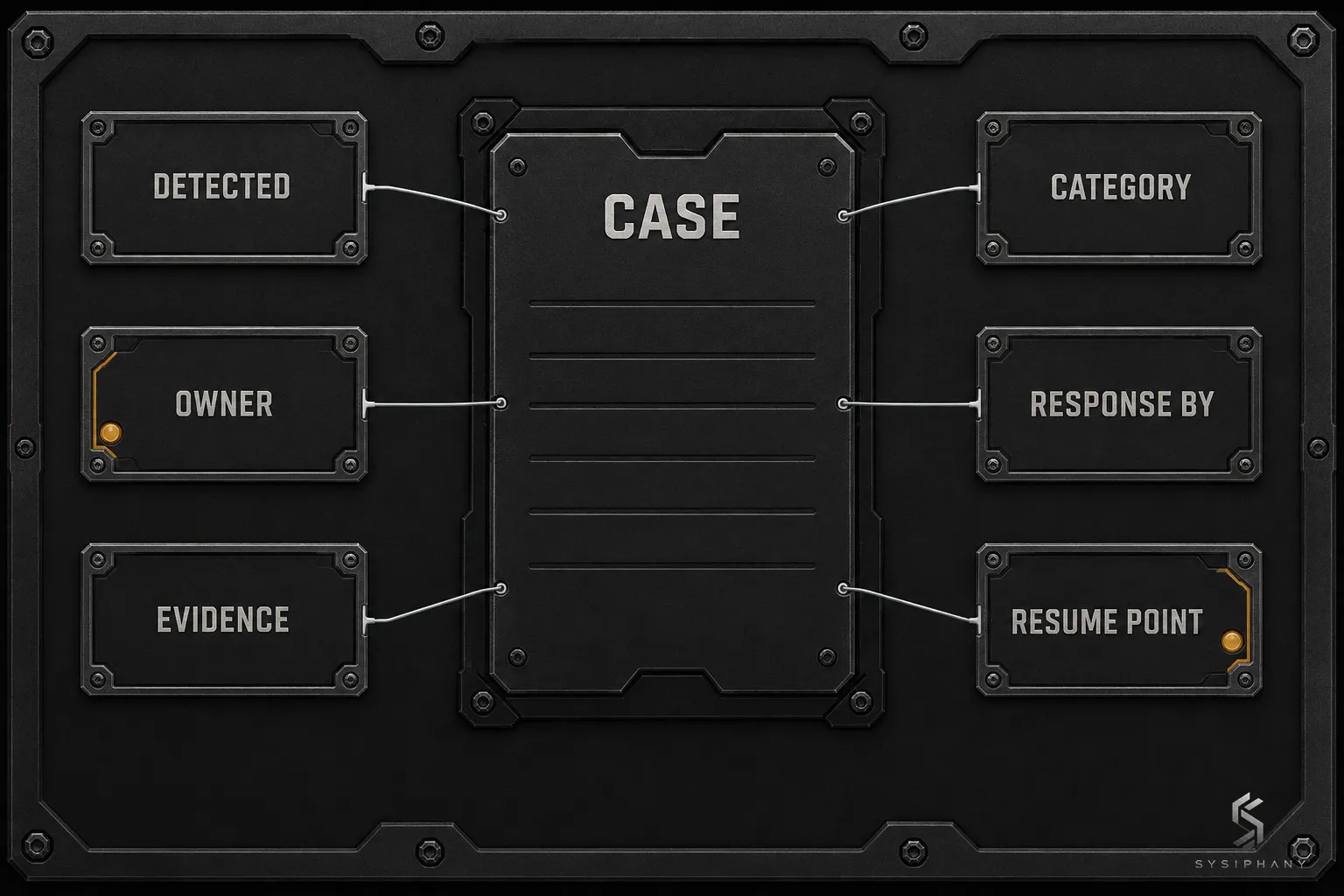
A minimum register can begin as a controlled table or existing work record:
| Field | Operating question |
|---|---|
| Detected | When and where did the case leave the normal path? |
| Category | Which local class helps route and review it? |
| Current owner | Who ensures the case reaches its next valid state? |
| Response by | When must the next meaningful response occur? |
| Authority route | Who may decide if the resolution creates a consequential commitment? |
| Evidence | Which facts and records support the disposition? |
| Resume point | Where can normal work safely restart, or why should the case close? |
4. Resolve with evidence, then choose a disposition
A reply is not a resolution. A meeting is not a resolution. The record should state what was decided or corrected, who had authority, which evidence controlled the choice, and what happens to the work now.
A valid disposition is one of these:
- Resume: return the case to a named normal-path stage with required context intact.
- Reroute: move it to an approved alternate path that can produce a valid outcome.
- Close: end the case with a recorded reason and any affected commitment addressed.
- Remain stopped: preserve the case when authority or safe conditions do not exist.
- Propose a standard change: send recurring evidence into process review without rewriting the standard inside the live case.
The resume point deserves special care. Returning work to “operations” or “the workflow” invites another ambiguous handoff. Name the exact stage, owner, required inputs, and resulting state.
The UK National Cyber Security Centre’s “Incident management | Plan: Your cyber incident response processes” is cyber-incident guidance, not a small-business process-management standard. Its transferable operating pattern is useful here: cover the full case lifecycle from discovery through closure, track and assign findings and tasks, use type and severity to involve the right people, verify remediation before recovery, and review lessons across incidents. This article applies that lifecycle discipline to nontechnical business-process exceptions without claiming that the NCSC prescribes an SMB exception register or quantified business outcomes.
5. Record enough to learn without creating a second job
After disposition, retain the category, trigger, owner, authority used, resolution, evidence, resume or close state, and any proposed process change. That is usually enough to reconstruct what happened and compare similar cases later.
Long narratives are rarely necessary for routine exceptions. The record should be proportionate to the consequence. A material customer commitment or legal exposure needs more context than a corrected data conflict with a clear audit trail.
A worked example: a scope change after a valid handoff
A sales-to-delivery handoff has already been accepted. The signed work package is complete, the current scope is clear, and delivery owns the next stage. The customer then asks for a new data migration that is not part of the standard service.
Delivery should not label the original handoff incomplete. Nor should it quietly absorb the work. The delivery lead opens an exception record linked to the authoritative customer file, notes where work paused, records the requested change and delivery impact, and becomes the current owner of movement.
The case is classified as work outside the standard. The decision-rights rule identifies who may approve a scope and commercial change; the exception record carries the evidence to that authority. If the change is accepted, the resolution includes the revised commitment and the exact delivery stage where work resumes. If it is declined, the record closes the request and confirms that delivery continues under the original scope. If no authorized decision is available by the response time, the case remains visibly stopped rather than drifting into unapproved work.
The exception loop preserved context and movement. It did not redesign the service, redefine authority, or turn the process owner into the automatic resolver.
When should recurring exceptions change the normal process?
Recurring exceptions should trigger review when they reveal that the standard, handoff, authority rule, source record, or operating capacity no longer fits the work. Recurrence is evidence for investigation, not proof of a root cause.
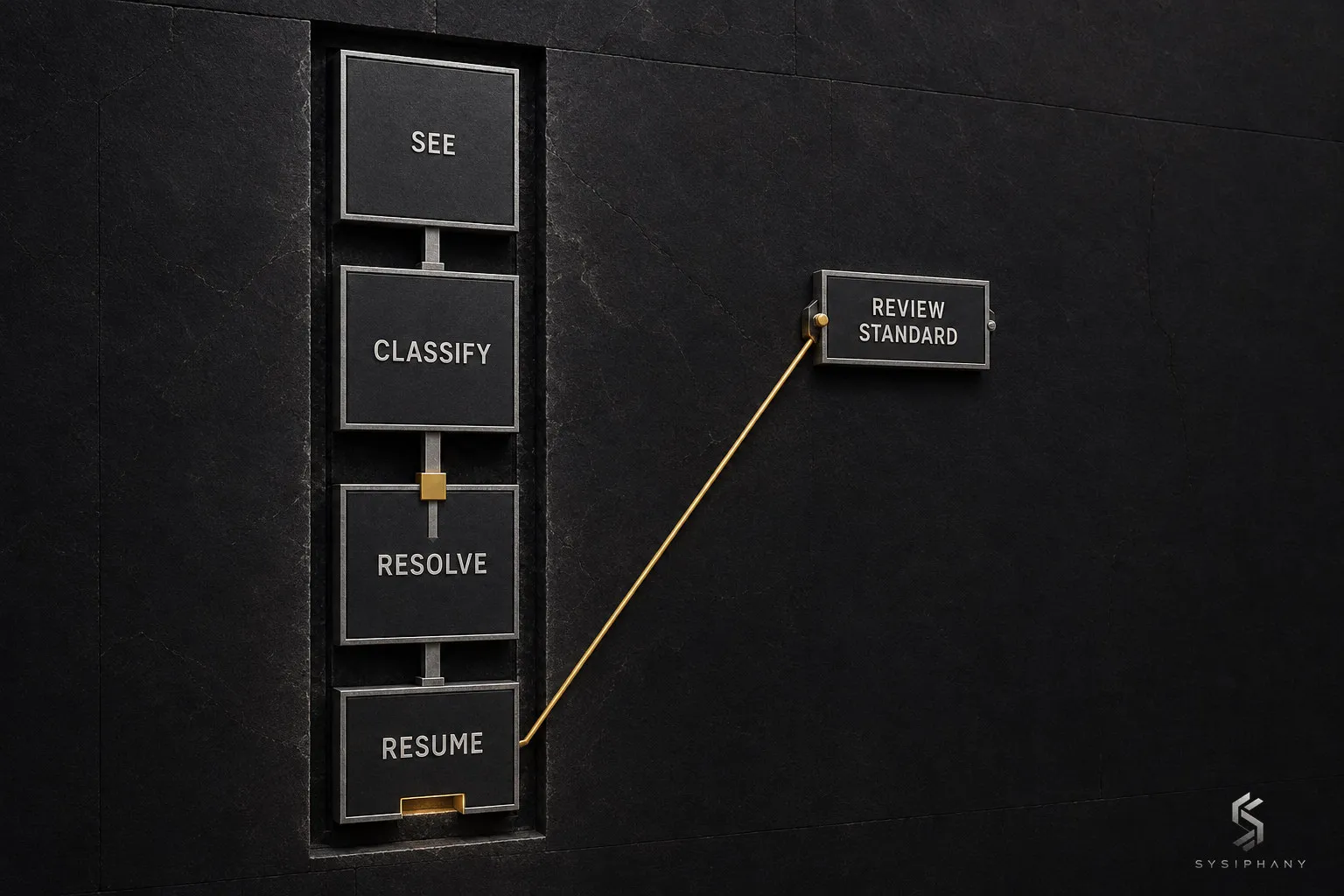
Patterns should be delegated to the operating layer that owns the correction:
| Recurring signal | Review destination |
|---|---|
| The same required input is repeatedly missing | Standard or handoff design |
| Similar cases repeatedly cross the same authority limit | Decision-rights review |
| People cannot tell where the case left the normal path | Process documentation or standardization |
| Exceptions accumulate or wait at one stage | Bottleneck diagnosis |
| The same integration or automated action fails | Workflow automation architecture |
Case resolution and process improvement are separate responsibilities. The live exception needs a timely, authorized outcome. Changing the normal path needs broader evidence, an accountable change owner, and a controlled test. One difficult case should not rewrite the process by reflex.
Test the loop with recent real cases
Reconstruct five to ten recent abnormal cases from one process. For each, ask whether a person could locate the controlling record, understand why normal work stopped, identify the current owner, see when a response was due, verify the resolution, and find the resume or close state.
Then use the minimum register during a bounded live test. Useful signals include:
- open exceptions with no current owner;
- time from detection to first named owner;
- cases beyond their response expectation;
- cases reopened because the resolution or resume point was unclear;
- repeated categories;
- cases that return to the founder despite an existing authority route.
These signals do not need universal thresholds. The first test asks whether the loop makes abnormal work visible and movable. Once the human protocol works, software can support intake, reminders, routing, and reporting. Technical detection, retries, monitoring, and recovery testing belong to the workflow-automation guide, not this operating loop.
If the test reveals ownerless exceptions, conflicting records, trapped judgment, and repeated founder rescue across several processes, Download the Operational Drag Diagnostic Kit. It can help separate one missing exception loop from a broader operating-design problem.
FAQ
What is an exception in a business process?
A process exception is a case that cannot safely reach a valid outcome through the documented normal path. It begins where permitted variation and ordinary operating rules no longer provide a valid next step.
What is the difference between an exception and a rejected handoff?
A rejected handoff means the receiving stage cannot accept the work because the agreed transfer criteria were not met. An exception means a case cannot safely continue through the normal process even when the transfer itself may have been valid.
Does the process owner resolve every exception?
No. The process owner is accountable for the end-to-end process and its improvement, but the current exception may require a specialist, delivery lead, finance role, counsel, or another authorized decision-maker. The exception record should distinguish movement ownership from decision authority.
What happens when an abnormal case crosses an authority limit?
If the decision rule names an authority and a safe interim state, the current owner preserves the evidence and follows that rule; the case has not entered the exception loop merely because it is waiting. It becomes an exception when no safe waiting state or usable authority route exists, or when the authorized decision leaves the normal process without a valid next step. Escalation by itself never counts as approval or resolution.
When should an exception change the standard process?
A repeated pattern should trigger review when evidence suggests the normal path, permitted variation, handoff, authority rule, or source record no longer fits the work. The process changes only after an accountable owner reviews the pattern and tests a controlled revision.
Should process exceptions be automated?
Automation can support capture, routing, reminders, evidence collection, and reporting after the human operating rule works. It should not invent ownership, authority, or a resume point from historical behavior. Consequential decisions and ambiguous cases remain with accountable people.
Make abnormal work visible before it becomes normal
Choose one process where unusual cases repeatedly disappear into private follow-up. Create a minimum register, reconstruct recent exceptions, and test whether each case can move from discovery to a valid resume, reroute, or close state.
If the exception pattern crosses teams, systems, customer commitments, and founder-held judgment, Book a SYSIPHANY discovery call. We can help design the operating boundaries and recovery paths before hidden work is automated at scale.