

To measure a business process, define one unit of work and its start and accepted completion, choose a few measures of flow, quality, and human effort, then collect them under consistent rules. The result should be a baseline another person can reproduce, with unfinished work and missing evidence still visible.
Suppose your team reports that it completed more requests this week. Did customers receive more usable work? Were older requests left waiting? Did the founder spend the evening correcting the output? A completion count alone cannot answer those questions.
You do not need a dashboard to start. You need a small observation record whose numbers mean the same thing to everyone using it.
Quick answer: how do you measure a business process?
Start with one process, a stated collection window, and three to five measures that show movement, acceptable output, and effort. For each measure, write the counting rule, unit, evidence source, and collection owner. Collect across two operating cycles as a starting point, then check whether the observations are complete and representative enough for the question you want to answer.
Two cycles are not a sufficient-sample rule. Low volume, unusual work, or missing records can leave the baseline provisional. The first deliverable is an honest account of current performance, not a target, a diagnosis, or a promise of improvement.
Agree on what counts before collecting numbers
Choose a process with an observable beginning and an outcome somebody can verify. “Customer service” is too broad. “A standard account-change request, from receipt in the service queue to confirmation that the approved change is correct” is a workable boundary.
The definition needs to settle a few practical questions:
- Unit: Is one item a request, an order, a document, or a batch? Multiple tasks within one request do not become multiple completed requests.
- Start: Which recorded event starts observation? Starting the clock only when someone begins work excludes earlier waiting.
- Accepted completion: What evidence shows that the output meets the agreed requirement? Sending a file is different from its acceptance.
- Included work: Which case types belong, and which are outside this baseline?
If the team cannot agree on those boundaries, document the current business process first. This article assumes a usable process definition; it does not replace one.
A named process owner should resolve disagreements about the operating meaning of a measure. The person collecting the data can be someone else. Neither role should have to reconstruct every case from private conversations.
Which process measures should you start with?
Start with measures that answer different questions: how work moves, whether the output is acceptable, and how much human effort the process consumes. Pick the smallest set that answers your actual operating question. More measures create more collection work, not automatically better evidence.
For an initial service-process baseline, this set can work:
| Lens | Possible measure | What must be explicit |
|---|---|---|
| Flow | Accepted completions from the defined case population | One accepted output per case; no counting subtasks as outputs |
| Flow | Elapsed time from the chosen start to accepted completion | Calendar or business hours; treatment of pauses and missing timestamps |
| Quality | Cases accepted at first review divided by cases receiving a first review | A defined acceptance test and a visible denominator |
| Workload | Human minutes spent on the included cases through the cutoff | Include checking, chasing, correction, and founder assistance; separate report preparation |
Open-case count and age belong beside these results as context. A fast completion-time result can describe only the cases that finished while the difficult cases remain open.
The 2016 SpringerPlus review “Business process performance measurement: a structured literature review of indicators, measures and metrics” explains that indicator selection depends on the organization and examines process performance across multiple perspectives. It supports choosing measures for the operating context. It does not establish this article’s starter set as a universal standard or supply small-business benchmarks.
Flow, quality, and workload are useful lenses, not a compulsory scoring formula. Accepted output anchors the set, but internal acceptance still does not prove customer value. If the process promises a customer outcome, keep the evidence for that outcome distinct from evidence that an internal step finished.
Give each measure a definition another person can use
A label such as “turnaround time” leaves too much open. The collector needs to know exactly which events, records, and cases count.
Before collection begins, complete this short specification for each chosen measure:
| Field | What to write |
|---|---|
| Question | What do we need to understand about this process? |
| Counting rule | Events counted, calculation, numerator and denominator where relevant |
| Unit and clock | Requests, minutes, hours, or percentage; business/calendar time and timezone |
| Population | Cases entering in the window, cases completing in it, or another explicitly defined set |
| Evidence | Authoritative fields or records; where acceptance is verified |
| Collector | Person responsible for capture and for flagging gaps |
| Limitations | Missing events, exclusions, estimates, and case types not represented |
For example: “Elapsed calendar hours from the service queue’s received timestamp to the acceptance timestamp, for standard account-change requests received in this window and accepted by the cutoff. Pauses remain in elapsed time. Report how many accepted cases have both timestamps, plus the count and age of cases still open.”
That definition is longer than “turnaround time,” but it prevents several different measurements from sharing one name. Detailed comparisons between lead time, cycle time, and touch time are a separate task. Here, the immediate requirement is to make the chosen clock reproducible.
Prefer evidence already created by the work. When a record is missing, mark it missing. An estimated timestamp should remain labelled as an estimate, with its basis, rather than being blended into observed timestamps. If two systems disagree, identify which record controls the measurement before combining their values.
Choose a window without hiding unfinished work
A baseline window needs both a start and a cutoff. It also needs a rule for which cases belong. Two useful approaches answer different questions:
- Entry group: Follow all eligible cases received during the window. Some may still be open at the cutoff. This exposes what happened to a defined group of incoming work.
- Completion window: Count eligible cases accepted during the window, including work received earlier. This describes output in that period, but does not describe the experience of all incoming work.
Either can be useful. Mixing their denominators without saying so makes the result misleading. Keep the case identifiers so another operator can reconstruct the population.
For a first baseline, observe two normal operating cycles and record the actual dates. A weekly cycle might mean two weeks; a monthly process needs a different window. Extend collection when the window misses ordinary case types, reflects an unusual surge, or contains too few completed cases to answer the intended question. High-consequence decisions need stronger evidence than a first look at the work.
Record the mix as well: standard versus complex requests, routine versus urgent work, or whichever distinction materially changes the effort. Avoid turning one blended average into a description of every case type.
Returned work stays connected to its original case. A correction is not another unit of completed output. If acceptance is later withdrawn and the case reopens before the cutoff, show it as open at that cutoff and retain its earlier acceptance history. If it reopens after the baseline was frozen, preserve the dated baseline and add a revision note rather than silently rewriting what was known then. The operational handling of the case belongs in business process exception management.
A small example: six requests, not six success stories
The following records are illustrative, not SYSIPHANY customer results. A team follows six standard account-change requests received during its two-cycle collection window. At the cutoff, four have accepted output and two remain open. All effort entries are observed minutes on those cases through that cutoff, including corrections and assistance.
| Case | State at cutoff | First review | Elapsed calendar hours to acceptance | Human minutes so far |
|---|---|---|---|---|
| A | Accepted | Accepted | 8 | 45 |
| B | Accepted | Accepted | 16 | 60 |
| C | Accepted after correction | Returned | 24 | 100 |
| D | Accepted | Accepted | Acceptance timestamp missing | 55 |
| E | Open; not yet reviewed | Not observed | Still open; age 32 hours | 30 |
| F | Open; not yet reviewed | Not observed | Still open; age 8 hours | 10 |
Case D has recorded evidence that the output was accepted, but no reliable acceptance time. That distinction matters: it can count as accepted output without being included in the elapsed-time calculation.
The baseline reads:
- Accepted output: four of the six incoming cases were accepted by the cutoff; two remain open. This is the entry group’s current disposition, not the process’s long-run completion rate.
- Elapsed time: median 16 calendar hours across the three accepted cases with complete timestamps. Coverage is three of four accepted cases. Neither the missing timestamp nor the open cases disappears from the report.
- First-review quality: three of four reviewed cases were accepted at first review, or 75%. The two cases not yet reviewed are reported separately, not classified as failures or successes.
- Human effort: 300 minutes spent on all six cases through the cutoff. Work on the two open cases is unfinished, so this is not a completed-case cost or a sustainable-capacity estimate.
The collector also spent 20 minutes preparing the baseline. That effort is reported separately so measurement does not become invisible overhead.
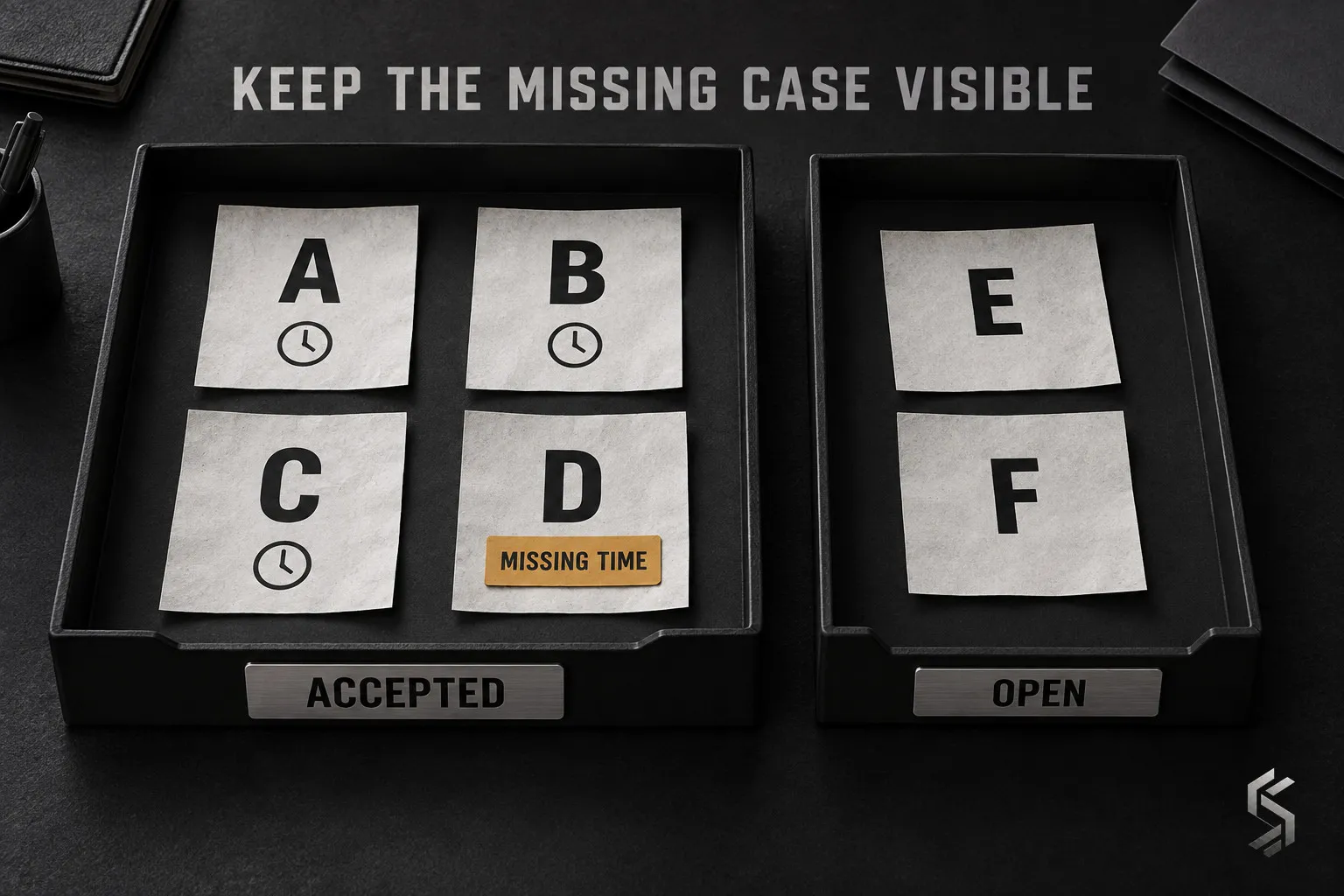
The example is useful because it exposes limits. It does not prove the process is fast, slow, healthy, or broken. Six requests are not a general benchmark. Case D’s missing time makes the elapsed result provisional, and the open cases mean the group’s eventual experience is not yet known.
Is the baseline usable, provisional, or unusable?
A baseline is usable for a stated purpose when its definitions are reproducible, its records support the calculations, and its limits do not defeat that purpose. It is provisional when more observation or evidence is needed, and unusable when the counting rules or source records cannot support the claimed result.
These are plain-language judgments, not statistical certification. Different measures on the same sheet may earn different judgments. In the example, the accepted-case count is reproducible at the cutoff; the elapsed-time result remains provisional.
Ask a second operator to reconstruct a few entries from the stated source. If they choose different start events, count a returned item twice, or cannot verify acceptance, repair the definition or evidence before relying on the total.
Then ask whether the window represents the work you intended to observe. The baseline may be perfectly calculated yet unsuitable for a staffing decision, a contractual promise, or an improvement claim. A short record of routine requests cannot stand in for complex seasonal work.
Finally, check the effort of collection. If people spend longer explaining the report than recording the work, remove fields that do not answer the stated question. Keep the minimum detail needed to reproduce the result and expose its limitations.
Finish with one baseline sheet, not an ongoing reporting system
The one-page summary should identify the process boundary, collection dates and population, definitions and sources, collector, results with denominators, open or missing cases, case mix, collection effort, and the judgment for each result. The underlying case list remains available for checking.
Stop there for this first pass. Targets, trend displays, decision triggers, and recurring review meetings belong to ongoing scorecard design. Investigating why work waits belongs to finding process bottlenecks. The baseline supplies evidence for those tasks; it does not perform them.
If collection keeps exposing conflicting records, unclear completion, or founder-only knowledge, Download the Operational Drag Diagnostic Kit. That is a reason to inspect the operating ambiguity before adding reporting software.
FAQ
Can I measure a process with a spreadsheet?
Yes. A controlled spreadsheet can hold the case list, definitions, sources, dates, and calculations. The important test is whether another person can reproduce the result, not whether the tool has a dashboard.
How much historical data do I need?
There is no universal minimum. Begin with a window covering normal operating cycles, then assess volume, case mix, missing evidence, and the consequence of the intended decision. Existing history is useful only when its definitions and records are comparable.
Should cancelled requests count as completed?
Only if the measure explicitly concerns resolved dispositions rather than accepted service output. Keep cancellations in the population with their reason and state, but do not quietly add them to accepted-output totals. Report the distinction.
Should I measure individuals or the whole process?
Begin with the process. Its results can depend on waiting, input quality, shared systems, and work passed between people. Named collection ownership does not make a process baseline a valid individual performance ranking.
Can AI fill gaps in the data?
AI may help locate or organize records, but it cannot turn a missing event into an observed fact. A person should verify extracted evidence and preserve unknowns. Do not use plausible estimates to make the baseline look complete.
Make the first observation trustworthy
Choose one process and write down exactly what will count. Collect across the initial window, keep incomplete cases visible, and ask someone else to reproduce the results. Extend the observation when its limits prevent the intended use.
If that is blocked by conflicting ownership or records across teams, Book a SYSIPHANY discovery call. The useful starting point is the operating boundary that prevents trustworthy measurement, not a new reporting platform.