

To find the root cause of a business process problem, define the recurring failure, reconstruct what happened, compare plausible explanations, and look for evidence that could prove each explanation wrong. Stop when you can support a specific causal statement within a clear scope, or explain exactly why the cause remains unresolved.
A team corrects an order, reminds everyone to check the details, and moves on. The same error returns. The reminder may have helped someone catch it sooner, but nobody established how the wrong detail entered the work.
Root cause analysis should change that conversation before the business funds another fix.
Quick answer: how do you investigate a recurring process problem?
Start with one observed outcome, not a preferred solution. Establish the facts, write competing causal hypotheses, and choose checks that distinguish them. A credible conclusion explains the mechanism, identifies its evidence, and names what remains uncertain.
Keep the investigation bounded:
- One failure type and a defined set of cases.
- A factual sequence with evidence references.
- More than one plausible explanation.
- A check that could weaken the favored explanation.
- A supported, narrowed, or unresolved finding.
This guide starts after a recurring problem has been identified. If the question is still where work gets stuck, use How to Identify Bottlenecks in a Business Process. Locating the constraint and explaining its cause are different jobs.
Frame the problem without smuggling in the answer
“The team needs training” is a proposed remedy. “The software is unreliable” is an explanation to test. Neither tells an investigator precisely what failed.
A useful problem statement identifies the expected outcome, observed departure, process boundary, affected cases, and period. Keep possible causes in a separate field.
Here is a hypothetical example used throughout this article. The business, records, observations, and people are invented for explanation, not client results:
During the selected review period, repeat orders arrived at dispatch with an address different from the customer’s confirmed delivery address. The investigation covers order creation through release to dispatch, for the affected repeat-order cases and comparable cases without that mismatch.
The order record is the starting point. Customer complaints after delivery may supply further evidence, but the team is investigating the address mismatch before dispatch, not every reason a delivery might fail.
The Centers for Medicare & Medicaid Services, in Guidance for Performing Root Cause Analysis (RCA) with Performance Improvement Projects (PIPs), recommends stating what went wrong objectively, building a factual timeline, and focusing the analysis on systems rather than individual performance. Its context is healthcare facilities. Those principles inform this investigation; its clinical requirements and examples are not small-business operating standards.
Assign someone to maintain the investigation note and bring in people who actually handled the work. Set a review point and a time budget proportionate to the consequence. A time limit forces a disposition; it does not make weak evidence sufficient.
Reconstruct what people could see at the time
For each selected case, follow the records from the last known correct state to the first confirmed incorrect state. That transition is more useful than a general account of a difficult week.
In the hypothetical order case, the investigator checks the customer confirmation, the address saved when the order was created, later edits, and the version released to dispatch. A screenshot of today’s customer record cannot establish what the order contained yesterday.
Keep three kinds of statement separate:
| Statement type | Example | How to treat it |
|---|---|---|
| Observed fact | The saved order contained the old address before dispatch opened it. | Attach the dated record or event reference. |
| Recollection | The operator remembers selecting the updated address. | Preserve as testimony; seek corroboration. |
| Interpretation | Dispatch must have overwritten the address. | Keep as a hypothesis until the sequence supports it. |
Interviews should ask, “What information was available when you made that choice?” An explanation that depends on knowledge acquired afterward misrepresents the decision people actually faced.
Include cases where the problem did not happen. Successful repeat orders may reveal a relevant difference: an alternate creation path, a manual check, or a different input state. Select comparisons for their relevance, and record differences in case type, timing, and handling. A convenient successful case is not automatically a valid comparison.
When timestamps conflict or a crucial record is missing, mark the gap. Do not silently arrange uncertain events into a confident causal story. If the basic definitions are unreliable, return to How to Measure a Business Process rather than inventing a baseline inside the investigation.
How do you tell a root cause from a symptom or correlation?
A symptom describes the unwanted result. A causal explanation describes how particular conditions produced it. A correlation says two things occurred together; it does not establish the mechanism connecting them.
“Orders have the wrong address” is the symptom. “The errors happened on busy days” is an association. “Copying a previous order retained its address even when the customer record had changed” describes a mechanism that can be checked.
The word root should not force the team to find one ultimate explanation. Several conditions may combine. A copied address might create the mismatch, while an incomplete release check lets it reach dispatch. A busy period might increase reliance on the copy function without directly changing any address.
These distinctions matter because they imply different claims. Evidence that an incorrect address passed a check does not prove why the address was incorrect. Evidence of a copying defect does not prove that every failed delivery came from that defect.
Avoid stopping at “human error.” If someone selected the wrong field, examine the available information, interface behavior, instructions, and competing demands. Keep any required individual-performance review separate. Systems investigation does not erase personal accountability; it answers a different question.
Put rival explanations beside the favored one
A hypothesis earns its place by explaining the observed sequence, not by sounding familiar. Ask someone close to the work to offer an alternative before the first explanation hardens into agreement.
For the hypothetical address mismatch, the team considers:
| Hypothesis | What we would expect to observe | Evidence that would weaken it |
|---|---|---|
| Copying a previous order preserves its old address. | The mismatch is present at creation on the copy path when the customer address has changed. | The creation record has the correct address and the mismatch appears only later. |
| Dispatch overwrites the address during release. | The order is correct before a dispatch edit and wrong afterward. | The wrong address is already saved before dispatch access. |
| Customers change the destination after the order is created. | The order matches the confirmation available at creation; a later customer change introduces the difference. | The confirmed destination predates creation and already differs from the saved order. |
Each explanation predicts something different. A team-wide training session would not tell you which prediction is correct.
Some hypotheses may coexist. A later customer change could explain one subset while copied fields explain another. Split the finding when the evidence supports different mechanisms; do not force all cases under the most convenient label.
5 Whys and fishbone diagrams can help organize possible causes. Choosing between those tools is a separate task. Neither the number of questions asked nor the completeness of a diagram establishes that its proposed causes occurred.
Choose a check that can change your mind
The next check should discriminate between explanations. Reading more of the same complaint summaries may add detail without doing that job.
In the hypothetical example, the creation record shows the old address before dispatch access, and the customer confirmation predates creation. That weakens both the dispatch-overwrite and late-customer-change explanations for that case. It still leaves the copy mechanism to verify.
The operator then inspects the saved creation method and, with permission, reproduces the copy behavior using synthetic records in an isolated test environment. No customer order is created or released. If the copied record retains the prior address while a newly created record takes the current address, the check supports the proposed mechanism under those test conditions.
That is a diagnostic reproduction, not proof that a proposed fix will work in production. Before transferring the finding to live cases, confirm that the relevant software version, settings, and creation path match. Intervention design, rollout, and PDSA testing come later.
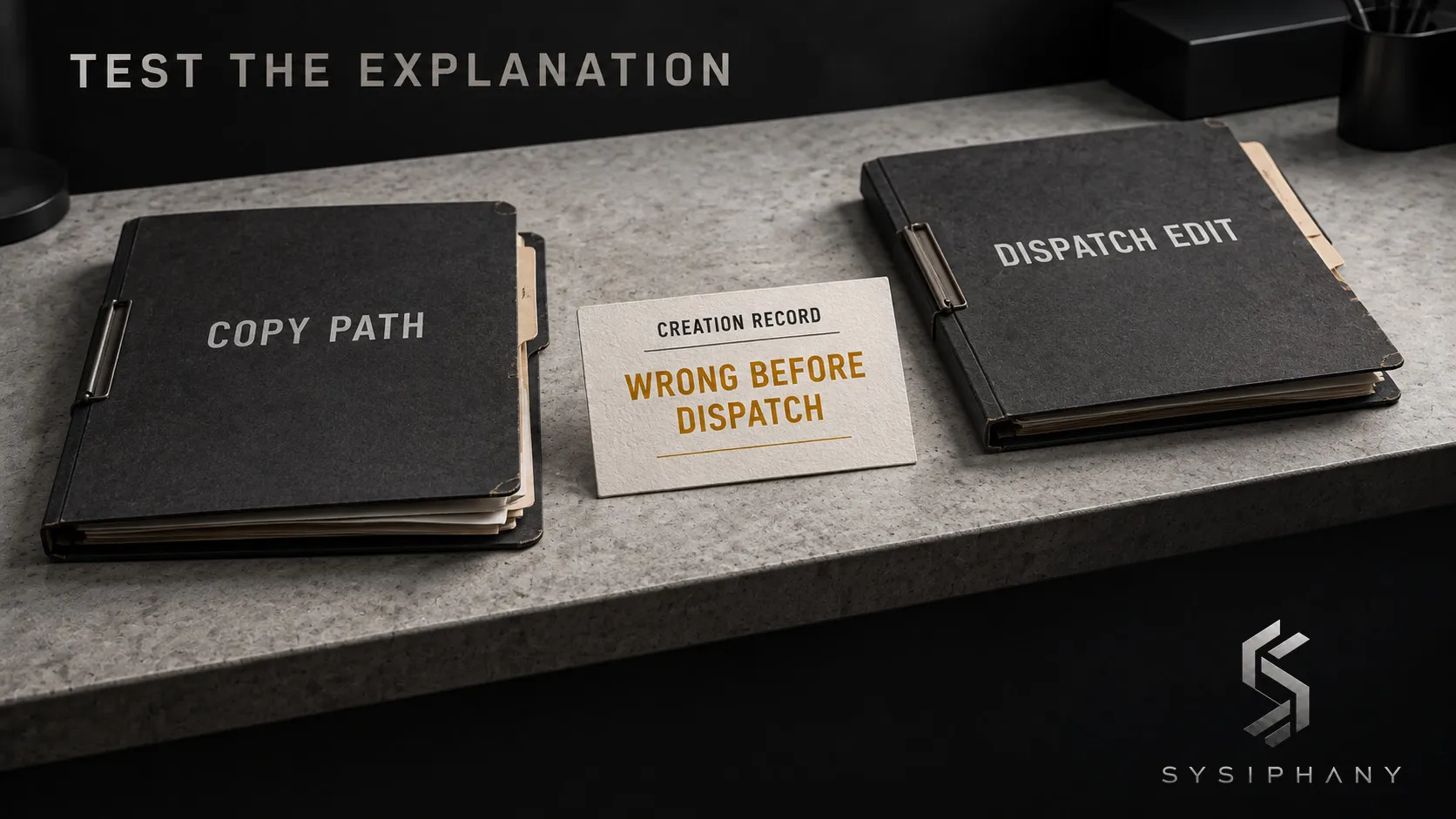
For each check, preserve its question, evidence reference, observed result, and effect on the hypothesis: supported, weakened, or still unresolved. Have a colleague inspect a material contradictory case rather than letting the hypothesis author explain it away.
A passed diagnostic check raises confidence within its scope. It does not make other causes impossible. If a live change would affect customers, finances, safety, or access rights, stop short of experimentation and involve the authorized owner or specialist.
When is there enough evidence to stop the investigation?
Stop the current investigation when the evidence supports a bounded cause statement strongly enough for the next authorized decision, with important alternatives and uncertainty visible. Stop unresolved when the necessary evidence cannot be obtained within the agreed scope.
There is no universal case count that proves a root cause. A directly observed mechanism can be more informative than many vague complaints. Conversely, an isolated reproduction may be insufficient for a consequential decision or an explanation intended to cover several teams.
Before accepting the finding, the investigator and process owner should be able to answer:
- Sequence: Did the proposed cause precede the outcome in the relevant cases?
- Mechanism: Can we explain and verify how it produced the failure?
- Alternatives: What evidence distinguishes it from credible rivals?
- Contradictions: Which cases do not fit, and how do they limit the claim?
- Decision: Is the remaining uncertainty acceptable for the specific next step?
A useful hypothetical conclusion for the case examined above would be:
For this repeat order, the saved creation record shows the previous address before dispatch access. The recorded copy method and an isolated reproduction support the copy-path explanation. This finding applies to this case and the tested configuration; other affected orders, newly created orders, and later customer changes have not been explained.
That statement is more useful than “the team was careless.” It identifies a supported creation mechanism without claiming that every reported mismatch shares it. Whether a release check should have caught the error is a separate question requiring its own evidence.
If the original records are unavailable, say unresolved, name the missing observation, and assign the next evidence-gathering decision. Do not keep widening the investigation indefinitely or approve a permanent fix because the meeting has run out of time.
Leave a cause statement, not another action backlog
The first operating asset is a compact investigation note. It needs the problem boundary, case references, factual sequence, rival hypotheses, checks and results, supported causal statement, remaining uncertainty, and the person accepting the disposition.
Keep sensitive records in their controlled location; the note can use case identifiers and links. Record why an alternative was rejected so another operator can inspect the reasoning without reconstructing the founder’s memory.
A supported cause is an input to corrective-action design, not an implementation authorization. Immediate customer protection may need to continue through the existing business process exception-management loop while that separate decision is made.
If this investigation exposes broader friction around ownership and conflicting records, Download the Operational Drag Diagnostic Kit. The cause statement itself remains usable without it.
Frequently asked questions
What if the problem disappears while we investigate?
Absence during a short observation window does not disprove a cause. Check whether the triggering conditions occurred, whether work volume or case mix changed, and whether someone quietly intervened. Keep the finding provisional when exposure to the suspected condition is unknown.
Can a root cause be outside our control?
Yes. Supplier changes or external service failures may contribute. Separate what the evidence establishes from what your business can change. An inconvenient cause does not become false because it is difficult to address.
What if two people disagree about what happened?
Preserve both accounts and identify the record or observation that could resolve the difference. Seniority is not evidence. If the difference materially affects the causal claim and cannot be resolved, keep that part of the finding uncertain.
Can AI perform the root cause analysis?
AI can organize approved evidence or suggest competing explanations. It cannot turn missing records into facts or accept responsibility for the conclusion. A named person must verify the supporting records, challenge the reasoning, and approve any consequential next decision.
Before funding a fix, ask someone outside the investigation to read the cause statement and find its evidence. If they can only find confidence, the investigation is not finished.
For a problem spanning several teams, conflicting systems, or unresolved decision authority, Book a SYSIPHANY discovery call.