
Process drift is a growing gap between an approved way of working and what people repeatedly do in practice. Detect it by comparing the applicable standard with real cases over time, including workarounds and hidden repair. Then decide whether the business needs to restore a useful rule, revise one that no longer fits, or retire a step whose purpose has gone.
The job still gets delivered. The customer may notice nothing. Inside the business, however, a coordinator knows which instruction to ignore, a colleague keeps a private checklist, and the founder supplies the missing decision when someone is away.
Those adaptations deserve examination. Following the document more closely could restore a necessary control. It could also force the team back through work that should no longer exist.
Quick answer: how do you detect process drift?
Compare one current, authorized standard with a documented pattern of actual work. Look across at least two review periods, or an existing set of repeated deviations, rather than treating one difficult case as a new normal.
Ask what changed, which cases were affected, what the original rule protects, and what happens when people follow or bypass it. Keep permitted variation and missing evidence separate from confirmed deviations. A recurring mismatch calls for an owned decision; it does not automatically justify retraining or rewriting the SOP.
These are practical diagnostic recommendations, not a statistical test or a universal audit threshold. A single serious control failure still needs immediate attention through the existing incident or exception route.
Establish which standard the work was meant to follow
Before counting deviations, identify the authorized instruction, its version, its effective date and the work it covers. Compare each case with the version that applied at the time. A new instruction cannot make yesterday’s compliant work retroactively wrong.
The standard may deliberately allow different routes. A coordinator choosing an approved option is not drifting. Nor is a separately authorized, time-limited exception necessarily evidence that the default has changed.
If there is no agreed default, you have a different problem. How to Standardize a Business Process covers defining the normal path, required controls and permitted variation. This guide starts after that work exists.
A useful comparison begins with one precise rule: “The coordinator checks the current service scope before confirming the booking,” rather than “People are not following the process.” Beside it, write the intended protection. In this case, the check prevents the business from confirming work it has not agreed to deliver.
The protection matters more than the document’s age. An old rule may still be necessary; a newly issued rule may already be impractical.
What signals suggest that a process has drifted?
Repeated bypasses, unofficial instructions and growing dependence on personal repair suggest drift when they show actual work separating from the applicable standard. Performance changes can point you toward a review, but they do not prove that separation by themselves.
| Signal to inspect | Evidence worth comparing | What it does not establish alone |
|---|---|---|
| The same step is skipped repeatedly | Case records and direct observation against the applicable rule | Whether the step is unnecessary or difficult to perform |
| Staff teach a different method | What a regular operator and a cover colleague actually do | Whether the unofficial method is authorized or safe |
| A workaround becomes routine | Repeated extra checks, private messages or duplicate records | Whether it solves the original problem or hides it |
| More cases need founder rescue | Where the standard stops giving a usable next step | Whether the cause is the rule, authority, access or workload |
| Results look stable but effort rises | Rework, checking and recovery behind accepted completions | That the process is healthy because customers receive the output |
| The work context changes | New case types, tools, suppliers or commitments beside the old rule | That the whole standard must be replaced |
CHA’s The Threat of Procedural Drift Is Real discusses this problem in safety- and compliance-focused engineering and related industries. It recommends collaborative observations and employee feedback, including considering revision when a procedure is consistently bypassed. That supports examining the procedure as well as its execution. It is not evidence of small-business results or a reason to remove mandatory controls.
Ask the person doing the work to show a recent case. “Where did the instruction stop helping?” is more useful than asking them to certify that they followed it. Check the explanation against the record before accepting it as the cause.
Compare like work before declaring a pattern
Start with the evidence already available in the process record. Select a defined case type and comparable observation windows. Include ordinary work, not only complaints, and retain unsuccessful or unfinished cases that reached the step being examined.
For each window, keep the number of eligible cases beside the number with the specific deviation. If only renewal bookings require a renewal check, new bookings do not belong in that denominator. More deviations during a busier period do not necessarily mean more frequent bypassing.
A compact comparison needs:
- the rule and version that applied;
- the case type, period and eligible-case count;
- confirmed deviations, permitted variations and cases where evidence is missing;
- any extra work needed to make the output usable;
- a change in conditions that could explain the difference.
Missing evidence stays unknown. An empty checkbox may mean the check was skipped, or that it happened without being recorded. Those require different responses. Avoid turning a weak audit trail into a confident accusation.
If the mix of work changed, separate the relevant case types before comparing periods. More complex bookings can create more exceptions even when the team applies the same standard. Conversely, a quiet month can conceal a growing habit of bypassing a control.
This comparison supports a bounded finding such as: “Across both windows, renewal bookings repeatedly used an old scope attachment instead of the current record.” It does not yet prove why. When competing explanations would lead to different actions, the root-cause investigation guide owns that deeper work.
Decide whether to restore, revise or retire
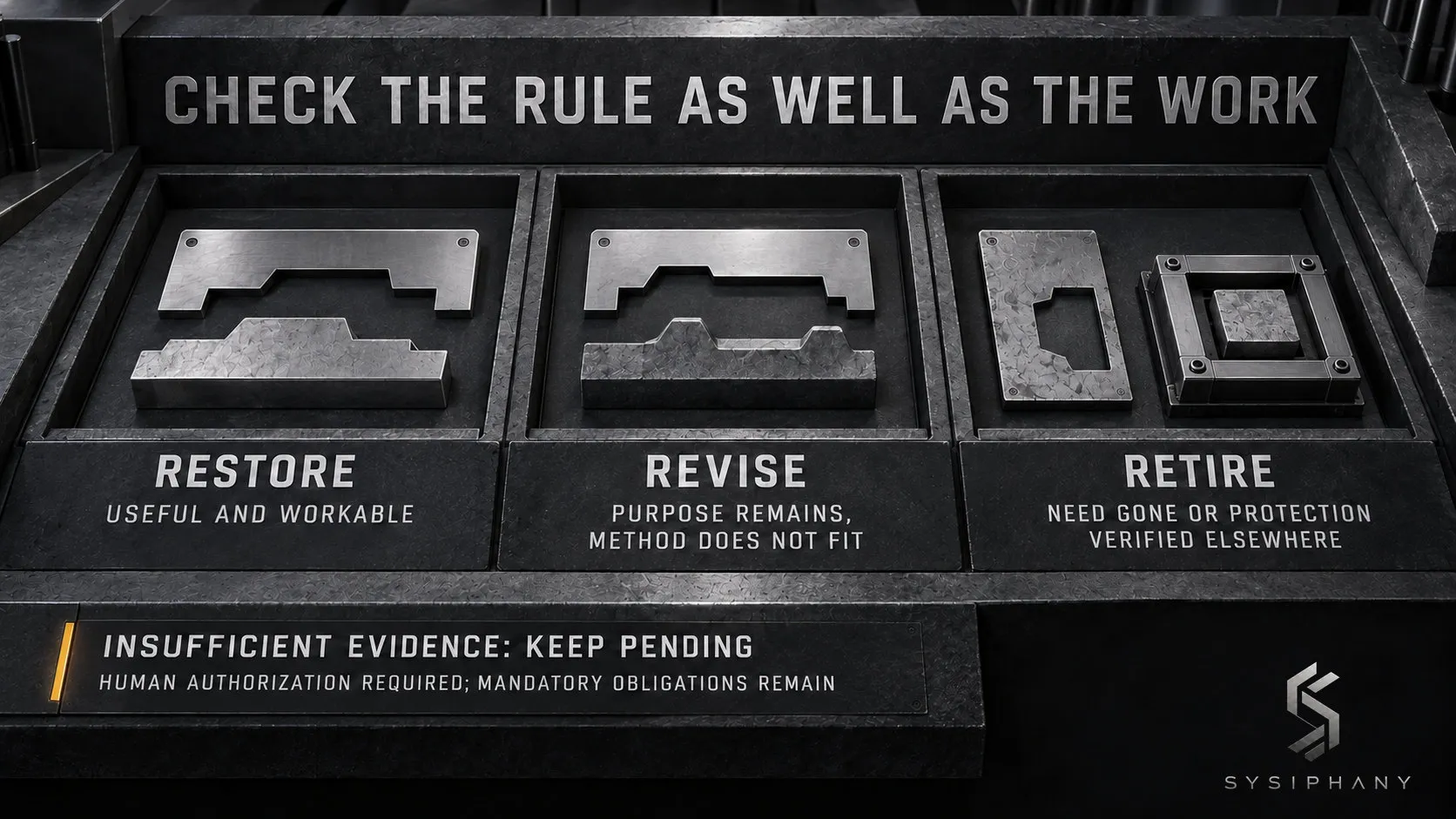
Separate two questions: Does the work follow the approved rule? Does that rule still serve a necessary purpose in current conditions? Answering only the first turns every mismatch into an enforcement problem. Answering only the second can excuse a shortcut that quietly removes protection.
| Disposition | Evidence that supports it | What must remain protected |
|---|---|---|
| Restore the existing standard | Its purpose remains necessary and the method is workable; deviations reflect a verified access, understanding or execution problem | The required control and the conditions people need to carry it out |
| Revise the standard | The purpose remains necessary, but changed conditions make the specified method unreliable or impractical | The purpose of the control, with a proposed replacement method evaluated before adoption |
| Retire a step or standard | Its original need has ended, or another verified control fully serves that need without leaving a gap | Any remaining legal, safety, contractual, security or business obligation |
| Keep the decision pending | The cause, current obligation or replacement protection is unclear | Existing protections, an authorized interim arrangement and a named next evidence check |
Restore does not mean sending the same reminder again. If staff cannot access the current record at the point of work, the access problem must be resolved. If the method cannot reliably work under ordinary conditions, calling it a training issue will not make it usable.
Revise is a direction for controlled change, not permission to copy the popular workaround into the SOP. A proposed replacement may need a bounded PDSA test before it can become the default.
Retirement requires more than “nobody uses this.” Confirm who relies on the output and what would fail if the step disappeared. The person accountable for the affected control must authorize its removal within their authority. Legal, safety or regulated obligations require qualified review; absence of a recent incident is not evidence that a protection is obsolete.
Where the evidence is incomplete, say exactly what is missing. “Finance must confirm whether the duplicate sign-off still fulfills a contractual requirement” is a useful pending decision. “Review process” is not.
An example: the written route survives through private repair
Consider an invented example, not a client result. A small maintenance business requires coordinators to check the current service scope before confirming renewal bookings. The instruction tells them to open the scope attachment in the booking system.
The operations lead reviews ten eligible renewals in each of two recent booking windows. Eight in the first window and nine in the second needed a private founder check after the coordinator opened an outdated attachment. All twenty have traceable records; the standard has no adopted replacement route. These invented counts illustrate repeated dependence, not a statistical threshold.
Bookings went out on time because the founder confirmed what each affected customer was entitled to receive. That extra check was keeping delivery moving under an authorized temporary arrangement, but it had become routine rather than exceptional.
Observation reveals a specific change: approved scopes now live in the customer record, but the booking system still presents the old attachment. Both the regular coordinator and their cover follow that link. Opening it complies with the written method; needing repeated private confirmation exposes that method’s loss of fit. The drift lies in the growing repair work required beyond the documented path, not in an accusation that staff ignored the instruction.
This supports revision, not a general instruction to “follow the SOP.” The scope check still protects a real commitment. The specified place to perform it no longer fits the work.
The finding can be short:
Mismatch: Renewal bookings repeatedly use an outdated scope attachment, with founder confirmation compensating for it.
Evidence: Comparable renewal-case records from both windows, current instruction, observed link destination and traceable founder checks.
Decision: Revise the lookup method; retain the scope check. The operations lead has authority for the instruction change, not for changing customer entitlements.
Pending check: Confirm that the proposed current-record lookup is accessible and identifies the approved scope for both regular and cover staff.
Interim protection: Continue the existing authorized confirmation route until the replacement is accepted. No unverified scope becomes a customer commitment.
In this example, the lead assigns the access and lookup check to the system owner for the next working day, before any rollout decision. If it fails, revision remains pending. The bypass does not become approved merely because the team needs to finish today’s bookings.
Different evidence would change the disposition. If the authorized current-record route already worked and staff were using an old saved shortcut, restoration could fit. If a separate verified booking control already checked the approved scope, the redundant manual lookup might be a retirement candidate. Neither conclusion follows from the number of bypasses alone.
Put one drift finding into the existing review
The process owner should bring the pattern, proposed disposition and unresolved control questions to the person authorized to decide. There is no need to create another standing meeting or a separate improvement backlog.
A decision note should identify the affected standard, evidence, scope, decision-maker, interim protection and next check. Set an actual date and name who will supply any missing evidence. Until a change is authorized, preserve the applicable control or a specifically approved interim arrangement; an overdue review does not authorize a bypass.
Individual cases still follow the exception-management process. The aggregate finding does not resolve those cases for them. Likewise, authorizing a revision does not complete its rollout; the continuous improvement loop covers carrying the decision into everyday work.
For future detection, add a specific trigger to the existing review: for example, the same unapproved bypass appearing in successive comparable windows, or a tool change that invalidates the instruction. These are locally chosen review triggers, not universal limits. Serious harm or loss of a mandatory control goes through the immediate response route without waiting for recurrence.
If the pattern extends across conflicting records and repeated founder repair, Download the Operational Drag Diagnostic Kit. One bounded drift finding remains a useful first result without it.
Frequently asked questions
Can process drift happen while performance looks good?
Yes. Extra checking, private coordination or founder intervention can preserve the customer-facing result while the documented process becomes less usable. Examine the work needed to deliver the result, not only the completion measure.
Is process drift the same as an approved process change?
No. An approved change deliberately establishes a new applicable standard for a defined scope. Drift develops without that explicit decision. Check effective dates and authorization before classifying a difference; otherwise a legitimate change can look like noncompliance.
What if the process happens only a few times a year?
Review each occurrence and relevant changes in conditions. Keep the conclusion narrow when observations are sparse, and schedule the next check around the next real occurrence. A calendar deadline does not create enough evidence to declare a trend.
Can software detect process drift automatically?
Software can flag recorded deviations or changed sequences if its records and reference standard are reliable. It may miss private repair work and cannot establish whether a control is still required. A person must interpret the signal and authorize the response; observed frequency is not permission to rewrite the rule.
When several teams disagree about which standard applies or who may change a necessary control, Book a SYSIPHANY discovery call. Bring the comparison and the unresolved decision. Another reminder to follow the process will not settle conflicting authority.