Continuous process improvement for a small business means repeatedly using evidence to change how work gets done, checking the result and retaining what works. Give one person responsibility for the loop, limit active changes to what the team can finish, and keep each change open until its decision has reached everyday work.
The awkward part can arrive after the successful test. The revised instruction is still in someone’s notes. A colleague covering the work uses the old version. Meanwhile, the founder has started the next improvement.
Another idea will not resolve that unfinished handover. The business needs a way to carry a change from observed problem through an authorized decision to a working routine.
Quick answer: what keeps an improvement loop running?
A lightweight loop connects evidence, diagnosis, selection, testing, adoption and learning. Each part leaves a result the next person can use. One continuing record shows where the change stands, who owes the next decision and what will allow it to close.
Start with one active improvement for the people sharing the work. Keep other suggestions visible, but do not treat them as commitments. A change awaiting approval, training or a usable instruction still occupies that active slot.
BDC’s entrepreneur guide, Continuous improvement: Build a culture that drives efficiency and results, advises making improvement part of routine, standardizing successful changes and updating operating procedures. That guidance supports retaining the learning in how work is done. The active-slot and closure rules below are our practical recommendations, not BDC requirements or proven performance benchmarks.
How do you set up a continuous improvement loop without another program?
Attach it to one existing process, its owner and its work record. Start where a baseline and a completed test decision already exist; then make the next transition explicit rather than building a new reporting system.
If no usable baseline exists, How to Measure a Business Process owns that starting work. This guide connects the pieces once they exist. It does not replace measurement, root-cause investigation or test design with a shorter checklist.
The process owner maintains continuity: someone must know what is waiting and follow it through. The person doing the change may be different. A named backup needs access to the record and clear limits on what they can decide during an absence.
Ownership of the loop does not confer spending, policy or customer-commitment authority. An unresolved choice stays pending with the authorized decision-maker. If that person cannot respond in time, the owner follows the existing escalation arrangement; silence is not approval.
A short setup note can establish the routine:
Process: Which recurring work are we improving?
Owner and cover: Who maintains the record, and who covers absence?
Current commitment: Which single improvement is active, and what work remains?
Capacity: Whose time is available, including evidence collection and adoption?
Next decision: Who must decide what, using which evidence, by which date?
Closure: What must be true before another improvement enters?
Fill in actual names and dates. Keep evidence in its authorized source and link to it; a broadly shared improvement record should not become a second store of customer or employee details.
Connect the stages through evidence, not more checklists
The loop needs clear transitions, but each stage does not need its own meeting or document. A row in the existing work tracker can point to the baseline, investigation and test record.
| Transition | What needs to travel with the work | Who checks the handover |
|---|---|---|
| Observation to investigation | A specific problem, affected process and traceable observation; uncertainty remains visible | Process owner accepts a bounded question worth investigating |
| Investigation to selection | Evidence-backed explanation or a clearly stated uncertainty that a test could resolve | Owner confirms the proposed next step fits the evidence |
| Selection to test | The chosen change, available capacity and authorized test boundary | Test owner accepts the work within existing authority |
| Test to adoption decision | Observations, limits, side effects and the test verdict | Authorized decision-maker determines what may change in ordinary work |
| Decision to closure | Current instruction, affected people’s readiness, open-work disposition and follow-up responsibility | Process owner verifies that the decision has been carried out |
Those are handover conditions, not permission to skip the underlying methods. Root-cause investigation establishes what an explanation can support. Prioritizing process improvements settles which opportunity deserves scarce effort. The PDSA cycle guide defines the bounded test.
A repeat or revise verdict returns to testing with renewed authorization. A stop verdict leads to safe closure and a retained lesson. Neither needs to be disguised as a success to justify the work already spent.
Adoption is a separate decision from a promising test result. Someone must authorize the new default for a stated scope. That decision cannot rest on outcomes from people, case types or conditions the test never covered.
Count unfinished commitments, not just running tests
For a small team starting this routine, one active improvement is a useful initial limit. Apply it to the people who share implementation and adoption work, not separately to each list they maintain. Otherwise, sales, operations and finance can each announce one priority while the same coordinator inherits all of them.
The limit covers the commitment from admission through closure. Waiting for a decision or a revised instruction does not make the work disappear.
The record can use these plain states:
- Waiting: A suggestion or evidenced opportunity is retained, but nobody has committed delivery capacity.
- Active: The team has accepted the next bounded investigation, test or adoption task.
- Awaiting decision: Evidence is ready; a named person owes an authorized choice by a recorded date.
- Adopting: A change has been authorized, but the instruction, people or work still need to be brought into line.
- Closed: The chosen outcome is carried out, the lesson is retained and continuing responsibilities have been accepted.
A paused item keeps its previous state visible and records the blocker, owner and next check. It still counts as unfinished. To free the slot, explicitly stop or defer the commitment, settle any live test work and assign any remaining protection or monitoring. Moving a card back to “Waiting” without doing that only hides the obligation.
Safety issues, live customer harm and required controls do not wait behind an improvement limit. Handle them through the existing incident or exception route. If that urgent work consumes the same people, pause the improvement deliberately and name when its status will be reconsidered. Do not quietly run both at full load.
The limit can grow later if the team has genuinely separate capacity. First demonstrate that it can finish and retain a change without repeated founder rescue. Counting ideas launched will not answer that question.
Close the change where people actually work
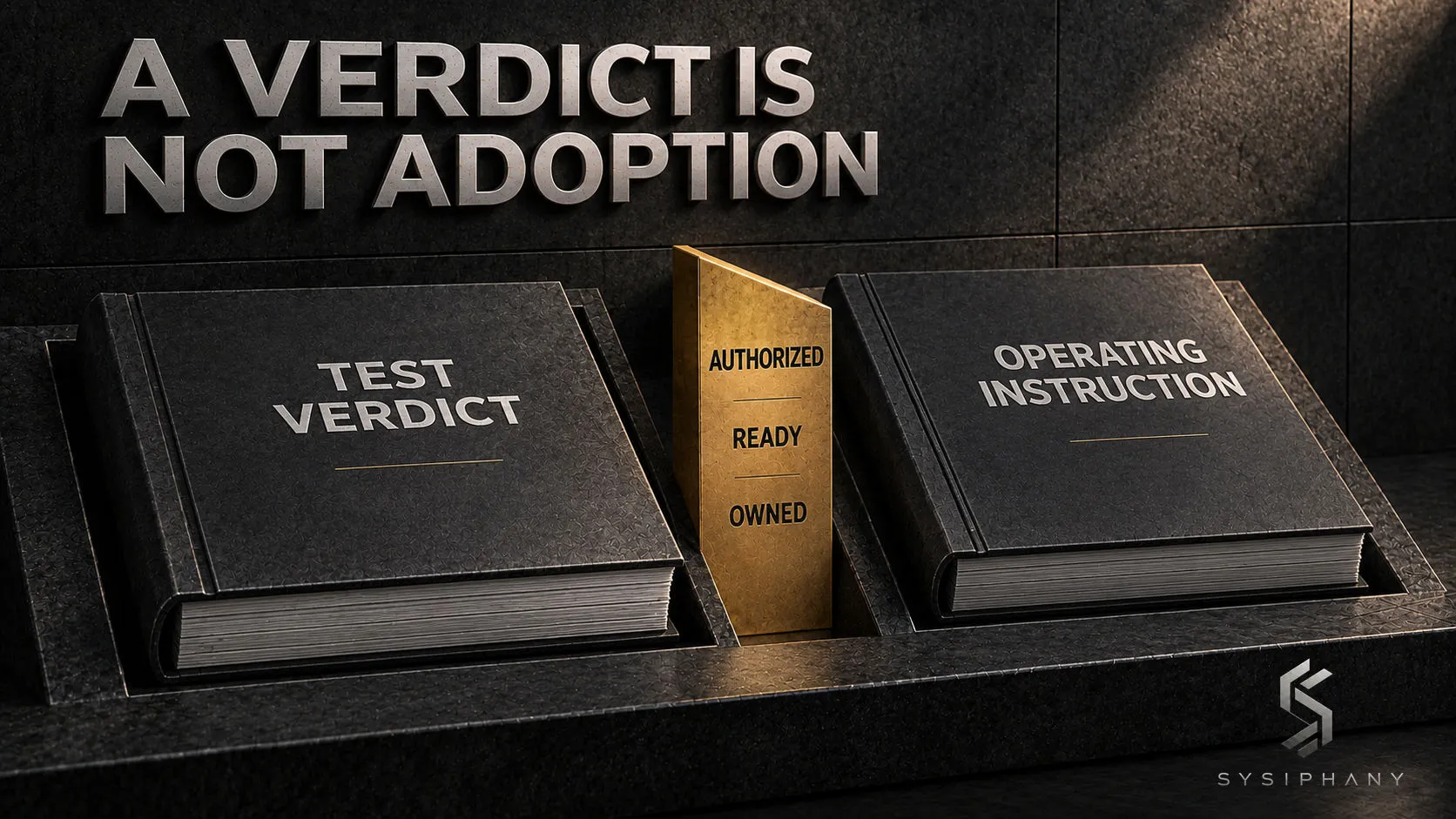
“Test passed” is not a sufficient closure note. For an adopted change, the owner should be able to point to the authorized working instruction, show who is ready to use it and identify who will check the outcome next.
Before releasing the active slot, confirm:
- The decision is explicit. Its scope and authority are recorded, including any conditions that remain excluded.
- The operating asset is current. The relevant checklist, instruction or system rule reflects the decision. Old copies are marked superseded or removed from routine use according to retention requirements.
- Affected people can work from it. The regular operator and relevant cover have had the necessary explanation and demonstrated the changed step. An unread announcement is not evidence of readiness.
- Open work has a safe disposition. Everyone knows which instruction applies to cases already underway; nothing is left between the test and normal operation.
- Follow-up is accepted. A named person owns the next check, its date and the condition that calls for action. The lesson links to the evidence behind the decision.
The artifact itself may be small. If the improvement removes a redundant report, the retained instruction might simply say that the report is no longer required, who authorized its removal and which remaining control still supplies the needed information. Do not create a replacement report merely to document progress.
How to Standardize a Business Process covers the default path and permitted variation. Here, the narrower question is whether the authorized change has actually reached that path.
For a stopped change, closure looks different: test entry has ended, affected work is safely accounted for, the applicable instruction is unambiguous and the reason for stopping is retained. A useful negative result deserves a clear record. It does not need a new standard.
An example: the test is over, but the slot stays occupied
Consider an invented example, not a client result. A small repair business has tested removing a duplicate internal job-status email. The approved job record already contains the information. The test decision supports removal for routine jobs, while urgent jobs retain their existing notification requirement.
The operations lead, Mara, has authority to adopt that limited change. She approves it. The coordinator, Joel, asks to start the next improvement: simplifying parts requests.
But the cover coordinator still has an old checklist requiring the email. The team has not settled which rule applies to routine jobs already open. Calling the first improvement complete would leave Joel to explain the exception each time he is away.
The continuing record could read:
| Field | Illustrative entry |
|---|---|
| Current state | Adopting; active slot remains occupied |
| Decision and evidence | Mara’s adoption decision and completed test record linked; routine jobs only |
| Remaining work | Update the shared checklist, retire the routine-use copy and confirm cover readiness |
| Open work | Mara confirms that routine jobs already open use the revised rule; urgent jobs keep their existing notification |
| Owner and next decision | Joel owns the update; Mara verifies closure before another change is admitted |
| Follow-up | Cover coordinator Nia accepts the next check of whether staff can find and apply the revised instruction without Joel’s help |
In this example, Joel’s update is due October 20, 2026, at noon; Mara’s closure check is at 3 p.m. that day. Nia’s follow-up is due October 23 at noon. All times are in the invented business’s local office time. These dates and roles illustrate a complete record, not a recommended cycle length.
If the instruction or cover readiness is still missing at Mara’s check, the state stays Adopting. Mara addresses the blocker and records a new decision date; the parts-request change remains waiting. When the closure conditions are verified, the first item closes and its follow-up remains assigned to Nia. Closure does not erase that responsibility.
The useful result is specific: a colleague can now identify the applicable rule without Joel’s personal explanation. No time saving or performance gain is assumed from the example.
Set a checkpoint that fits the evidence
Choose the next decision date when work is admitted, then match later checks to the process and the risk. A weekly checkpoint may suit frequent service work. A change affecting a monthly activity needs observation of that activity before its result can be judged.
The date creates an obligation to review the state, not an obligation to report an improvement. If evidence is insufficient, the owner records what is missing, who will obtain it and whether the commitment should continue within its limits.
Keep this check inside the existing review routine. How to Run a Process Performance Review covers the agenda and decision roles when discussion is necessary. This loop needs continuity between those reviews, including during holidays and busy periods.
Suggestions should still receive an answer while the active slot is occupied. The owner acknowledges the observation and records whether it is waiting, needs evidence or is outside scope, with a reason and a return date where appropriate. People doing the work need to see that their contribution was considered. They do not need a promise that every suggestion will become a project.
Before admitting the next item, look back at the closed record. What did the evidence change? Which obligation remains with normal operations? What would make the team reopen the question? Carry those answers forward without copying the entire history into a new form.
If even one loop repeatedly stalls because records conflict or ordinary decisions return to the founder, Download the Operational Drag Diagnostic Kit. The routine above remains usable without it.
Frequently asked questions
Is continuous improvement the same as constant change?
No. A process can remain unchanged while the team observes its performance and checks whether a proposed intervention is justified. Keeping a useful standard is a valid outcome. An improvement routine should not require a fresh project merely to fill the calendar.
Do we need continuous improvement software?
Not to start. An existing work record with links to evidence, an owner, a current state and a next decision date can support the loop. Consider software only when a demonstrated coordination problem warrants it; moving an unclear commitment into a new application will not make it finish.
What if the owner leaves or changes roles?
Transfer the open commitments, evidence access, authority limits and follow-up dates to a named successor who accepts them. Until that happens, the responsible manager must retain oversight and decide whether active tests can safely continue. A new name in the tracker alone is not a completed transfer.
Can two teams run improvements at the same time?
Yes, if their capacity and affected work are genuinely independent. Check for shared reviewers, systems, operators and customer commitments before treating the work as separate. When both changes depend on the same people or could obscure each other’s results, agree sequencing or a combined authorization rather than assuming two free slots.
When a change cannot move into everyday work because authority or commitments conflict across teams, Book a SYSIPHANY discovery call. Bring the unfinished improvement record. The missing piece may be an operating decision, not another initiative.