
A workaround gets work moving despite a problem. Corrective action addresses a supported cause so the same failure is less likely to recur. A successful workaround may be necessary today, but it does not establish that the underlying process has been corrected.
The customer receives the amended document. The ticket closes. Next week, someone makes the same amendment again.
If that person is the founder, the business may look reliable while quietly depending on their availability. The rescue worked. The recurring problem remains open, even if the task board says otherwise.
Quick answer: corrective action vs workaround
Judge the response by what it changes, not how quickly it was completed. A workaround changes how today’s work gets through. A corrective action changes the conditions that caused the failure; an effectiveness check determines whether that change worked within the agreed scope.
| Response | Its job | What completion does not prove |
|---|---|---|
| Containment | Limit exposure while the problem is unresolved, such as holding suspect output. | That the cause has been removed. |
| Correction | Repair the affected item, such as replacing an incorrect reference. | That future items will be right. |
| Workaround | Use an alternate route or extra effort to complete work despite the problem. | That the normal process can succeed without the rescue. |
| Corrective action | Address a cause of an observed failure to prevent recurrence. | That installation alone establishes effectiveness. |
| Preventive action | Address a potential failure before it occurs in the relevant scope. | That every related process now needs the same change. |
These jobs can coexist. A team might hold documents, correct affected copies, use a temporary manual check, and change the source of the error. Calling all four activities “the fix” hides which work is still outstanding.
This article begins with a cause supported by evidence. If the cause is still a plausible story, use How to Find the Root Cause of a Business Process Problem. For routing and resolving the live abnormal case, use Business Process Exception Management. Here, the decision is whether the response corrects the process and what would justify closing it.
How can you tell whether a fix is only a workaround?
Ask what would happen on the next comparable case if the extra rescue stopped. If the same failure would still arise from the unchanged condition, the response is compensating for the problem.
That is a reasoning check, not permission to remove protection from live work.
Consider an invented example, not a client result. A service firm has already established that staff retype a confirmed project reference into a separate completion-certificate template. That duplicate entry creates mismatches. The reference is required; the second editable copy is not.
The responses have different jobs:
- Holding affected certificates before sending them contains the exposure.
- Amending a wrong certificate corrects that document.
- Asking a coordinator to compare every certificate with the project record is a workaround while the duplicate entry remains.
- Removing the duplicate editable field and generating the reference from the confirmed project record is a proposed corrective action against this particular cause.
A training session on careful typing would leave the duplicate-entry condition intact. Training could still be needed to introduce the changed process, but attendance would not prove that mismatches had stopped.
Nor would automating the coordinator’s comparison automatically change the classification. A faster check might be a useful protective control. If the error-producing condition is untouched, describe the remaining limitation honestly.
The useful question is specific: which supported cause does this change remove or control? “Improve communication” does not answer it. “Remove the second place where this reference can be entered” does.
When is keeping the workaround a reasonable choice?
A workaround can remain appropriate when it protects current commitments and an authorized owner accepts its cost and residual risk. It needs a review point and a stated limit; continued use must not quietly become evidence that the problem is solved.
Not every small failure justifies a large corrective-action project. A low-impact issue in a process due to retire may reasonably stay under a documented temporary control. Repeated customer harm, growing rescue effort or reliance on one unavailable person makes continued deferral harder to defend.
For the certificate example, suppose the old template will be retired after an already-approved migration. The operations lead might retain the comparison check until that retirement rather than commission a separate template rebuild. The decision should name who performs the check, who covers absence, which certificates it covers, and when the owner will reconsider it.
An expiry is a decision deadline, not an instruction to turn off a safeguard. At that point, the owner must retire it safely, extend it with reasons and a new date, or escalate because the current arrangement is no longer acceptable. Silence is not renewal.
Where safety, security, financial controls or regulatory obligations are involved, the responsible specialist determines the permitted response. This operating aid does not replace a required corrective and preventive action, or CAPA, system.
Connect the proposed action to the cause
A corrective-action record should make the change inspectable before anyone calls it complete. Keep it beside the existing problem record instead of creating a second reporting system.
For the hypothetical certificate problem, the action owner could write:
Supported cause and scope: Project references are retyped into the completion-certificate template, allowing the second value to differ from the confirmed project record. This action covers that template and creation path only.
Proposed change: Remove the duplicate editable entry. The certificate takes its reference from the confirmed project record; a missing reference blocks certificate generation for authorized resolution.
Owner and due date: The operations administrator implements the approved change by the agreed release date. The operations lead accepts the result and decides whether the temporary check can end.
Implementation evidence: Released template version, configuration check and updated working instruction.
Effectiveness evidence: Comparable certificates show the correct reference before any manual amendment, including the case variants named in the review plan. Missing references are held visibly rather than replaced by invented values.
Temporary protection and review: The coordinator’s check remains active until the operations lead reviews the evidence on the agreed date. Any mismatch or hidden manual rescue prevents closure for that path.
In your own record, replace role labels and relative dates with named people and actual dates. Link the evidence rather than copying sensitive customer details into the note.
The implementation owner needs authority to make the change, not just a task assignment. If that authority sits elsewhere, identify the approving person before the work starts. A small team may combine roles; a consequential change may require separate review under its existing controls.
The cause-to-action link also limits scope. Removing duplicate entry on one certificate template does not establish that every document in the business is correct. Extending the change elsewhere requires checking whether the same condition exists there.
What evidence is enough to close a corrective action?
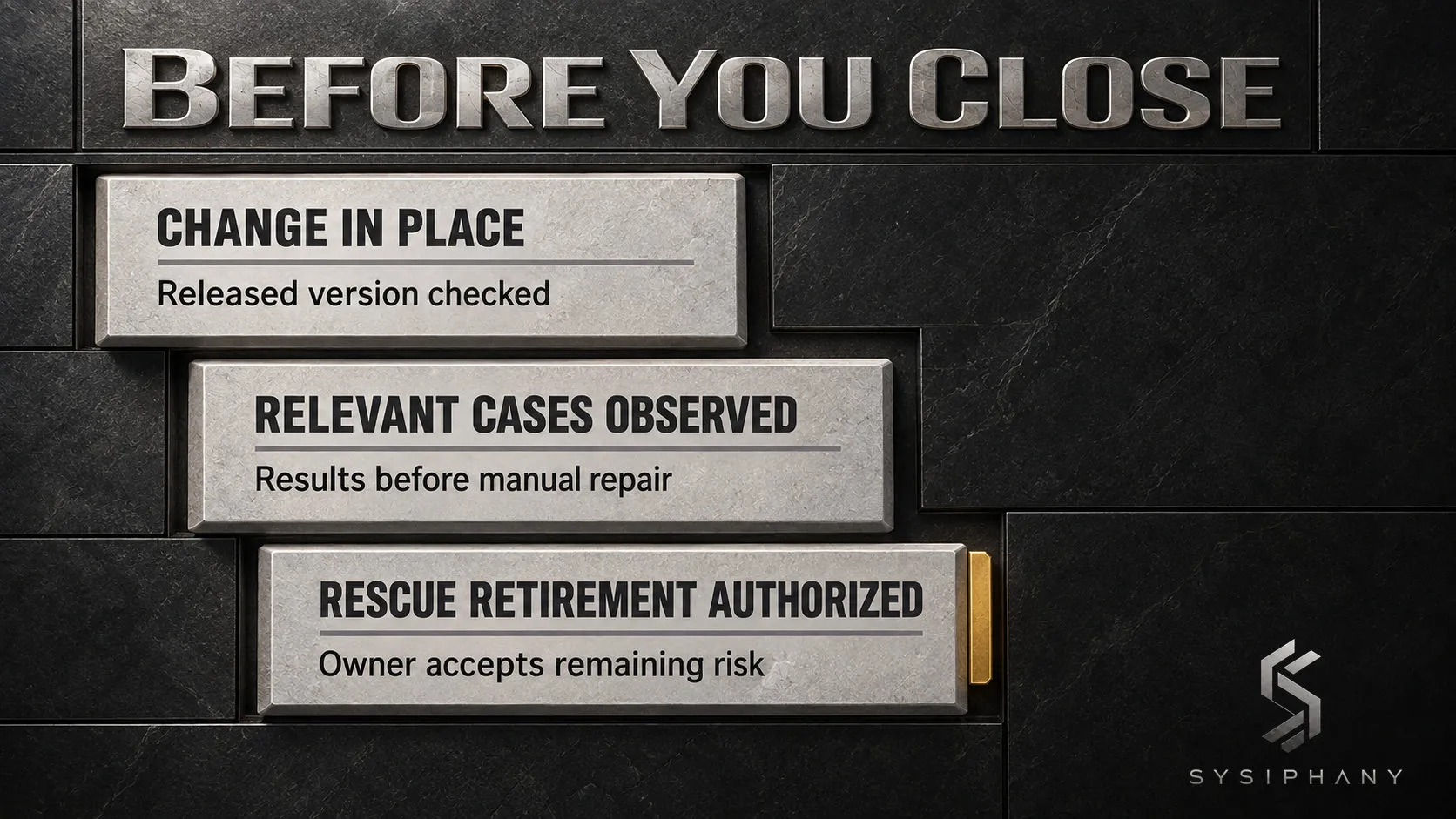
Closure needs evidence that the approved change was implemented and achieved its intended result under relevant conditions, with adverse effects and remaining risk reviewed. A completed task, a new template or a quiet week is insufficient on its own.
The U.S. Food and Drug Administration, in its 2018 Corrective and Preventive Actions - Transcript, explains checking both an action’s effectiveness and whether it adversely affects the finished device. That is medical-device training, cited here for this narrow quality principle, not as current regulatory advice or evidence that the business example works.
Before implementation, the action owner and reviewer should agree on the failure being checked, the relevant case types, the existing comparison evidence, the acceptance condition and the observation window. The window must contain opportunities for this failure to recur. Its length depends on the work and consequence, not a universal number of days.
For the certificate example, the reviewer needs to distinguish the generated document from the version sent after someone repaired it. Otherwise, the coordinator’s diligence can make an ineffective change look successful. Keep the protection while recording what it catches.
A useful closure review separates two questions:
Was the intended change actually made? Inspect the released version and the affected creation path. An updated instruction is weak evidence if people still open the old template from a bookmark.
Did it work without moving the problem elsewhere? Examine eligible certificates before amendment, and check that missing-reference cases remain visible. Fewer incorrect certificates would be a poor result if valid work now disappears into an unowned hold queue.
Choose the disposition the evidence supports
| What the review finds | Honest disposition |
|---|---|
| The change is released, but the affected work type has not occurred. | Implemented; effectiveness still unverified. Set the next review around relevant exposure. |
| Comparable work meets the agreed condition, no hidden repairs explain the result, and adverse effects are acceptable. | The reviewer may accept effectiveness within that scope and separately authorize removal of temporary protection. |
| The original failure recurs through the changed path, or staff still repair it before it becomes visible. | Keep the action open or reopen it; preserve protection and review the failed action or causal finding. |
| One case type passes, but another has not been observed. | Limit the conclusion to the observed type. Leave the wider action open or explicitly split its scope. |
There is no universal sample count that proves a fix permanent. For low-volume work, a safe controlled check may add evidence, but it should be labeled as such rather than reported as successful live operation. High-consequence decisions need evidence and expertise proportionate to the risk.
A later recurrence also deserves context. The same symptom through a different cause does not automatically invalidate the earlier finding. Preserve the new case, compare it with the action’s stated scope, and let the responsible reviewer decide whether to reopen that action or start a separate investigation.
Retire the rescue deliberately
When the agreed evidence supports removal, the reviewer records which temporary check ends, when it ends and who has been told. Required ongoing controls remain in place. The team should also know which recurrence signal would bring the issue back for review.
Without that handoff, the coordinator may keep checking forever, or stop because they assume someone else approved it. Either outcome defeats the purpose of a named decision.
The accepted change belongs in the existing operating instruction and source configuration. Designing the broader default path is a separate job covered in How to Standardize a Business Process. This action record should point to the changed asset, not grow into another process manual.
If several recurring rescues reveal wider friction in ownership or information flow, Download the Operational Drag Diagnostic Kit. You can complete the classification and closure decision above without it.
Frequently asked questions
Can a corrective action be quick?
Yes. Duration does not determine the label. A small configuration change can address a supported cause, while a lengthy manual workaround may leave it intact. The action still needs appropriate authorization and evidence of effectiveness.
What if the cause belongs to a supplier?
Your team may need to maintain containment while the supplier changes its process. Ask for evidence relevant to the affected work; a promise that the issue is fixed is not enough. Your owner remains responsible for deciding what protection the business needs while that evidence is pending.
Can a workaround become the permanent process?
An authorized alternative may become the accepted operating method after its consequences and continuing effort are reviewed. That is a deliberate process decision. Do not relabel an unchanged failure as eliminated merely because the team has agreed to live with it.
Is corrective action the same as preventive action?
Corrective action responds to a failure that has occurred and aims to prevent recurrence. Preventive action addresses a potential failure before it occurs in the relevant scope. Applying a lesson from one failed process to a similar, unaffected process can be preventive work there.
What if the action misses its due date?
The owner should explain the delay, review whether temporary protection is still adequate, and obtain an authorized revised date or escalation. Moving a deadline without reviewing the exposure hides the unresolved decision.
Choose one recurring rescue and examine its current status. If today’s work is restored but the cause remains unchanged, label it accurately and give the next decision an owner.
For a correction blocked by cross-team authority, conflicting records or dependence on the founder’s private judgment, Book a SYSIPHANY discovery call to discuss the operating problem. Specialist compliance and safety decisions remain with the authorized experts.